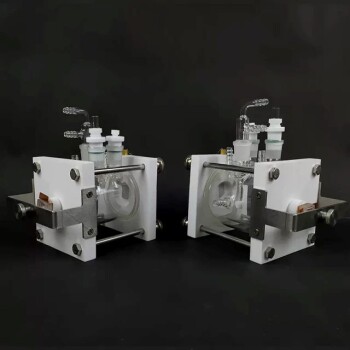
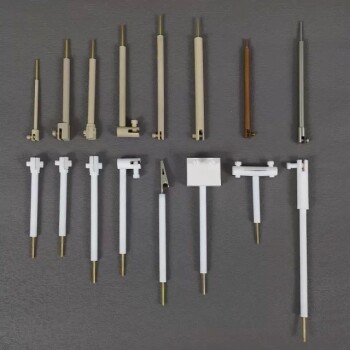
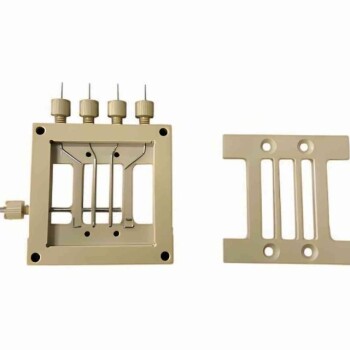
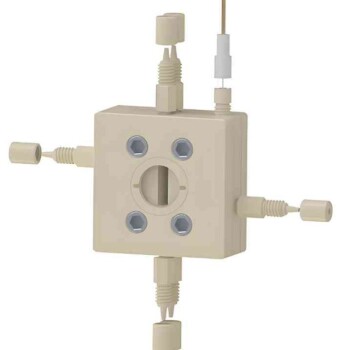
Evaluating the electrochemical performance of Ru@ZnO/CN catalysts requires a highly controlled testing environment provided by a three-electrode electrolytic cell. This system utilizes a working electrode coated with the catalyst, an Ag/AgCl reference electrode for stable potential control, and a platinum counter electrode to complete the circuit. These components allow for the precise execution of Linear Sweep Voltammetry (LSV) and Electrochemical Impedance Spectroscopy (EIS) to quantify charge migration and reaction kinetics.
The core value of the three-electrode electrolytic system lies in its ability to isolate the catalyst’s intrinsic performance from systemic interference. By decoupling the potential measurement from the current flow, researchers can accurately map the Z-scheme heterojunction efficiency and interfacial resistance of the Ru@ZnO/CN material.
The Architecture of the Three-Electrode System
The Working Electrode as the Catalyst Carrier
The Ru@ZnO/CN catalyst is typically deposited onto a carrier, such as a glassy carbon electrode, which serves as the working electrode. This electrode is the primary site of interest where the redox reactions occur and the current is measured.
The Role of the Ag/AgCl Reference Electrode
The reference electrode provides a constant and known electrochemical potential. This allows the system to monitor the exact potential at the catalyst surface without being affected by the current flowing through the cell.
The Function of the Platinum Counter Electrode
The platinum counter electrode ensures that the electrical circuit is closed by providing a surface for the balancing half-reaction. This configuration prevents counter electrode polarization from distorting the data collected from the catalyst.
Key Diagnostic Techniques for Catalyst Evaluation
Assessing Kinetics through Linear Sweep Voltammetry (LSV)
LSV is utilized to measure the current response as the electrical potential is varied at a constant rate. This technique is essential for determining the overpotential required to drive the photocatalytic hydrogenation process.
Quantifying Charge Migration with EIS
Electrochemical Impedance Spectroscopy (EIS) measures the resistance encountered by charges as they move through the system. For Ru@ZnO/CN, EIS is used to quantitatively analyze photo-generated charge migration efficiency across the Z-scheme heterojunction.
Enhancing Data Reliability
The electrolytic cell environment minimizes solution resistance drops, ensuring that the measured current-potential curves are accurate. This precision is vital for calculating Tafel slopes and understanding the underlying reaction mechanisms on the catalyst surface.
Understanding the Trade-offs and Pitfalls
Sensitivity to Electrolyte Conditions
The performance of the Ru@ZnO/CN catalyst can vary significantly depending on the electrolyte pH and concentration. Inconsistent solution preparation can lead to shifts in the measured redox potentials, making cross-study comparisons difficult.
Interface Resistance Issues
If the catalyst is not properly adhered to the glassy carbon working electrode, high contact resistance can occur. This "dead space" can lead to an overestimation of the material's actual resistance during EIS testing.
Over-reliance on Idealized Conditions
Standard electrolytic cells use highly conductive electrolytes to ensure stability. However, these conditions may not perfectly reflect the real-world environments where Ru@ZnO/CN might be deployed, potentially masking practical performance limitations.
How to Apply These Findings to Your Research
If you are utilizing electrolytic cells to evaluate advanced heterojunction catalysts, consider your primary objective to select the correct parameters:
- If your primary focus is Mechanistic Understanding: Prioritize EIS measurements to map the specific charge transfer resistances across the Z-scheme interface.
- If your primary focus is Catalytic Efficiency: Use LSV and Tafel plots to determine the exact overpotential and kinetic rates of the hydrogenation reaction.
- If your primary focus is Material Stability: Perform Cyclic Voltammetry (CV) over many cycles to observe potential shifts in the catalyst’s active sites.
By precisely controlling the electrochemical environment through a three-electrode system, you can move beyond simple observation to a definitive quantitative analysis of catalyst performance.
Summary Table:
| Component/Technique | Role in Evaluation | Key Insight Provided |
|---|---|---|
| Working Electrode | Carries Ru@ZnO/CN catalyst | Site of primary redox reactions |
| Reference Electrode | Ag/AgCl stable potential | Ensures accurate potential measurement |
| Counter Electrode | Platinum (Pt) | Completes circuit; prevents polarization |
| LSV Technique | Measures current vs. potential | Determines overpotential & reaction kinetics |
| EIS Technique | Measures impedance/resistance | Quantifies Z-scheme charge migration efficiency |
Elevate Your Electrochemical Research with KINTEK
Precise catalyst evaluation requires high-performance hardware. KINTEK specializes in providing researchers with top-tier electrolytic cells and electrodes, including high-purity platinum counter electrodes, stable Ag/AgCl reference electrodes, and glassy carbon working electrodes designed for rigorous LSV and EIS testing.
Beyond electrochemistry, we support your entire material synthesis workflow with our comprehensive range of high-temperature furnaces (muffle, vacuum, CVD), high-pressure reactors, and precision crushing and milling systems.
Ready to achieve superior data reliability for your Ru@ZnO/CN or battery research? Contact our experts today to find the perfect equipment configuration for your laboratory!
References
- Arzoo Chauhan, Rajendra Srivastava. Thermocatalytic and photocatalytic chemoselective reduction of cinnamaldehyde to cinnamyl alcohol and hydrocinnamaldehyde over Ru@ZnO/CN. DOI: 10.1039/d3ta02000b
This article is also based on technical information from Kintek Solution Knowledge Base .
Related Products
- H Type Electrolytic Cell Triple Electrochemical Cell
- Electrolytic Electrochemical Cell Gas Diffusion Liquid Flow Reaction Cell
- Electrolytic Electrochemical Cell with Five-Port
- Super Sealed Electrolytic Electrochemical Cell
- PTFE Electrolytic Cell Electrochemical Cell Corrosion-Resistant Sealed and Non-Sealed
People Also Ask
- What is a H type cell? A Guide to Divided Electrochemical Cells for Accurate Experiments
- How should the electrolyte be prepared and added to the H-type electrolytic cell? Best Practices for Purity and Safety
- What is the technical necessity of using an H-type electrolytic cell for NO3RR tests? Protect Your Ammonia Yields
- How does the design of an H-type electrolytic cell benefit the neutral water electrolysis process for metal recovery?
- What is the primary function of an H-type electrolytic cell in NitRR? Ensure Accurate Product Yields