Laboratory hydraulic presses and powder pellet dies serve as the primary densification tools in the assembly of all-solid-state batteries. They apply extreme mechanical pressure—often ranging from 150 MPa to 500 MPa—to convert loose solid electrolyte powders and electrode materials into dense, cohesive layers. This cold-pressing process is the fundamental mechanism used to establish the physical structure necessary for the battery to function.
Core Insight: In solid-state batteries, ions cannot flow through air gaps; they require continuous physical pathways. The hydraulic press drives the densification required to eliminate microscopic voids, ensuring the tight solid-solid contact needed to minimize interface impedance and enable effective ion transport.
The Critical Role of High-Pressure Densification
The transition from liquid to solid electrolytes introduces a challenge: contact resistance. Liquid electrolytes naturally flow into pores, but solid electrolytes must be mechanically forced into place.
Eliminating Particle Voids
Laboratory presses are used to apply specific pressures, typically up to 500 MPa, to sulfide solid electrolytes like Li6PS5Cl.
This intense pressure physically crushes the void spaces between individual powder particles. By removing these air gaps, the process significantly reduces the porosity of the material, creating a continuous medium rather than a collection of loose grains.
Reducing Grain Boundary Resistance
The application of pressure directly impacts the battery's internal resistance.
By compressing materials like Li10GeP2S12 or Li2S-P2S5-P2O5, the press increases the contact area between grains. This reduction in grain boundary resistance is critical for achieving high ionic conductivity, allowing lithium ions to move freely through the electrolyte layer.
Preventing Internal Shorts
Beyond performance, densification is a safety requirement.
Inadequate compression leaves voids that can lead to uneven ion flux and dendrite formation. High-pressure densification creates a uniform, dense pellet structure that helps prevent internal short circuits within the battery cell.
Optimizing the Electrode-Electrolyte Interface
The performance of an all-solid-state battery is defined at the interface where the cathode, anode, and electrolyte meet.
Establishing Solid-Solid Contact
Hydraulic presses, often used with Cold Isostatic Pressing (CIP) techniques, are essential for assembling composite electrodes, such as those using Lithium Iron Phosphate (LFP).
The press applies force to electrode particles coated with solid electrolytes. This ensures tight physical contact between the active material and the electrolyte, creating effective lithium-ion transport channels that would otherwise be broken by microscopic gaps.
Managing Mechanical Stability
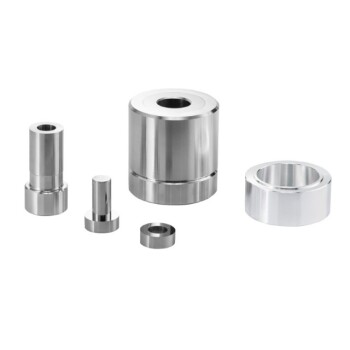
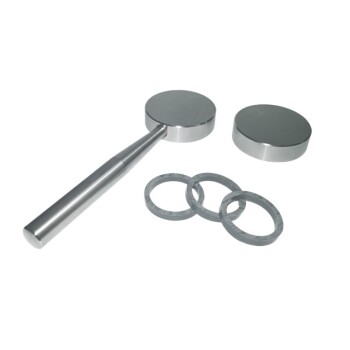
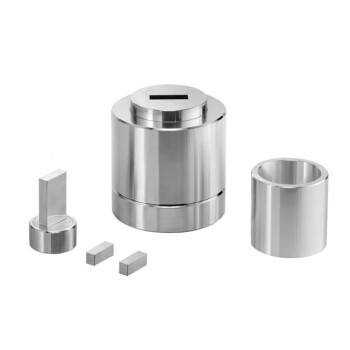
Specialized powder pellet dies (molds) made of high-strength materials like stainless steel and PEEK are used to fix the relative positions of the battery layers.
Once compressed, the sulfide electrolyte acts as a "buffer layer." Because of its moderate Young's modulus, the compacted electrolyte can accommodate the volume changes (expansion and contraction) of electrode materials during charging cycles, preventing the structural collapse of the cell.
Understanding the Trade-offs
While high pressure is beneficial, the assembly process requires precision to avoid damaging the cell components.
Pressure Calibration is Vital
Applying pressure blindly can be detrimental. The process requires a specific range—often 370 to 400 MPa for certain sulfide electrolytes, or 151 to 267 MPa for multilayer assemblies—to achieve optimal results.
Material Limitations
The molds used must be capable of withstanding immense uniaxial pressure without deforming. If the die material (e.g., standard steel vs. composite PEEK/steel) is not matched to the pressure requirements, the pellet may suffer from uneven density gradients, leading to localized areas of high impedance.
Making the Right Choice for Your Assembly
When selecting equipment and determining parameters for solid-state battery assembly, align your approach with your specific performance metrics.
- If your primary focus is Ionic Conductivity: Target the higher pressure ranges (up to 500 MPa) to maximally reduce porosity and grain boundary resistance within the electrolyte layer.
- If your primary focus is Interface Stability: Utilize Cold Isostatic Presses (CIP) or precise hydraulic molds to ensure uniform contact between the cathode and electrolyte, reducing interfacial impedance.
- If your primary focus is Cycle Life: Ensure your process compacts the electrolyte sufficiently to act as a mechanical buffer, accommodating electrode volume expansion without delamination.
Ultimately, the hydraulic press is not just a shaping tool; it is the instrument that enforces the atomic-level connectivity required for a solid-state battery to conduct energy.
Summary Table:
| Process Component | Role in Battery Assembly | Typical Pressure Range |
|---|---|---|
| Hydraulic Press | Drives densification to eliminate voids & reduce impedance | 150 MPa - 500 MPa |
| Powder Pellet Dies | Maintains structural integrity & fixes layer positions | Material-dependent (PEEK/Steel) |
| Solid Electrolytes | Crushed to create continuous ion-transport pathways | 370 MPa - 400 MPa |
| Composite Electrodes | Establishes critical solid-solid interfacial contact | 151 MPa - 267 MPa |
Advance Your Battery Research with KINTEK Precision
Achieving the perfect energy density in all-solid-state batteries requires uncompromising pressure control. KINTEK specializes in high-performance laboratory equipment designed for the most demanding battery research applications.
Our extensive portfolio includes:
- Advanced Hydraulic Presses: Manual, electric, and cold isostatic (CIP) systems for uniform pellet densification.
- Precision Powder Pellet Dies: High-strength molds engineered to withstand up to 500 MPa.
- Comprehensive Lab Solutions: From high-temperature furnaces and glovebox-compatible tools to battery research consumables and milling systems.
Don't let interface impedance hinder your innovation. Let KINTEK provide the tools for your next breakthrough. Contact our technical experts today to find the right equipment for your lab!
Related Products
- Automatic Laboratory Hydraulic Press for XRF & KBR Pellet Press
- Laboratory Hydraulic Pellet Press for XRF KBR FTIR Lab Applications
- Automatic Laboratory Hydraulic Pellet Press Machine for Lab Use
- Laboratory Hydraulic Press Lab Pellet Press Machine for Glove Box
- Laboratory Manual Hydraulic Pellet Press for Lab Use
People Also Ask
- What is the significance of applying 200 MPa of pressure with a laboratory hydraulic pellet press for composite ceramics?
- What is the role of a laboratory hydraulic pellet press and stainless steel molds in the fabrication of RuO2/NbC anodes?
- What is the necessity of using a laboratory hydraulic pellet press in the preparation of biomass fuel pellets? Guide
- How does a laboratory hydraulic pellet press contribute to SiCw/2024 aluminum composite preforms? Optimize Densification
- What role does a laboratory hydraulic pellet press play in fly ash utilization? Enhancing Adsorption and Flow Control