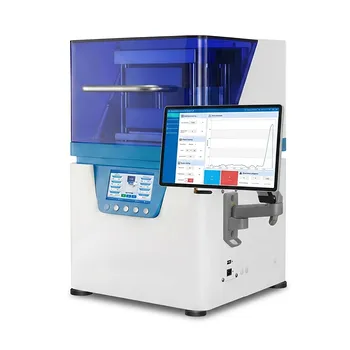
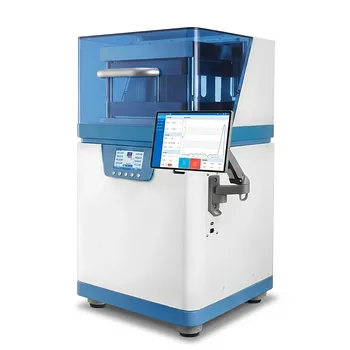
The precision application of pressure is the critical step in transforming synthesized carbon nitride powder into a viable medium for information security. By using laboratory hydraulic presses to compress the material into dense, high-strength pellets, manufacturers can optimize its physical structure and optical properties for reliable luminescence-based data retrieval.
Laboratory hydraulic presses bridge the gap between raw synthesized powder and functional information carriers by enhancing material density and optimizing internal optical paths. This ensures the final product is both physically durable and optically efficient enough for high-contrast data storage and retrieval.
Enhancing Material Integrity and Density
Achieving Structural Stability Through Molds
Hydraulic presses apply uniform force to compress carbon nitride powder into specific, repeatable shapes using specialized molds. This process creates dense pellets that serve as standalone carriers for encrypted data, ensuring they maintain their form throughout the information lifecycle.
Increasing Bulk Density and Strength
High-pressure compression significantly reduces the air gaps and voids within the powder matrix. This increase in bulk density directly improves the material's mechanical strength, preventing physical degradation or crumbling during handling and storage.
Optimizing Optical Performance for Information Retrieval
Refining Internal Optical Paths
The compression process rearranges the internal microstructure of the carbon nitride. By minimizing light-scattering voids, the press optimizes internal optical paths, allowing for more efficient light transmission through the material.
Enhancing Luminescence Contrast
Effective information security relies on the clear detection of stored signals. Higher density achieved through hydraulic pressing results in enhanced brightness and contrast during luminescence, which is vital for the accurate and secure retrieval of stored data.
Understanding the Trade-offs and Pitfalls
Risks of Excessive Compression
Applying pressure beyond the material's limit can cause structural micro-fractures within the pellet. These internal defects can scatter light unpredictably, inadvertently reducing the signal-to-noise ratio and making information retrieval less reliable.
The Problem of Insufficient Pressure
If the compression force is too low, the resulting material remains porous and physically fragile. This leads to low luminescence intensity and poor contrast, which can render the stored information unreadable or susceptible to environmental wear.
How to Apply This to Your Project
When integrating laboratory hydraulic presses into your carbon nitride production workflow, your specific goals will dictate your pressure parameters.
- If your primary focus is mechanical durability: Prioritize maximizing bulk density through controlled, high-pressure compression to ensure the information carrier can withstand physical stress.
- If your primary focus is signal clarity: Focus on fine-tuning pressure levels to optimize internal optical paths, which ensures maximum luminescence contrast for high-fidelity data retrieval.
Mastering the interplay between hydraulic pressure and material density is the foundation for creating high-performance, secure carbon nitride information systems.
Summary Table:
| Key Feature | Impact on Carbon Nitride | Security Benefit |
|---|---|---|
| High-Pressure Compression | Increases bulk density and structural integrity | Prevents data carrier degradation during handling |
| Microstructure Refinement | Minimizes voids and optimizes optical paths | Enhances signal brightness for accurate data retrieval |
| Precision Mold Usage | Creates uniform, repeatable pellet shapes | Ensures consistent performance across data storage media |
| Controlled Force | Prevents structural micro-fractures | Maintains a high signal-to-noise ratio for secure reading |
Elevate Your Material Research with KINTEK Precision
Are you developing next-generation carbon nitride solutions for information security? KINTEK specializes in high-performance laboratory equipment designed to meet the rigorous demands of advanced materials science. Our extensive range of manual, automatic, and isostatic hydraulic presses provides the precision pressure control necessary to achieve optimal density and optical clarity in your pellets.
Beyond pelletizing, KINTEK offers a comprehensive ecosystem for your lab, including:
- Crushing and Milling Systems: For perfect powder preparation.
- High-Temperature Furnaces: Including vacuum and atmosphere models for material synthesis.
- Specialized Consumables: High-quality PTFE products, ceramics, and crucibles.
Whether you are a researcher aiming for high-contrast luminescence or a manufacturer focused on mechanical durability, our team is ready to provide the technical support and reliable equipment you need.
Contact KINTEK today to optimize your production workflow!
References
- Huibin Zheng, Junying Zhang. Band Structure Engineering Induced Ultraviolet–Visible Emission Bulk Carbon Nitride with Near‐Unity Quantum Yield for Information Security. DOI: 10.1002/lpor.202300301
This article is also based on technical information from Kintek Solution Knowledge Base .
Related Products
- Laboratory Hydraulic Press Lab Pellet Press Machine for Glove Box
- Laboratory Hydraulic Press Split Electric Lab Pellet Press
- Fully Automatic Heated Hydraulic Lab Press for Materials Sintering and Sample Preparation
- Laboratory Hydraulic Press Lab Pellet Press for Button Battery
- Automatic Laboratory Hydraulic Press for XRF & KBR Pellet Press
People Also Ask
- How do laboratory hydraulic presses contribute to zero-gap electrolyzers? Optimize Performance & Safety
- Why is a laboratory hydraulic press necessary for ZrO2/Cr2O3 interface analysis? Optimize Sample Density and Accuracy
- How do a precision laboratory hydraulic press and specialized molds contribute to the fabrication of spherical ceramic samples? Achieving High-Density Material Precision
- What is the role of a laboratory hydraulic press in the preparation of rare earth denitrification catalysts?
- How does pressure control of a laboratory hydraulic press affect W-Ti alloys? Optimize Grain Structure & Density