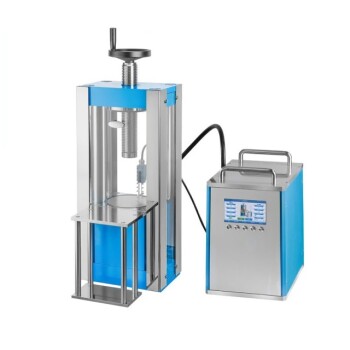
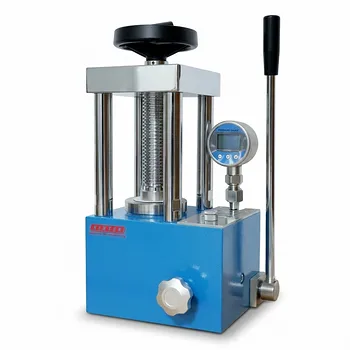
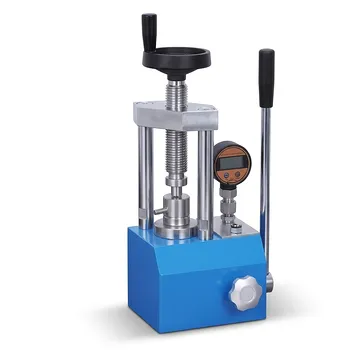
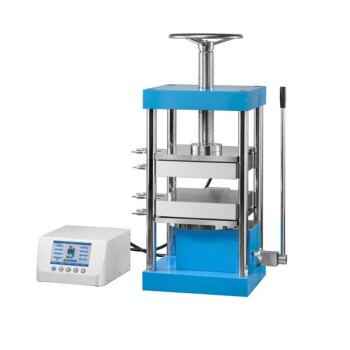
High-pressure densification is the critical mechanism driving this fabrication process. A precision laboratory hydraulic press, operating in tandem with specialized molds, applies a uniform pressure of 200 MPa to mixed ceramic powders. This force transforms loose particles into solid, geometric spheres with precise diameters ranging from 1.0 to 1.5 mm, creating the essential "green" (pre-sintered) structure.
The combination of high hydraulic pressure and specialized molding significantly increases the green density of the samples while minimizing internal voids. This densification is the prerequisite for ensuring the ceramic spheres achieve high mechanical strength and geometric consistency after sintering.
The Mechanics of Spherical Fabrication
Achieving Uniform Compression
The hydraulic press is not merely applying force; it is delivering a specific, uniform load of 200 MPa.
This consistency is vital for mixed powders. It ensures that force is distributed evenly throughout the material, preventing density gradients that could lead to warping later.
Precision Shaping and Sizing
While the press supplies the force, the specialized molds define the geometry.
These molds constrain the compressing powder to form perfect spheres. The equipment is calibrated to produce a strict diameter range of 1.0–1.5 mm.
The Material Impact of High Pressure
Maximizing Green Density
The immediate result of this process is a sharp increase in green density.
By forcing particles closer together, the press reduces the free volume within the sample. A high green density is the single most important predictor of a high-quality final sintered product.
Minimizing Internal Voids
The application of 200 MPa effectively collapses air pockets and gaps between powder particles.
Minimizing these internal voids is critical. If left in the material, these voids become permanent defects that compromise the structural integrity of the ceramic.
Critical Process Dependencies
The Necessity of High Pressure
There is no shortcut to the 200 MPa requirement. Lower pressures fail to compact the powder sufficiently to eliminate voids.
If the pressure is inadequate, the resulting spheres will lack the necessary green density, leading to weak mechanical performance after sintering.
Dependence on Mold Precision
The geometric consistency of the final product is entirely dependent on the quality of the specialized molds.
Without these precise constraints, the spheres cannot maintain the 1.0–1.5 mm specification. Variations in shape or size at this stage will result in uneven shrinkage and potential cracking during the sintering phase.
Making the Right Choice for Your Goal
To ensure the successful fabrication of ceramic spheres, you must prioritize specific process parameters based on your desired outcome:
- If your primary focus is Mechanical Strength: You must verify that the hydraulic press consistently delivers 200 MPa of pressure to minimize internal voids and maximize density.
- If your primary focus is Geometric Consistency: You must utilize high-quality specialized molds to strictly maintain sample diameters between 1.0 and 1.5 mm.
Precision in the green body stage is the only way to guarantee performance in the sintered product.
Summary Table:
| Parameter | Specification | Impact on Sample |
|---|---|---|
| Applied Pressure | 200 MPa | Maximizes green density and eliminates internal voids |
| Sample Shape | Spherical | Ensures geometric consistency and uniform shrinkage |
| Diameter Range | 1.0 - 1.5 mm | Provides precise sizing for specialized ceramic applications |
| Process Outcome | High-Density "Green" Body | Prevents warping and structural defects during sintering |
Elevate Your Ceramic Fabrication with KINTEK Precision
Achieving the perfect 200 MPa densification and geometric accuracy requires more than just force—it requires precision engineering. KINTEK specializes in advanced laboratory equipment, offering high-performance hydraulic presses (pellet, hot, isostatic) and custom specialized molds designed to eliminate internal voids and maximize green density for your research.
Whether you are developing ceramic spheres for aerospace, medical, or industrial applications, our comprehensive portfolio—including high-temperature furnaces, crushing systems, and specialized consumables—is built to support your most rigorous material science goals.
Ready to optimize your sample consistency and mechanical strength? Contact KINTEK today to discuss your laboratory needs!
References
- Dmitriy I. Shlimas, Maxim V. Zdorovets. Study of the Surface-Layer Softening Effects in xLi2ZrO3–(1−x)Li4SiO4 Ceramics under Irradiation with He2+ Ions. DOI: 10.3390/ceramics7020036
This article is also based on technical information from Kintek Solution Knowledge Base .
Related Products
- Laboratory Hydraulic Press Split Electric Lab Pellet Press
- Laboratory Hydraulic Press Lab Pellet Press Machine for Glove Box
- Laboratory Hydraulic Press Lab Pellet Press for Button Battery
- Automatic Laboratory Hydraulic Pellet Press Machine for Lab Use
- Automatic Laboratory Hydraulic Press for XRF & KBR Pellet Press
People Also Ask
- What are the roles of a laboratory hydraulic press and stainless steel molds in the preparation of graphite samples?
- What is the role of a laboratory hydraulic press in electrode prep? Maximize Energy Density & Sealing Precision
- How does a laboratory hydraulic press ensure the quality of alumina-forming alloy green bodies? Optimize CSP Research
- How is a laboratory hydraulic press used to evaluate the mechanical performance of nano-modified concrete? Expert Guide
- Why is a laboratory hydraulic press used for ASSB assembly? Achieving 392 MPa for Optimal Solid-State Battery Density