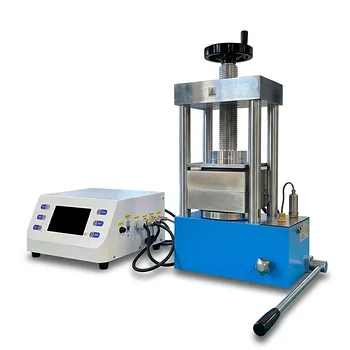
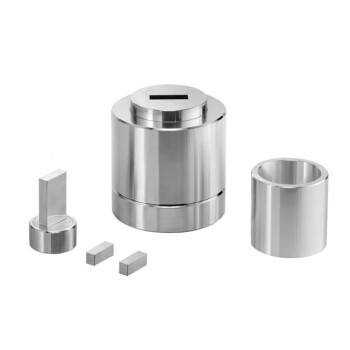
The collaboration between a laboratory hydraulic press and a high-temperature vacuum furnace acts as a sequential, two-stage workflow designed to transform loose powder into a solid, high-performance material. The hydraulic press is responsible for the initial mechanical shaping, creating a cohesive form known as a "green body," while the vacuum furnace facilitates the final chemical and physical bonding through heat.
Core Takeaway: This process decouples mechanical shaping from thermal densification. The hydraulic press compacts powder to create a distinct shape, while the vacuum furnace provides the necessary environment to eliminate pores and achieve metallurgical bonding without the risk of oxidation.
The Two-Stage Consolidation Workflow
Phase 1: Mechanical Compaction
The process begins with the laboratory hydraulic press. This machine applies high pressure to the loose, mixed powders of the ODS high-entropy alloy.
The goal here is cold pressing. By forcing the particles close together, the press creates a "green body."
The Nature of the "Green Body"
The green body produced by the press has a defined shape and sufficient strength to be handled. However, it is not yet a fully functional alloy.
It relies on mechanical interlocking rather than chemical bonding. It remains porous and lacks the final density required for high-performance applications.
Phase 2: Thermal Sintering
Once the green body is formed, it is transferred to the high-temperature vacuum furnace. This stage is known as short-term sintering.
The reference process suggests operating temperatures around 1373 K.
Achieving Metallurgical Bonding
Inside the furnace, the heat promotes diffusion between the powder particles. Atoms move across particle boundaries, fusing them together.
This transformation creates true metallurgical bonds. The result is a high-density alloy billet with significantly improved mechanical properties compared to the pressed powder.
The Critical Role of the Vacuum Environment
Preventing Oxidation
High-entropy alloys can be sensitive to impurities at high temperatures. The vacuum environment is essential during the heating phase.
It prevents oxygen from reacting with the metal powders. Without a vacuum, the high temperatures required for sintering would likely ruin the material through rapid oxidation.
Eliminating Porosity
The combination of heat and vacuum does more than just bond particles. It actively helps eliminate pores trapped within the green body.
As diffusion occurs, the voids between particles shrink, resulting in a solid, non-porous final structure.
Understanding the Trade-offs
Green Body Fragility
While the hydraulic press creates a shape, the resulting green body is mechanically weak compared to the final product.
It must be handled with extreme care during the transfer to the furnace. Any cracks introduced during ejection from the press or transport will likely remain or worsen during sintering.
Dependency on Vacuum Integrity
The success of the second phase relies entirely on the quality of the vacuum.
Even a minor leak or insufficient vacuum level during the 1373 K sintering cycle can compromise the alloy. If oxidation occurs effectively prevents the diffusion bonding necessary for high density.
Making the Right Choice for Your Goal
To maximize the effectiveness of this consolidation method, consider your specific priorities:
- If your primary focus is structural integrity: Ensure the hydraulic press applies sufficient pressure to maximize the density of the green body before it ever reaches the furnace.
- If your primary focus is material purity: Prioritize the maintenance of the vacuum furnace to ensure a pristine environment that prevents oxidation during the critical diffusion phase.
By balancing mechanical compaction with controlled thermal bonding, you achieve a dense, high-quality ODS high-entropy alloy.
Summary Table:
| Stage | Equipment | Primary Function | Key Outcome |
|---|---|---|---|
| Phase 1 | Laboratory Hydraulic Press | Mechanical Compaction | Creation of a "Green Body" (Mechanical Interlocking) |
| Phase 2 | High-Temperature Vacuum Furnace | Thermal Sintering (1373 K) | Metallurgical Bonding & Porosity Elimination |
| Environment | Vacuum Atmosphere | Oxidation Prevention | Material Purity & High-Density Final Billet |
Elevate Your Material Research with KINTEK
Ready to achieve superior density and purity in your ODS high-entropy alloys? KINTEK specializes in high-precision laboratory equipment designed for advanced material consolidation. From our robust hydraulic pellet presses for creating the perfect green body to our state-of-the-art high-temperature vacuum furnaces that ensure oxidation-free sintering, we provide the complete workflow solution for your lab.
Our extensive portfolio also includes:
- High-temperature furnaces (Muffle, Tube, Rotary, CVD/PECVD)
- Advanced Milling Systems & Sieving Equipment
- Hydraulic Presses (Pellet, Hot, Isostatic)
- High-pressure reactors & Autoclaves
- Ceramic & PTFE Consumables
Don't compromise on your material integrity. Contact KINTEK today to consult with our experts and find the ideal equipment configuration for your specific research goals!
References
- І.V. Kolodiy, V. S. Okovit. MICROSTRUCTURE AND MECHANICAL PROPERTIES OF OXIDE DISPERSION STRENGTHENED HIGH-ENTROPY ALLOYS CoCrFeMnNi AND CrFe2MnNi. DOI: 10.46813/2021-132-087
This article is also based on technical information from Kintek Solution Knowledge Base .
Related Products
- Round Bidirectional Press Mold for Lab
- Automatic High Temperature Heated Hydraulic Press Machine with Heated Plates for Lab
- Manual High Temperature Heated Hydraulic Press Machine with Heated Plates for Lab
- Ball Press Mold for Lab
- Laboratory Hydraulic Press Split Electric Lab Pellet Press
People Also Ask
- How to use a press mold? Master the Art of Creating Consistent Ceramic Forms
- What is the press mould method? A Guide to Consistent, Detailed Ceramic Forms
- What is the function of press molds during the preparation of SiCf/Ti-43Al-9V composites? Achieve Structural Precision
- What is a press mold used for? Achieve Repeatable Precision and Efficiency
- What is the purpose of specialized pressure devices in sulfide solid-state batteries? Ensure Chemo-Mechanical Stability