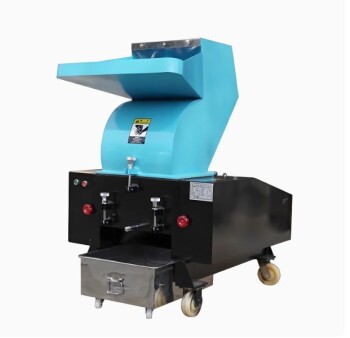
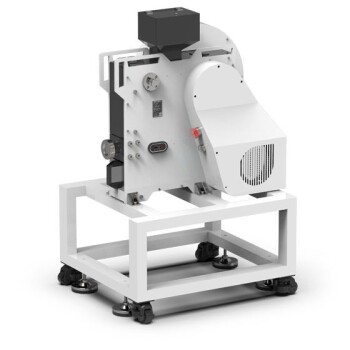
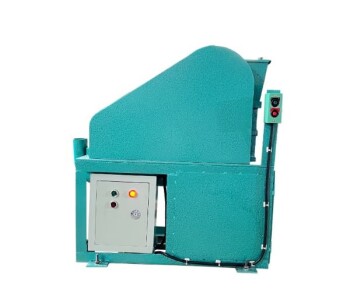
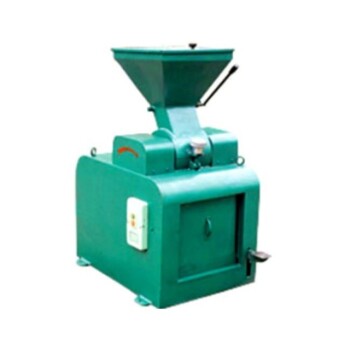
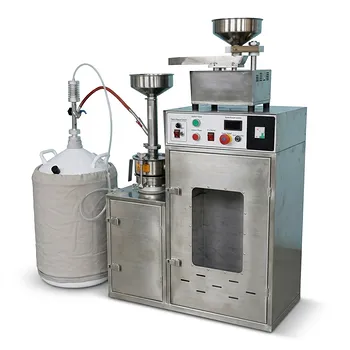
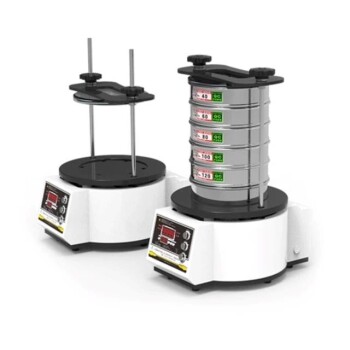
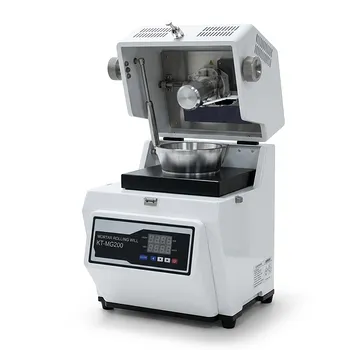
Crushing and sieving systems dictate the effectiveness of radiation shielding by transforming raw minerals into the precise, fine powders required for high-performance composites. These mechanical processes enable minerals such as zircon, graphite, ilmenite, and garnet to be uniformly dispersed within an epoxy matrix at high concentrations, directly enhancing the material’s ability to block high-energy radiation.
The core value of crushing and sieving lies in homogeneity and density. By processing minerals into fine powders with specific size ranges, manufacturers can achieve a 60 wt.% concentration in epoxy resin, significantly improving the attenuation of 662 keV photons compared to less uniform materials.
The Role of Particle Processing in Shielding
The transformation of raw mineral ore into a functional composite shield relies entirely on the initial mechanical processing. Without precise crushing and sieving, the minerals cannot effectively integrate with the epoxy resin.
Achieving Specific Particle Ranges
Raw minerals must be reduced from their natural state into fine powders. Crushing systems break down the bulk material, while sieving systems filter the output to ensure only particles within a specific, optimal size range are utilized.
Enabling High Concentration Loading
To block radiation effectively, the shield must be dense. The use of fine, sieved powders allows for a high "loading" of the mineral into the resin—specifically up to 60 wt.%. This high density of active shielding material is impossible to achieve with coarse or irregular chunks of mineral.
Mechanisms of Improved Attenuation
The physical structure of the composite at the microscopic level determines how well it interacts with incoming radiation.
Uniform Dispersion
A shield is only as strong as its weakest point. Crushing and sieving ensure that the mineral powder is uniformly dispersed throughout the epoxy matrix. This prevents "clumping" or voids, ensuring there are no gaps for radiation to stream through.
Blocking High-Energy Photons
The ultimate goal of this processing is to stop radiation. The uniform distribution of these fine mineral powders significantly enhances the composite's ability to attenuate high-energy 662 keV photons. The consistent internal structure maximizes the probability that a photon will interact with a mineral particle and be absorbed or scattered.
Understanding the Constraints
While crushing and sieving are essential, they introduce specific variables that must be managed to ensure the final product works as intended.
The Necessity of Precision
The process is not merely about making rocks smaller; it is about consistency. If the sieving process fails to produce a specific particle size range, the uniformity of the composite is compromised. Inconsistent particle sizes can lead to uneven dispersion, reducing the overall shielding effectiveness.
Matrix Saturation Limits
The reference highlights a concentration of 60 wt.% as a target for high performance. It is critical to note that the crushing and sieving process is what makes this high saturation possible. Without fine powders, the epoxy matrix could not hold this much weight without losing structural integrity or homogeneity.
Making the Right Choice for Your Goal
To maximize the radiation protection of your mineral-epoxy composites, focus on the quality of your powder preparation.
- If your primary focus is maximum attenuation: Ensure your processing system can produce fine powders capable of reaching a 60 wt.% concentration without agglomerating.
- If your primary focus is reliability and consistency: Prioritize the sieving stage to guarantee a narrow, specific particle size range, which ensures uniform dispersion and predictable performance against 662 keV photons.
Precise mechanical processing acts as the foundation of shielding performance, turning raw minerals into a sophisticated barrier against high-energy radiation.
Summary Table:
| Process Stage | Function in Shielding | Impact on Performance |
|---|---|---|
| Crushing | Reduces raw mineral ore to fine powder | Enables high 60 wt.% loading in epoxy matrix |
| Sieving | Ensures narrow particle size distribution | Guarantees uniform dispersion & eliminates voids |
| Mixing | Integrates minerals with epoxy resin | Maximizes attenuation of high-energy photons |
| Quality Control | Maintains consistency of particle range | Ensures reliable, predictable radiation protection |
Elevate Your Material Research with KINTEK Precision Solutions
At KINTEK, we understand that high-performance radiation shielding starts with the perfect particle. Our professional-grade crushing and milling systems and high-precision sieving equipment are engineered to help you achieve the exact 60 wt.% mineral loading and uniform dispersion required for advanced epoxy composites.
Whether you are developing next-generation mineral-resin shields or conducting battery research, our comprehensive range of laboratory equipment—including hydraulic presses, high-temperature furnaces, and PTFE consumables—provides the reliability your lab demands.
Ready to optimize your composite performance? Contact our technical experts today to find the right equipment for your specific mineral processing and material synthesis needs.
References
- Edyta Słupek, Jacek Gębicki. New generation of green sorbents for desulfurization of biogas streams. DOI: 10.21175/rad.abstr.book.2023.17.3
This article is also based on technical information from Kintek Solution Knowledge Base .
Related Products
- Laboratory Test Sieves and Sieving Machines
- Laboratory Vibratory Sieve Shaker Machine for Dry and Wet Three-Dimensional Sieving
- Three-dimensional electromagnetic sieving instrument
- Powerful Plastic Crusher Machine
- Laboratory Jaw Crusher
People Also Ask
- What are laboratory test sieves used for? A Guide to Particle Size Analysis
- How do you calculate the sieve test? Master Particle Size Distribution for Quality Control
- How does a lab test sieve contribute to biomass charcoal powder preparation? Achieve Uniform Particle Size
- What are the specifications for test sieves? A Guide to ASTM & ISO Standards for Accurate Particle Analysis
- What materials are required for sieving? Achieve Accurate Particle Size Analysis