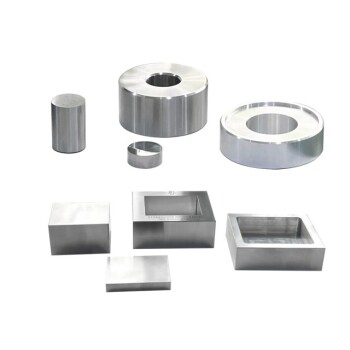
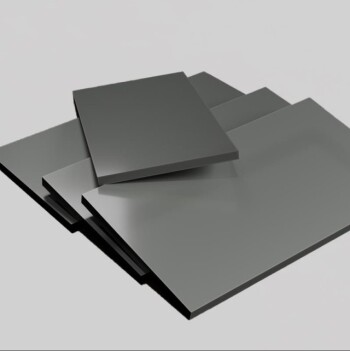
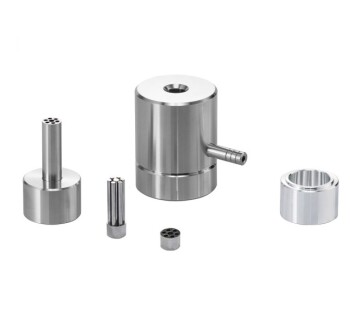
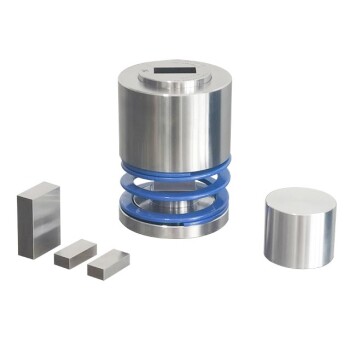
Graphite molds serve as the critical structural interface between the heavy machinery of a hot press and the delicate TiAl/Ti6Al4V laminated sheets. Leveraging high thermal conductivity and superior high-temperature strength, these molds withstand continuous pressures of 30 MPa to facilitate the precise shaping, bonding, and densification of the composite material without undergoing deformation themselves.
The Core Utility Graphite molds function as more than just containers; they are active transmission media. Their primary role is to convert raw hydraulic force into uniform, hydrostatic-like pressure across the sheet surfaces, ensuring the tight interlayer contact necessary for successful diffusion bonding.
Structural Integrity Under Load
Withstanding Extreme Pressure
The primary challenge in hot-pressing is maintaining geometry while applying immense force.
Graphite molds are selected for their ability to maintain structural rigidity under loads of 30 MPa. Unlike standard metal molds which might soften or warp, graphite retains its strength at the elevated temperatures required for processing titanium alloys.
Thermal Conductivity and Stability
Processing TiAl and Ti6Al4V requires precise thermal management.
Graphite’s high thermal conductivity ensures that heat is transferred efficiently and uniformly from the heating elements to the laminated sheets. This prevents thermal gradients that could lead to uneven bonding or internal stresses within the composite layers.
The Mechanics of Densification
Uniform Pressure Transmission
For laminated sheets, pressure must be applied evenly across the entire surface area.
The graphite mold acts as a pressure transfer medium, vertically transmitting force from the hydraulic cylinders to the sample. This uniformity is vital for eliminating voids and ensuring that the TiAl and Ti6Al4V layers form a cohesive unit.
Facilitating Interlayer Contact
The ultimate goal of the process is diffusion bonding between the distinct metal layers.
By maintaining high pressure without deformation, the mold forces the layers into tight contact. This proximity allows for atomic diffusion between the TiAl and Ti6Al4V materials, resulting in a fully densified, high-integrity composite.
Operational Trade-offs
The Requirement for Vacuum
While graphite is mechanically robust, it is chemically reactive with oxygen at high temperatures.
To utilize graphite molds effectively, the hot-pressing process must occur within a vacuum environment. Without this protection, the graphite would oxidize and degrade rapidly, potentially contaminating the titanium sheets.
Consumable Nature
Graphite molds are generally considered consumables in this process.
Despite their strength, the combination of high thermal cycling and mechanical friction eventually causes wear. They provide excellent dimensional stability for the billet, but they have a finite lifespan compared to reusable superalloy molds used in lower-temperature applications.
Making the Right Choice for Your Goal
To optimize your hot-pressing process for TiAl/Ti6Al4V laminates, consider the following priorities:
- If your primary focus is densification: Ensure your mold design accounts for the specific shrinkage rates of the powder or sheets to maintain the 30 MPa pressure throughout the sintering cycle.
- If your primary focus is geometric precision: Utilize high-density graphite grades to minimize mold wear and friction, ensuring the final laminate retains the exact macroscopic shape intended.
By maintaining rigidity under heat and pressure, graphite molds transform raw force into the controlled environment necessary for advanced composite fabrication.
Summary Table:
| Feature | Role in Hot-Pressing |
|---|---|
| Pressure Tolerance | Sustains 30 MPa loads without deformation at high temperatures |
| Thermal Conductivity | Ensures uniform heat distribution to prevent internal stresses |
| Pressure Transmission | Converts hydraulic force into uniform surface pressure for bonding |
| Structural Integrity | Maintains geometric precision of laminates during densification |
| Environment Req. | Requires vacuum to prevent graphite oxidation and contamination |
Elevate Your Advanced Material Fabrication with KINTEK
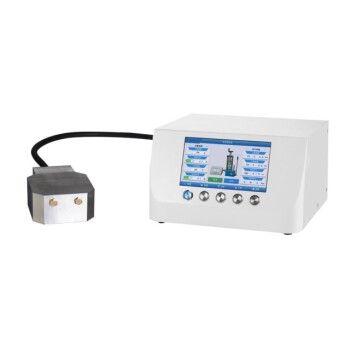
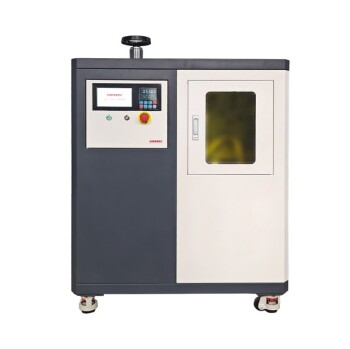
Precision in hot-pressing begins with the right environment and equipment. KINTEK specializes in high-performance laboratory solutions, providing the robust vacuum hot-pressing systems and hydraulic presses needed to process TiAl/Ti6Al4V laminates with absolute reliability.
Our extensive portfolio supports every stage of your research and production, including:
- Advanced Furnaces: Vacuum, muffle, and induction melting systems for precise thermal control.
- Precision Pressing: High-tonnage hydraulic, hot, and isostatic presses designed for uniform densification.
- Essential Consumables: High-purity graphite, ceramics, and crucibles tailored for extreme conditions.
- Material Processing: High-performance crushing, milling, and sieving equipment.
Don't let equipment limitations compromise your material integrity. Contact KINTEK today to discover how our high-temperature and high-pressure solutions can optimize your bonding processes and deliver superior structural results.
Related Products
- Special Heat Press Mold for Lab Use
- Double Plate Heating Press Mold for Lab
- Anti-Cracking Press Mold for Lab Use
- Lab Infrared Press Mold
- Ball Press Mold for Lab
People Also Ask
- How to use a press mold? Master the Art of Creating Consistent Ceramic Forms
- What is the press mould method? A Guide to Consistent, Detailed Ceramic Forms
- What is a press mold used for? Achieve Repeatable Precision and Efficiency
- What is the function of press molds during the preparation of SiCf/Ti-43Al-9V composites? Achieve Structural Precision
- What is the purpose of specialized pressure devices in sulfide solid-state batteries? Ensure Chemo-Mechanical Stability