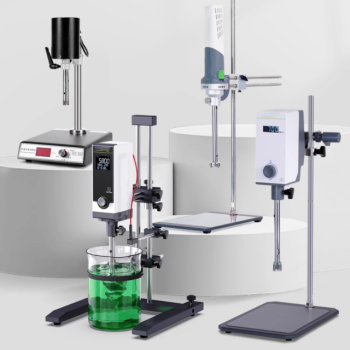
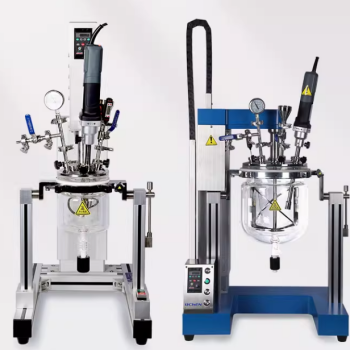
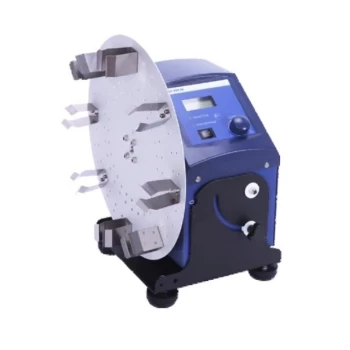
High-performance ultrasonic homogenizers and mechanical shakers operate by applying intense physical forces to separate bulk Layered Double Hydroxides (LDHs). Specifically, ultrasonic homogenizers utilize the cavitation effect, while mechanical shakers rely on strong shear forces. These mechanisms are essential to overcome the robust interlayer electrostatic attraction and hydrogen bonding that hold the bulk LDH structure together.
By transforming bulk LDHs into positively charged single-layer or few-layer nanosheets, these mechanical processes create the critical physical state required for precision molecular assembly with negatively charged materials like graphene or MXenes.
The Mechanics of Exfoliation
Overcoming Internal Bonding
Bulk LDHs are characterized by strong hydrogen bonding and electrostatic attraction between their layers.
These internal forces are significant enough that simple mixing cannot disrupt them. High-energy mechanical intervention is required to overpower these bonds and separate the layers.
The Role of Ultrasonic Cavitation
High-performance ultrasonic homogenizers introduce energy through the cavitation effect.
Rapid pressure fluctuations create microscopic bubbles in the liquid medium which collapse violently. The shockwaves from this collapse provide the localized energy needed to strip layers away from the bulk material.
The Role of Mechanical Shear
Mechanical shakers achieve a similar result using strong shear force.
This involves physically agitating the mixture to create drag and friction between the fluid and the solid particles. This force slides the layers apart, effectively peeling them from the main structure.
Preparing for Electrostatic Assembly
Creating Positively Charged Nanosheets
The primary output of this exfoliation process is the production of single-layer or few-layer nanosheets.
Critically, these nanosheets maintain a positive surface charge. This charge is not a byproduct; it is a functional requirement for the subsequent engineering steps.
Enabling Heterojunction Formation
The positive charge of the exfoliated LDH nanosheets serves as an anchor for molecular assembly.
It allows the sheets to electrostatically attract and bind with negatively charged 2D materials. This specific interaction is the foundation for building complex heterojunction structures.
Application in Energy Storage
The ultimate goal of this assembly is often the fabrication of efficient supercapacitor electrodes.
By combining positive LDH nanosheets with negative materials like graphene or MXenes, researchers can create highly conductive, high-surface-area electrodes.
Understanding the Trade-offs
Balancing Force and Integrity
While high energy is required to exfoliate LDHs, excessive force can be detrimental.
Over-processing via ultrasonic cavitation can fragment the nanosheets, reducing their lateral size and effectiveness. It is vital to tune the intensity to exfoliate without destroying the sheet structure.
Yield and Uniformity
Neither cavitation nor shear force guarantees a 100% yield of single-layer sheets.
The process often results in a distribution of single-layers, few-layers, and some unexfoliated material. This may necessitate downstream separation processes to isolate the optimal nanosheets for assembly.
Optimizing the Assembly Process
To ensure the successful creation of heterojunction electrodes, align your processing method with your end goal.
- If your primary focus is breaking strong interlayer bonds: Rely on the intense energy of ultrasonic cavitation or strong shear force to overcome hydrogen bonding and electrostatic attraction.
- If your primary focus is supercapacitor electrode efficiency: Verify that your exfoliation method preserves the positive charge of the nanosheets to ensure robust bonding with negatively charged graphene or MXenes.
Mastering the physical exfoliation of LDHs is the definitive step toward engineering high-performance energy storage materials.
Summary Table:
| Feature | Ultrasonic Homogenizer | Mechanical Shaker |
|---|---|---|
| Primary Mechanism | Cavitation Effect (Bubble Collapse) | Strong Shear Force (Fluid Friction) |
| Energy Source | High-frequency acoustic waves | Physical agitation and drag |
| Best For | Overcoming robust hydrogen bonding | Peeling layers via lateral friction |
| Resulting Product | Positively charged 2D nanosheets | Positively charged 2D nanosheets |
| Main Application | Heterojunction formation with MXenes/Graphene | Supercapacitor electrode fabrication |
Elevate Your Material Research with KINTEK Precision
Unlock the full potential of your 2D material synthesis with KINTEK’s high-performance laboratory equipment. Whether you are exfoliating Layered Double Hydroxides (LDHs) for supercapacitor electrodes or engineering advanced heterojunctions, our specialized homogenizers, shakers, and ultrasonic systems provide the precise energy control required to preserve nanosheet integrity and surface charge.
From high-temperature furnaces and vacuum reactors for material synthesis to crushing, milling, and hydraulic presses for electrode preparation, KINTEK offers a comprehensive ecosystem for battery research and energy storage development. Our portfolio also includes essential consumables like PTFE products, ceramics, and crucibles to ensure contamination-free processing.
Ready to optimize your exfoliation and assembly process? Contact our technical experts today to find the perfect equipment solution for your laboratory’s unique requirements.
References
- Xue Li, Zhanhu Guo. Progress of layered double hydroxide-based materials for supercapacitors. DOI: 10.1039/d2qm01346k
This article is also based on technical information from Kintek Solution Knowledge Base .
Related Products
- High Shear Homogenizer for Pharmaceutical and Cosmetic Applications
- High Performance Lab Homogenizer for Pharma Cosmetics and Food R&D
- Lab Sterile Slapping Type Homogenizer for Tissue Mashing and Dispersing
- Laboratory High Throughput Tissue Grinding Mill Grinder
- Laboratory Disc Rotary Mixer for Efficient Sample Mixing and Homogenization
People Also Ask
- Why Use a High Shear Homogenizer for Cathode Slurries? Optimize Double-Layer Solid-State Battery Production
- What is the function of high-shear dispersion equipment in corona-resistant nanocomposites? Elevate Your Insulation
- What is the necessity of using an industrial-grade high-shear homogenizer for biomass washing? Ensure Process Efficiency
- What are the advantages of using a high-shear homogenizer for BED/GMA coatings? Achieve Superior Nano-Dispersion
- What role does a high-shear homogenizer play in ODC catalyst suspensions? Unlock Superior Electrochemical Efficiency