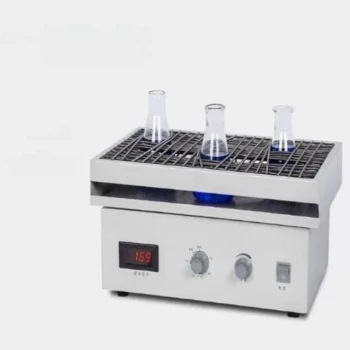
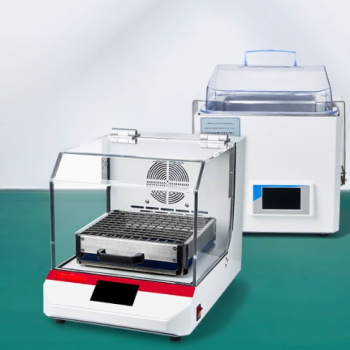
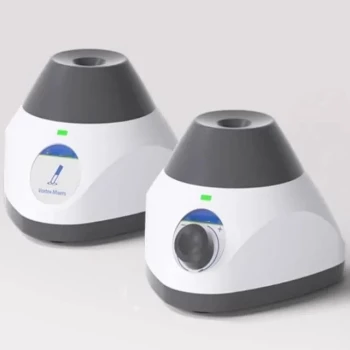
Industrial-grade constant temperature shakers fundamentally secure data accuracy in batch adsorption experiments by enforcing rigid control over rotation speed and thermal conditions. These devices ensure uniform contact between adsorbent particles and target ions, effectively eliminating the interference of liquid film mass transfer resistance to yield precise kinetic data.
Core Takeaway: The reliability of your adsorption data hinges on isolating the material's chemical performance from physical inconsistencies. By stabilizing agitation and temperature, these shakers remove external variables, ensuring that the resulting isotherms and kinetic models reflect the true behavior of the adsorbent for scalable industrial application.
The Mechanics of Kinetic Accuracy
Overcoming Mass Transfer Resistance
The primary barrier to accurate data in static or poorly mixed experiments is liquid film mass transfer resistance. This occurs when a stagnant layer of liquid surrounds the particle, slowing down the interaction.
Industrial shakers provide controlled mechanical force to break this resistance. This ensures the rate-limiting step is the adsorption process itself, not the physical mixing limitations.
Ensuring Uniform Suspension
To determine the true maximum adsorption capacity ($q_{max}$), the adsorbent must remain in a fully suspended state.
Consistent mechanical agitation prevents sedimentation, ensuring every surface of the composite material is available for reaction. This thorough contact leads to a reliable assessment of how the material interacts with heavy metal ions.
Facilitating Internal Pore Diffusion
Beyond the surface, the adsorbate must penetrate the internal structure of the material.
The mechanical power generated by the shaker promotes the diffusion of ions (such as Ni(II)) into the internal pores of the adsorbent. This allows researchers to capture data that reflects the material's full porosity, rather than just its surface characteristics.
The Role of Thermal Stability
Eliminating Ambient Interference
Adsorption is a temperature-dependent process; even slight fluctuations can alter the reaction rate and equilibrium position.
Industrial-grade shakers isolate the experiment from ambient temperature fluctuations. By maintaining a specific, stable temperature, they ensure that changes in data are caused by the chemistry of the interaction, not the environment of the lab.
Deriving Accurate Thermodynamic Parameters
Precise thermal management is non-negotiable for calculating thermodynamic parameters like enthalpy and entropy.
To simulate pollutant removal efficiency across different environmental conditions, the temperature must remain constant throughout the batch test. This stability is the only way to produce reproducible thermodynamic data required for scientific analysis.
Understanding the Trade-offs
The Risk of Variable Conditions
While these devices are essential for accuracy, reliance on them highlights a critical trade-off in experimental design: sensitivity to parameter settings.
If the rotation speed is too low, mass transfer resistance will skew the data, making the adsorbent appear less effective than it is. Conversely, excessive agitation can cause particle attrition (physical breakdown), leading to artificially high surface area availability that cannot be replicated in a large-scale static bed.
The Cost of Precision
Achieving this level of accuracy requires equipment capable of long-duration operation without drift.
Standard laboratory stirrers may drift in speed or heat over time, introducing "noise" into long-term equilibrium studies. Industrial-grade equipment mitigates this but requires strict calibration to ensure the "constant" conditions are truly constant.
Making the Right Choice for Your Goal
Whether you are conducting fundamental research or designing a treatment plant, the application of this equipment changes slightly.
- If your primary focus is Kinetic Modeling: Prioritize the stability of rotation speed to ensure you are measuring the reaction rate, not the diffusion rate through the liquid film.
- If your primary focus is Thermodynamic Analysis: Prioritize precise temperature control to eliminate ambient fluctuations that will invalidate your enthalpy and entropy calculations.
- If your primary focus is Industrial Scaling: Use the shaker to determine optimal operational parameters (pH, contact time) to screen for the most effective nano-consumables.
Ultimately, the constant temperature shaker acts as the baseline for validity, transforming raw experimental observations into reliable, scalable engineering data.
Summary Table:
| Factor | Influence on Data Accuracy | Operational Benefit |
|---|---|---|
| Rotation Speed | Eliminates liquid film mass transfer resistance | Ensures rate-limiting step is chemical, not physical |
| Uniform Suspension | Prevents particle sedimentation | Guarantees full surface area availability for $q_{max}$ |
| Pore Diffusion | Promotes ion penetration into internal structures | Reflects full porosity of the adsorbent material |
| Thermal Stability | Isolates experiments from ambient temperature drift | Essential for accurate enthalpy & entropy calculations |
| Agitation Power | Prevents data skewing from poor mixing | Ensures reproducibility for industrial scaling |
Maximize Your Research Precision with KINTEK
Don't let physical inconsistencies compromise your material science data. KINTEK specializes in high-performance laboratory equipment designed to deliver the rigid control your experiments demand.
Our industrial-grade shakers, homogenizers, and thermal solutions ensure your adsorption isotherms and kinetic models are accurate, reproducible, and ready for scaling. Beyond shaking, we provide a comprehensive range of high-temperature furnaces, hydraulic presses, and autoclaves to support every stage of your lab's workflow.
Ready to upgrade your lab's accuracy? Contact our technical experts today to find the perfect equipment solution for your research goals.
References
- Khalid Z. Elwakeel, Abdullah S. Al‐Bogami. Perspectives regarding metal/mineral-incorporating materials for water purification: with special focus on Cr(<scp>vi</scp>) removal. DOI: 10.1039/d0ma00153h
This article is also based on technical information from Kintek Solution Knowledge Base .
Related Products
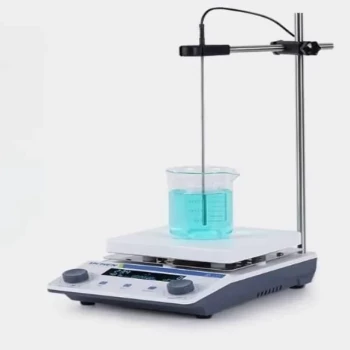
- Laboratory Small Constant Temperature Heated Magnetic Stirrer Heater and Stirrer
- High Temperature Constant Temperature Heating Circulator Water Bath Chiller Circulator for Reaction Bath
- 40L Chiller Water Bath Cooling Circulator Low Temperature Constant Temperature Reaction Bath
- 50L Chiller Water Bath Cooling Circulator Low Temperature Constant Temperature Reaction Bath
- 5L Chilling Circulator Cooling Water Bath Circulator for Low Temperature Constant Temperature Reaction Bath
People Also Ask
- What role does a magnetic stirrer with heating play in ZnO nanoparticle synthesis? Precision Control for Quality Results
- What role does a constant temperature heating magnetic stirrer play in MFC-HAp synthesis? Achieve Material Homogeneity
- What is the function of a laboratory magnetic stirrer in Ni–Cr–P electrodeposition? Optimize Ion Transport & Coating
- Why is a laboratory magnetic stirrer required for benzoic acid esters? Boost Reaction Speed & Yield with High RPM
- What role does a laboratory magnetic stirrer play in TiO2 and TiO2-Ag sol preparation? Master Chemical Kinetics