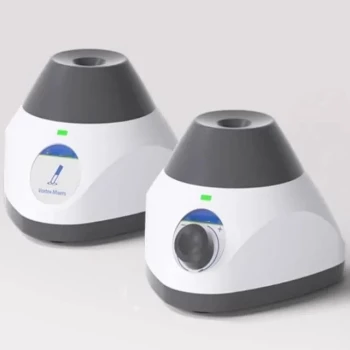
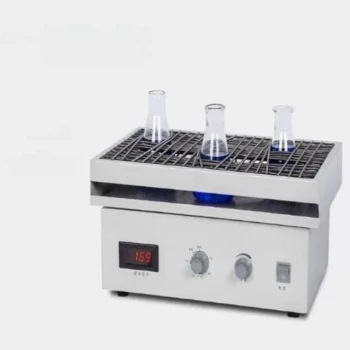
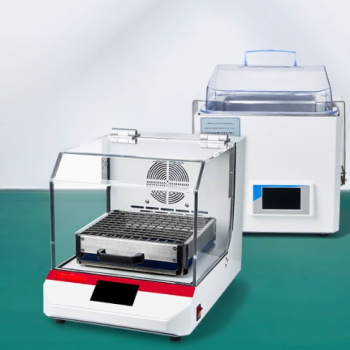
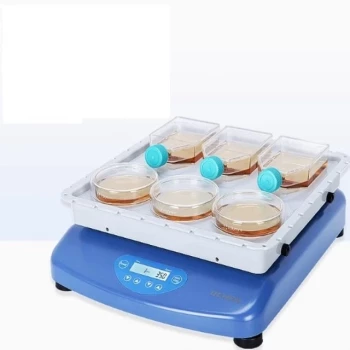
A constant temperature shaker is strictly required to provide continuous mechanical agitation during the impregnation process. This dynamic environment ensures that activated carbon particles maintain full and uniform contact with the manganese nitrate solution, preventing the active ingredients from settling or reacting unevenly.
The shaker does not merely mix ingredients; it provides the kinetic conditions necessary to overcome liquid-solid interface resistance, forcing manganese ions deep into the carbon's pores to ensure a highly dispersed coating.
The Mechanics of Uniform Impregnation
To understand why this equipment is critical, you must look beyond simple mixing and look at the microscopic interaction between the solid carbon and the liquid solution.
Overcoming Interface Resistance
In a static environment, a natural resistance forms at the liquid-solid interface. This boundary layer can prevent the manganese solution from interacting effectively with the carbon surface.
The constant temperature shaker creates a dynamic environment that provides the kinetic energy needed to break through this resistance. This allows the manganese ions to effectively transfer from the bulk solution onto the solid carbon structure.
Deep Pore Penetration
Activated carbon is valuable because of its massive internal surface area, comprised of deep, intricate pores.
Without continuous agitation, the solution may only coat the exterior of the particle. The mechanical agitation forces the manganese ions to penetrate deep into the internal pores. This ensures that the active ingredient utilizes the entire structure of the support material, not just the outer shell.
Achieving High Dispersion
The ultimate goal of impregnation is a uniform layer of manganese oxide.
By maintaining full contact through agitation, the process results in a highly dispersed layer of active material. This maximizes the catalytic surface area available for future reactions.
Understanding the Risks of Improper Agitation
Failing to utilize a constant temperature shaker introduces significant risks to the structural integrity of the final catalyst.
The Danger of Local Aggregation
Without dynamic mixing, manganese ions tend to cluster together rather than spreading out.
This leads to local aggregation, where "hot spots" of thick manganese accumulate while other areas remain bare. These aggregates reduce the overall efficiency of the material and waste the active ingredient.
Incomplete Surface Utilization
If the solution is not forced into the pores kinetically, the internal surface area of the activated carbon remains untapped.
This results in a finished product where the manganese sits superficially on the surface, failing to leverage the high porosity that makes activated carbon an effective support in the first place.
Ensuring Process Success
To ensure you achieve a high-quality impregnation, consider your specific objectives:
- If your primary focus is maximizing catalytic activity: Ensure the agitation is vigorous enough to force ions into internal pores, exposing the maximum amount of active surface area.
- If your primary focus is material consistency: Rely on continuous agitation to prevent local aggregation, ensuring every particle has a uniform distribution of manganese oxide.
By using a constant temperature shaker, you transform a simple soaking process into a kinetically driven engineering operation that guarantees deep penetration and uniform dispersion.
Summary Table:
| Feature | Static Impregnation | Shaker-Assisted Impregnation |
|---|---|---|
| Interface Resistance | High (Boundary layer remains) | Low (Kinetic energy breaks resistance) |
| Pore Penetration | Superficial (Surface only) | Deep (Internal pores utilized) |
| Active Dispersion | Localized aggregation (Clumping) | Highly dispersed & uniform layer |
| Surface Utilization | Low (Internal area untapped) | High (Maximizes catalytic area) |
Elevate Your Catalyst Research with KINTEK Precision
Unlock the full potential of your materials with KINTEK’s advanced laboratory solutions. Whether you are working on the impregnation of active ingredients or specialized battery research, our high-performance shakers, homogenizers, and high-temperature furnaces provide the precise kinetic and thermal conditions your processes demand.
From high-temperature high-pressure reactors to precision crushing and milling systems, KINTEK specializes in providing global laboratories with the equipment and consumables—including PTFE products, ceramics, and crucibles—needed for consistent, reproducible results.
Ready to ensure uniform dispersion and maximize your catalytic surface area?
Contact KINTEK today to find the perfect equipment for your lab!
References
- Jianhui Xu, Yong Ren. Destruction of Toluene by the Combination of High Frequency Discharge Electrodeless Lamp and Manganese Oxide-Impregnated Granular Activated Carbon Catalyst. DOI: 10.1155/2014/365862
This article is also based on technical information from Kintek Solution Knowledge Base .
Related Products
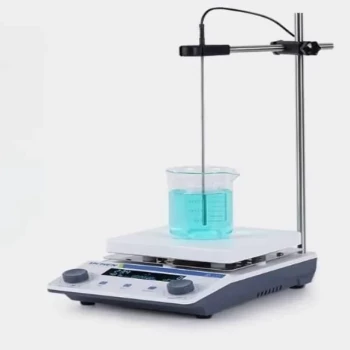
- Laboratory Small Constant Temperature Heated Magnetic Stirrer Heater and Stirrer
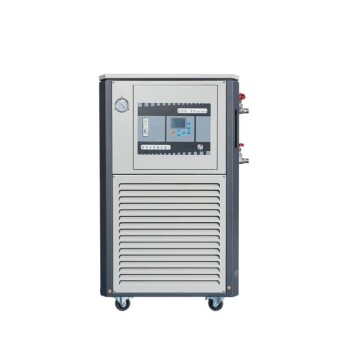
- High Temperature Constant Temperature Heating Circulator Water Bath Chiller Circulator for Reaction Bath
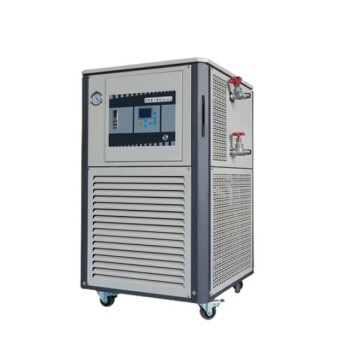
- 5L Heating Chilling Circulator Cooling Water Bath Circulator for High and Low Temperature Constant Temperature Reaction
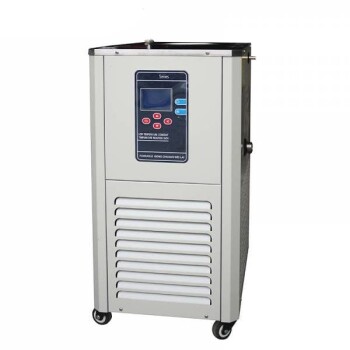
- 50L Chiller Water Bath Cooling Circulator Low Temperature Constant Temperature Reaction Bath
- 10L Heating Chilling Circulator Cooling Water Bath Circulator for High and Low Temperature Constant Temperature Reaction
People Also Ask
- What role does a magnetic stirrer with heating play in ZnO nanoparticle synthesis? Precision Control for Quality Results
- What role does a constant temperature heating magnetic stirrer play in MFC-HAp synthesis? Achieve Material Homogeneity
- What is the function of a laboratory magnetic stirrer in Ni–Cr–P electrodeposition? Optimize Ion Transport & Coating
- Why is a laboratory magnetic stirrer required for benzoic acid esters? Boost Reaction Speed & Yield with High RPM
- What role does a laboratory magnetic stirrer play in TiO2 and TiO2-Ag sol preparation? Master Chemical Kinetics