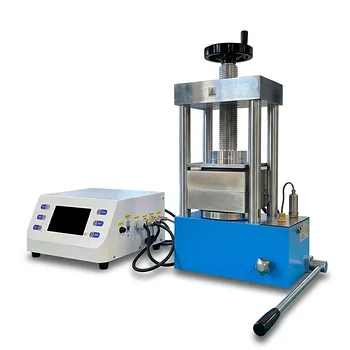
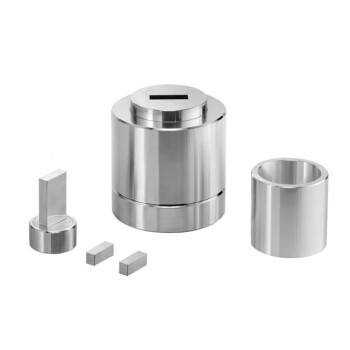
Achieving consistent electrochemical data requires rigorous physical control over both the material and the testing environment. Laboratory hydraulic presses ensure electrode materials reach uniform density and optimal contact interfaces, while specialized fixtures rigidly maintain the geometry between electrodes. Together, these tools eliminate variables like inconsistent particle distribution and physical displacement, ensuring that test results reflect true material properties rather than experimental error.
Reliability in electrochemical testing is defined by the elimination of physical variables. By standardizing material density through hydraulic pressure and locking electrode positioning with precision fixtures, researchers minimize contact resistance and signal noise to guarantee reproducibility.
The Role of the Hydraulic Press in Preparation
To generate accurate data, the electrode material itself must be structurally consistent. The laboratory hydraulic press is the primary tool for achieving this standardization.
Ensuring Uniform Particle Distribution
In the initial preparation phase, hydraulic presses apply force to powder materials. This controlled force ensures that particles are distributed evenly throughout the sample, preventing localized inconsistencies that could skew results.
Achieving Specific Green Densities
Presses allow researchers to reach exact "green densities" (the density of a compacted powder before sintering). Controlling this variable is critical, as density variations directly affect how the material interacts with electrolytes during testing.
Reducing Contact Resistance
During cell component assembly, the press provides uniform axial pressure. This establishes tight physical contact between the electrode, the electrolyte interface, and current collectors like platinum paste. Good interfacial contact significantly reduces resistance, thereby enhancing data accuracy.
The Critical Function of Specialized Fixtures
Once the material is prepared, the testing setup must be geometrically perfect. Specialized fixtures, such as glass racks, are engineered to maintain this precision.
Exact Control of Electrode Distance
These fixtures utilize precision-machined grooves and spacers. This design allows for the exact control of the distance between stainless steel test electrodes, ensuring that the electrolyte path length remains constant across all tests.
Preventing Physical Displacement
The primary goal of these racks is stability. By rigidly holding the components in place, the fixture prevents any physical movement or shifting of the electrodes during the experiment.
Eliminating Unstable Signals
Physical instability leads to data noise. By preventing inconsistent electrode positioning, these fixtures stop unstable electrical signals from contaminating the test data, ensuring a clear reading of the material's electrochemical behavior.
Understanding the Trade-offs: The Pressure Balance
While hydraulic presses are essential for reducing resistance, there is a critical balance to maintain regarding applied force.
The Risk of Over-Densification
Applying too much pressure can lead to excessive density. This may crush the porosity of the material, inhibiting the electrolyte infiltration necessary for accurate electrochemical reactions.
The Risk of Under-Compression
Conversely, insufficient pressure results in poor interfacial contact. This leads to high contact resistance, which introduces artificial impedance into the data, making the material appear less conductive than it actually is.
Optimizing Your Testing Protocol
To ensure the highest fidelity in your electrochemical measurements, match your tooling strategy to your specific experimental needs.
- If your primary focus is Material Reproducibility: Prioritize the calibration of your hydraulic press to ensure every sample reaches the exact same green density and contact pressure.
- If your primary focus is Signal Stability: Ensure your testing rig utilizes precision-machined fixtures with spacers to lock in electrode distance and eliminate geometric variables.
Precision in tooling is the prerequisite for precision in data.
Summary Table:
| Feature | Function in Testing | Impact on Data Accuracy |
|---|---|---|
| Hydraulic Press | Standardizes green density & axial pressure | Reduces contact resistance and ensures uniform particle distribution |
| Specialized Fixtures | Rigidly maintains electrode geometry | Prevents physical displacement and eliminates signal noise |
| Precision Spacers | Controls electrolyte path length | Ensures reproducibility across multiple experimental runs |
| Pressure Calibration | Balances densification vs. porosity | Optimizes electrolyte infiltration for true material behavior |
Elevate Your Electrochemical Research with KINTEK Precision
Consistency in electrochemical data starts with the physical integrity of your setup. At KINTEK, we specialize in providing high-performance laboratory hydraulic presses (pellet, hot, and isostatic) and specialized fixtures designed to eliminate experimental variables for researchers worldwide.
Whether you are developing next-generation battery materials or conducting fundamental electrochemical studies, our comprehensive range of equipment—including high-temperature furnaces, electrolytic cells, and precision crushing systems—is engineered to meet the most rigorous lab standards.
Ready to minimize contact resistance and maximize reproducibility? Contact our technical experts today to find the perfect tooling solution for your laboratory.
References
- Andrzej Bąk, Josef Jampílek. Sulfolane: Magic Extractor or Bad Actor? Pilot-Scale Study on Solvent Corrosion Potential. DOI: 10.3390/su10103677
This article is also based on technical information from Kintek Solution Knowledge Base .
Related Products
- Laboratory Hydraulic Press Split Electric Lab Pellet Press
- Automatic Laboratory Hydraulic Press for XRF & KBR Pellet Press
- Laboratory Hydraulic Pellet Press for XRF KBR FTIR Lab Applications
- Electric Heated Hydraulic Vacuum Heat Press for Lab
- Laboratory Manual Hydraulic Pellet Press for Lab Use
People Also Ask
- What role does a laboratory hydraulic press play in platinum recovery research? Enhancing Sample Precision
- What are the specific applications of a lab hydraulic press in biochar evaluation? Optimize density and data accuracy.
- What are the roles of a laboratory hydraulic press and stainless steel molds in the preparation of graphite samples?
- What is the role of a laboratory hydraulic press in electrode prep? Maximize Energy Density & Sealing Precision
- Why must a laboratory hydraulic press equipped with cylindrical molds be used when preparing BZY green bodies? High Density