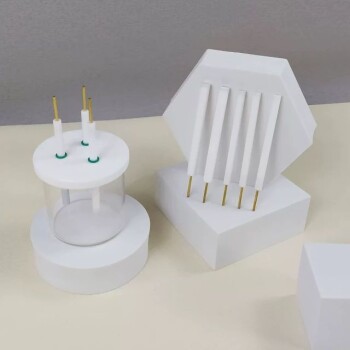
Rough or micro-nano structured electrode surfaces improve efficiency primarily by creating superoleophobic and anti-adhesion barriers against fouling. Unlike smooth surfaces, these textured architectures prevent the accumulation of gas bubbles and hydrophobic reaction byproducts that typically block the electrode's active sites. This physical modification directly results in lower charge transfer resistance and sustained performance, particularly at high current densities.
In (non-)Kolbe electrolysis, the physical morphology of the electrode is as critical as its chemical composition. By implementing multi-scale roughness, you prevent the "masking" effect of gas bubbles and organic buildup, ensuring the electrode remains active and electrically efficient over time.
The Mechanism of Bubble Management
Preventing Gas Masking
Electrolysis inevitably generates gas, specifically carbon dioxide ($CO_2$), as a byproduct of the reaction. On a smooth surface, these gas bubbles tend to adhere strongly, effectively "masking" or covering the active sites of the electrode.
Maintaining Active Site Availability
Micro-nano structured surfaces disrupt this adhesion. By reducing the contact area available for bubbles to grip, the surface prevents gas from lingering. This ensures that the active sites remain exposed to the electrolyte rather than being insulated by a layer of gas.
Mitigating Product Accumulation
Superoleophobic Characteristics
Kolbe and non-Kolbe electrolysis reactions frequently produce hydrophobic (water-repelling) organic compounds. These oily or waxy products naturally want to stick to the electrode surface. Rough surfaces, however, are engineered to be superoleophobic, meaning they strongly repel these organic oils.
Anti-Adhesion of Hydrophobic Products
The multi-scale structure creates a physical barrier that minimizes the adhesion of these products. Instead of forming a passivating film that chokes off the reaction, the hydrophobic products are released from the surface. This prevents the rapid accumulation of byproducts that typically degrades the performance of smooth electrodes.
Electrical Performance and Stability
Lowering Charge Transfer Resistance
Because the surface remains clean of both gas bubbles and organic fouling, the electrochemical pathway remains open. This results in significantly lower charge transfer resistance. Electrons can move freely between the electrode and the reactant without overcoming the impedance of a fouling layer.
Stability at High Current Densities
Operating at high current densities usually accelerates electrode fouling. However, the anti-adhesion properties of rough surfaces counteract this. By continuously shedding bubbles and products, these electrodes exhibit enhanced long-term stability, maintaining high efficiency even under aggressive operational conditions.
Common Pitfalls to Avoid
Overlooking Surface Architecture
A common error in electrode design is focusing solely on the catalytic material while ignoring surface topography. A highly active catalyst on a smooth surface will still fail if it becomes physically blocked by bubbles or product buildup.
Misinterpreting Resistance Spikes
If you observe a rapid spike in voltage or resistance during operation, it is often misdiagnosed as catalyst degradation. In reality, this is frequently a mass transfer issue caused by bubble masking or product adhesion, which could be solved by introducing surface roughness rather than changing the catalyst material.
Making the Right Choice for Your Goal
To maximize the efficiency of your electrolysis setup, consider the following regarding electrode surface morphology:
- If your primary focus is long-term operation: Prioritize micro-nano structured surfaces to minimize maintenance and prevent the gradual rise in voltage caused by product fouling.
- If your primary focus is high-speed production: Use rough surfaces to enable high current densities without suffering from the immediate performance drops associated with bubble masking.
Structuring your electrode surface is not just about increasing area; it is a critical strategy for self-cleaning and sustained electrochemical activity.
Summary Table:
| Feature | Smooth Electrode Surface | Rough/Micro-Nano Structured Surface |
|---|---|---|
| Bubble Adhesion | High (Masks active sites) | Low (Rapid gas release) |
| Organic Fouling | High (Forms passivating films) | Low (Superoleophobic properties) |
| Charge Resistance | High (Increases over time) | Low (Sustained performance) |
| Current Stability | Unstable at high densities | High stability under aggressive conditions |
| Self-Cleaning | Minimal | Significant (Anti-adhesion architecture) |
Elevate Your Electrochemical Research with KINTEK
Maximize your electrolysis efficiency with precision-engineered components from KINTEK. Whether you are optimizing (non-)Kolbe electrolysis or developing next-generation energy solutions, our expertise in electrolytic cells, advanced electrodes, and high-performance battery research tools ensures your lab achieves peak stability and output.
Why partner with KINTEK?
- Advanced Surface Tech: Premium electrode materials designed to minimize resistance and fouling.
- Comprehensive Range: From high-temperature furnaces to precision hydraulic presses and specialized consumables (PTFE, Ceramics, Crucibles).
- Custom Solutions: Tailored support for high-pressure reactors and complex cooling systems.
Don't let bubble masking or product accumulation stall your progress. Contact KINTEK today to discuss your electrode and laboratory equipment needs!
References
- F. Joschka Holzhäuser, Regina Palkovits. (Non-)Kolbe electrolysis in biomass valorization – a discussion of potential applications. DOI: 10.1039/c9gc03264a
This article is also based on technical information from Kintek Solution Knowledge Base .
Related Products
- Reference Electrode Calomel Silver Chloride Mercury Sulfate for Laboratory Use
- Graphite Disc Rod and Sheet Electrode Electrochemical Graphite Electrode
- Glassy Carbon Electrochemical Electrode
- RRDE rotating disk (ring disk) electrode / compatible with PINE, Japanese ALS, Swiss Metrohm glassy carbon platinum
- Gold Disc Electrode
People Also Ask
- What is the function of a reference electrode? Master Precision in Three-Electrode Reactor Reconstruction
- What is the recommended maintenance for the filling solution of a reference electrode? A Guide to Stable & Accurate Readings
- Which electrode is used as a ground reference? Master the Key to Accurate Electrochemical Measurements
- What is the reference electrode in potentiometry? The Key to Stable & Accurate Measurements
- Which electrode is used as a reference? A Guide to Accurate Electrochemical Measurements