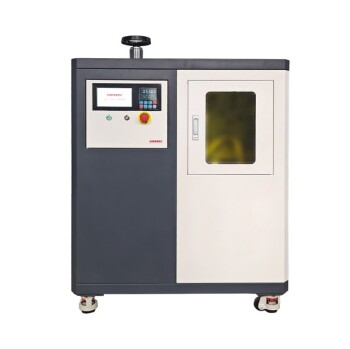
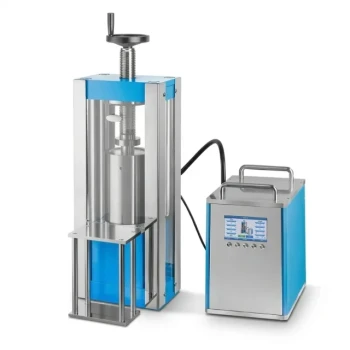
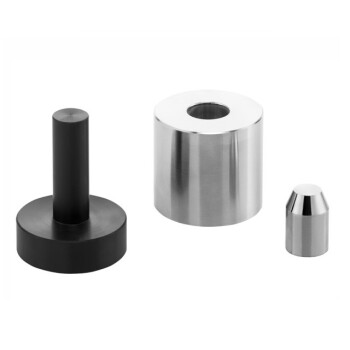
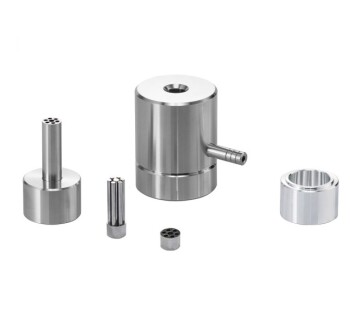
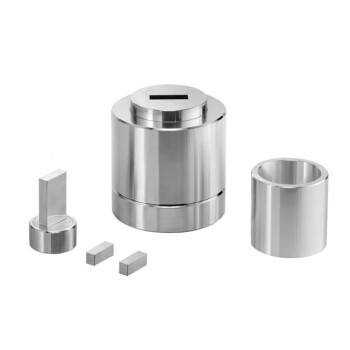
Specialized molds and high-pressure presses operate as an integrated mechanical system to solve the primary challenge of solid-state battery assembly: physical contact. The molds serve as precision confinement vessels, locking the electrolyte, cathode, and anode layers into exact alignment. Once assembled, the press applies massive force—typically between 151 MPa and 500 MPa—to fuse these separate layers into a single, dense electrochemical unit.
Core Takeaway In solid-state batteries, ions cannot flow through air gaps or loose particles. The collaboration between the mold (alignment) and the press (force) is the only mechanism available to eliminate microscopic voids and establish the solid-solid interfacial contact required for the battery to function.
The Mechanics of Interaction
The Role of the Mold: Alignment and Confinement
The specialized mold acts as the structural foundation of the assembly process. Its primary function is to fix the relative positions of the active layers.
It prevents the electrolyte, cathode, and anode materials from shifting or mixing during the application of force.
Advanced molds often utilize composite materials, such as stainless steel and PEEK, to withstand the immense pressures required without deforming.
The Role of the Press: Densification
Once the layers are secured within the mold, an isostatic or hydraulic press is engaged to apply high-tonnage pressure.
The primary reference notes a standard pressure range of 151 MPa to 267 MPa for general assembly.
However, depending on the specific chemistry (such as sulfide electrolytes), supplementary data indicates that pressures can scale up to 500 MPa.
Creating the Unified Pellet
The press drives the mold components together, compressing the loose powder or stacked layers.
This action forces the materials to undergo high-pressure densification.
The result is a unified "pellet" or cell stack where separate layers are mechanically fused into a cohesive solid structure.
Why High Pressure is Critical
Eliminating Interlayer Gaps
Unlike liquid electrolytes, which flow into pores, solid electrolytes are rigid.
Without sufficient pressure, interlayer gaps remain between the electrodes and the electrolyte.
The press eliminates these gaps, ensuring that the physical interface is continuous rather than broken by air pockets.
Reducing Interfacial Impedance
The most significant barrier to solid-state performance is interfacial impedance (resistance at the boundary between layers).
High-pressure assembly minimizes this resistance by maximizing the surface area where particles touch.
This is explicitly linked to enhanced cycling stability, allowing the battery to charge and discharge repeatedly without rapid degradation.
Ensuring Grain Boundary Connectivity
For specific materials like sulfide solid electrolytes (e.g., Li6PS5Cl), pressure serves an additional purpose.
It reduces grain boundary resistance by crushing particles closer together.
This tight physical contact allows ions to move efficiently from particle to particle, directly determining the battery's ionic conductivity.
Understanding the Trade-offs
Pressure Magnitude Variance
Not all batteries require the same force. While the baseline assembly may require ~150-260 MPa, minimizing porosity in certain materials requires significantly more force.
Supplementary data highlights that laboratory hydraulic presses are often pushed to 370–400 MPa or even 500 MPa for sulfide-based systems.
Applying insufficient pressure in these scenarios will result in high porosity and poor ion transport.
Equipment Limitations
Standard molds cannot survive these processes.
The use of high-strength powder pellet dies is mandatory to prevent tool failure under loads exceeding 300 MPa.
Operators must ensure their tooling materials (like the PEEK composites mentioned) are rated for the specific pressure targets of their electrolyte chemistry.
Making the Right Choice for Your Goal
- If your primary focus is Standard Assembly: Target the 151 MPa to 267 MPa range to establish baseline solid-solid contact and ensure general cycling stability.
- If your primary focus is Sulfide Electrolyte Performance: Utilize pressures between 370 MPa and 500 MPa to aggressively reduce grain boundary resistance and maximize ionic conductivity.
- If your primary focus is Reducing Interface Impedance: Prioritize high-tonnage hydraulic or cold isostatic presses (CIP) to eliminate interface voids between the cathode (e.g., LFP) and the solid electrolyte.
The success of an all-solid-state battery is ultimately determined by how effectively you can mechanically force two solids to behave as a single, continuous conductor.
Summary Table:
| Component | Primary Function | Pressure Range | Key Material Impact |
|---|---|---|---|
| Specialized Mold | Alignment & Confinement | N/A | Fixes layer positions; prevents material shifting |
| Hydraulic Press | High-Pressure Densification | 151 - 267 MPa | Eliminates interlayer gaps and air pockets |
| Isostatic Press | Uniform Consolidation | 370 - 500+ MPa | Maximizes ionic conductivity; reduces grain resistance |
| Unified Pellet | Final Cell Structure | Resultant State | Minimizes impedance for enhanced cycling stability |
Elevate Your Battery Research with KINTEK Precision Engineering
Don't let interfacial impedance hinder your solid-state breakthroughs. KINTEK specializes in advanced laboratory solutions designed for the rigors of next-generation energy storage. Our comprehensive range of hydraulic presses (pellet, hot, isostatic) and specialized powder pellet dies are engineered to deliver the precise 151 MPa to 500+ MPa forces required for superior cell densification.
Whether you are working with sulfide electrolytes or exploring novel cathode materials, KINTEK provides the high-performance crushing, milling, and high-temperature furnace systems necessary to refine your battery chemistry.
Ready to achieve perfect solid-solid contact? Contact our laboratory experts today to discover how our tailored equipment and high-quality consumables can streamline your R&D process and enhance your cycling stability.
Related Products
- Warm Isostatic Press for Solid State Battery Research
- Laboratory Hydraulic Press Lab Pellet Press for Button Battery
- Anti-Cracking Press Mold for Lab Use
- Electric Split Lab Cold Isostatic Press CIP Machine for Cold Isostatic Pressing
- Button Battery Tablet Press Sealing Mold for Lab Use
People Also Ask
- What is the temperature of a warm isostatic press? Achieve Optimal Densification for Your Materials
- What is the function of a Warm Isostatic Press (WIP) in all-solid-state pouch cells? Optimize Battery Density
- Why are Warm Isostatic Presses (WIP) necessary for solid-state batteries? Achieve Atomic-Level Contact
- What advantages does a warm isostatic press offer over a traditional uniaxial press for Li6PS5Cl electrolyte sheets?
- How do warm isostatic presses improve dry electrode performance? Enhance ASSB Conductivity with Heat & Pressure