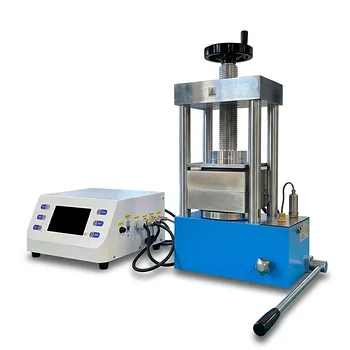
The collaboration between steel molds and hydraulic equipment provides the necessary confinement and force to achieve high-density molding. This process involves loading layered powders into rigid steel forms and compressing them with a hydraulic system to create a cohesive, geometrically precise "green body."
By subjecting powders confined in steel to stable, high pressure (such as 250 MPa), you force particles into a tight packing arrangement. This creates a unified structure where distinct material layers bond together mechanically before sintering.
The Mechanics of High-Density Molding
Precise Powder Containment
The process begins with the steel mold, which acts as the rigid containment vessel. Uniformly mixed WC/Cu powder is loaded into this mold according to the specific design of the functionally graded material (FGM) layers.
Application of Hydraulic Force
Once the powder is layered, hydraulic equipment is engaged to generate massive force. This equipment is essential for applying high pressure, cited specifically as 250 MPa in successful applications.
Increasing Packing Density
The pressure applied by the hydraulic system acts directly on the confined powder. This force significantly increases the packing density, eliminating voids between the powder particles.
Creating the Green Body Structure
Layer Integration
A critical function of this pressure is ensuring the integrity of the FGM structure. The stable pressure forces the multiple layers of powder to bond tightly together, preventing delamination.
Geometric Stability
The steel mold dictates the final physical form of the material. As the hydraulic pressure compacts the powder, it takes the shape of the mold, resulting in a regular rectangular or cylindrical form.
Mechanical Strength
The result of this collaboration is a "green body"—a pressed part that is not yet fully sintered but holds its shape. The compression ensures this body has specific mechanical strength, allowing it to be handled without crumbling.
Understanding the Constraints
The Pressure Requirement
High-density molding relies heavily on the magnitude of force applied. If the hydraulic equipment cannot maintain stable pressure at levels like 250 MPa, the powder will not pack sufficiently, leading to a weak or porous green body.
Mold Rigidity
The mold material is not arbitrary; it must be steel. The mold must withstand the immense internal stresses generated by the hydraulic press without deforming, ensuring the final part maintains accurate dimensions.
Making the Right Choice for Your Goal
To successfully prepare WC/Cu functionally graded material green bodies, you must balance equipment capability with mold design.
- If your primary focus is material density: Ensure your hydraulic equipment is rated to deliver and sustain high pressure (e.g., 250 MPa) to maximize particle packing.
- If your primary focus is layer integrity: Prioritize the use of rigid steel molds that prevent lateral expansion, ensuring the vertical pressure forces layers to bond tightly rather than spread.
Ultimately, the geometric precision provided by the steel mold combined with the densifying power of the hydraulic press is the only way to produce a viable, high-strength green body.
Summary Table:
| Component | Role in Molding Process | Key Technical Benefit |
|---|---|---|
| Steel Mold | Rigid Containment | Ensures geometric stability and prevents lateral deformation. |
| Hydraulic Press | Application of Force | Delivers 250 MPa pressure to maximize powder packing density. |
| Powder Layers | Layered Loading | Facilitates the structural gradient of WC/Cu materials. |
| Green Body | Final Intermediate Product | Provides necessary mechanical strength for handling before sintering. |
Elevate Your Material Research with KINTEK Precision
Achieving the perfect green body requires more than just pressure—it demands equipment engineered for precision and durability. KINTEK specializes in advanced laboratory solutions, offering a comprehensive range of hydraulic presses (pellet, hot, isostatic) and custom steel molds designed to withstand the rigorous demands of WC/Cu functionally graded material preparation.
From high-performance crushing and milling systems to high-temperature furnaces and vacuum sintering solutions, our portfolio empowers researchers to achieve superior density and structural integrity.
Ready to optimize your molding process? Contact our technical experts today to discover how KINTEK’s laboratory equipment and consumables can streamline your material science workflows.
Related Products
- Laboratory Hydraulic Press Split Electric Lab Pellet Press
- Laboratory Hydraulic Pellet Press for XRF KBR FTIR Lab Applications
- Automatic Heated Hydraulic Press Machine with Heated Plates for Laboratory Hot Press 25T 30T 50T
- Hydraulic Diaphragm Lab Filter Press for Laboratory Filtration
- Automatic Laboratory Hydraulic Press for XRF & KBR Pellet Press
People Also Ask
- What are the roles of a laboratory hydraulic press and stainless steel molds in the preparation of graphite samples?
- What is the role of a laboratory hydraulic press in electrode prep? Maximize Energy Density & Sealing Precision
- How does a laboratory hydraulic press ensure the quality of alumina-forming alloy green bodies? Optimize CSP Research
- How is a laboratory hydraulic press used to evaluate the mechanical performance of nano-modified concrete? Expert Guide
- Why is a laboratory hydraulic press used for ASSB assembly? Achieving 392 MPa for Optimal Solid-State Battery Density