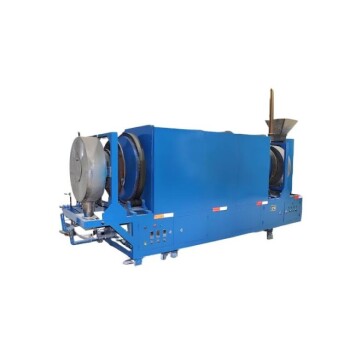
A continuous belt furnace functions by transporting substrates coated with platinum (Pt) paste through a series of distinct, precisely controlled temperature zones at a regulated speed. This automated movement ensures that every substrate receives an identical thermal profile, converting the raw paste into a stable, high-performance catalytic layer of platinum nanoparticles.
The core advantage of this process is the elimination of batch-to-batch variation. By locking in travel speed and thermal zones, the furnace guarantees that every counter electrode produced exhibits consistent electrical conductivity and electrochemical catalytic activity, which is essential for large-scale manufacturing.
The Mechanics of the Annealing Process
controlled Temperature Zones
The furnace is divided into specific thermal sections. As the belt moves, the coated glass substrates pass through these zones, which subjects them to a precise heating curve.
Regulated Travel Speed
The speed of the belt determines the duration of heat exposure. This variable is strictly controlled to ensure the platinum paste has adequate time to react and settle without overheating or under-curing.
Continuous Processing
Unlike batch ovens that treat groups of products at once, this system allows for a steady flow of material. This design enables high-volume throughput while maintaining strict quality standards for every individual unit.
Material Transformation and Quality
Formation of Platinum Nanoparticles
The primary goal of the annealing process is physical transformation. The heat treatment facilitates the conversion of the applied Pt paste into a stable layer of platinum nanoparticles.
Ensuring Electrical Conductivity
A successful annealing cycle results in a layer that is highly conductive. This conductivity is critical for the electrode's function in electrochemical applications.
Stabilizing Catalytic Activity
Beyond simple conductivity, the process activates the platinum. The resulting nanoparticle layer possesses the specific electrochemical catalytic activity required for the counter electrode to function effectively.
Understanding the Operational Requirements
The Necessity of Precision
While the system is automated, it relies entirely on the precise calibration of "time at temperature." Deviations in belt speed or zone temperature will disrupt the formation of the nanoparticle layer.
Uniformity vs. Flexibility
The strength of this system is uniformity, but this can make quick changes difficult. Once the ideal profile for a specific Pt paste is established, the system is best used for continuous, unchanged production runs rather than frequent experimental adjustments.
Making the Right Choice for Your Production
To maximize the effectiveness of a continuous belt furnace for platinum counter electrodes, consider your primary manufacturing goals:
- If your primary focus is consistency: Prioritize the calibration of temperature zones to ensure every nanoparticle layer forms with identical catalytic properties.
- If your primary focus is scale: Optimize the belt travel speed to maximize throughput without compromising the stability of the platinum layer.
The continuous belt furnace is the definitive solution for transforming raw platinum paste into reliable, high-performance electrodes at an industrial scale.
Summary Table:
| Process Component | Functional Role | Impact on Pt Electrode |
|---|---|---|
| Thermal Zones | Precisely controlled heating stages | Converts Pt paste into stable nanoparticles |
| Belt Speed | Regulates duration of heat exposure | Ensures uniform electrical conductivity |
| Continuous Flow | Automated, steady-state throughput | Eliminates batch-to-batch variation |
| Process Goal | High-volume industrial annealing | Maximizes electrochemical catalytic activity |
Elevate Your Electrode Production with KINTEK Precision
Consistency is the hallmark of high-performance electrochemical components. At KINTEK, we specialize in the advanced thermal systems and laboratory equipment required to transform raw materials into industrial-grade technology. Whether you are optimizing the annealing of platinum nanoparticles or scaling up production of complex catalytic layers, our comprehensive range of continuous belt furnaces, vacuum systems, and high-temperature reactors ensures your lab achieves repeatable, high-quality results every time.
From high-precision muffle and tube furnaces to specialized crushing and milling systems for precursor preparation, KINTEK provides the tools needed for battery research, material science, and electrode manufacturing. Our expertise extends to essential consumables like PTFE products, ceramics, and crucibles, supporting your entire workflow.
Ready to maximize your lab’s efficiency and throughput?
Contact KINTEK today to discuss your specific thermal processing needs!
References
- Ressa Muhripah Novianti, Syoni Soepriyanto. The Addition of C, Zn-C and Sn-C on Anatase Titanium Dioxide (TiO2) for Dye-Sensitized Solar Cells Application. DOI: 10.55981/metalurgi.2023.686
This article is also based on technical information from Kintek Solution Knowledge Base .
Related Products
- Mesh belt controlled atmosphere furnace
- Vacuum Sealed Continuous Working Rotary Tube Furnace Rotating Tube Furnace
- Graphite Vacuum Continuous Graphitization Furnace
- Electric Rotary Kiln Continuous Working Small Rotary Furnace Heating Pyrolysis Plant
- Multi Heating Zones CVD Tube Furnace Machine Chemical Vapor Deposition Chamber System Equipment
People Also Ask
- What are some of the reasons why a controlled atmosphere furnace is desirable in sintering? Achieve Superior Sintering Results
- Why is a furnace equipped with a controlled atmosphere necessary for the preparation of active metal catalysts?
- What role does a controlled atmosphere furnace with argon gas flow play in the production of reduced graphene oxide (rGO)?
- How does a mesh belt furnace work? Achieve High-Volume, Repeatable Heat Treatment
- What is the process of a mesh belt furnace? Achieve Consistent, High-Volume Heat Treatment