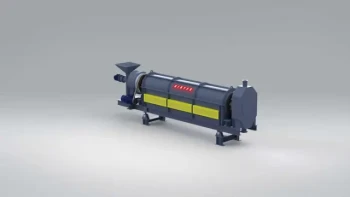
The primary purpose of this configuration is chemical reduction. A horizontal tube furnace equipped with a hydrogen-nitrogen atmosphere provides the stable, high-temperature environment necessary to convert inert nickel oxide (NiO) precursors into active metallic nickel (Ni) nanoparticles. This conversion is the prerequisite for carbon nanotube production, as the oxide form lacks the catalytic ability to decompose methane.
The success of your final material depends entirely on this pre-treatment phase; it transforms the substrate coating from a passive precursor into the active "seeds" required for carbon nanotube growth.
The Mechanism of Catalyst Activation
Converting Precursors to Active Sites
The nickel oxide (NiO) initially loaded onto the mullite substrate is chemically stable but catalytically inactive regarding hydrocarbon decomposition.
You use a reducing atmosphere (hydrogen mixed with nitrogen) to strip oxygen atoms from the NiO. This chemical reaction leaves behind pure, metallic nickel (Ni) nanoparticles, which serve as the actual catalytic centers.
The Role of Methane Decomposition
Once reduced to its metallic state, the nickel becomes capable of breaking down methane gas.
This decomposition is the fundamental driver of the process. The metallic nickel acts as an anchor point where carbon atoms from the methane are deposited and assembled, initiating the physical growth of carbon nanotubes.
Determining Final Material Properties
Controlling Particle Distribution
The specific conditions within the tube furnace directly influence the morphology of the resulting nickel particles.
By controlling the reduction process, you determine the size and distribution of these metallic nanoparticles. This is a critical variable, as the catalyst particle size dictates the diameter of the resulting nanotubes.
Impact on Network Density and Quality
The effectiveness of the pre-treatment defines the yield of your final product.
A high degree of reduction ensures a maximum number of active sites are available. This directly correlates to the density of the carbon nanotube network and the overall quality of the material produced.
Critical Process Control Variables
Managing the Degree of Reduction
A common pitfall in this process is failing to achieve complete reduction of the NiO precursor.
If the atmosphere is not sufficiently reducing or the temperature is unstable, portions of the catalyst will remain as oxide. These unreduced areas will fail to decompose methane, resulting in "dead spots" on the substrate where no nanotubes grow.
Balancing Particle Aggregation
While high temperatures are necessary for reduction, excessive heat or prolonged exposure can cause the newly formed nickel nanoparticles to sinter (merge together).
This reduces the total surface area of the catalyst and results in fewer, larger nanotubes rather than a dense network of fine tubes. Precision in the furnace profile is required to balance reduction against aggregation.
Making the Right Choice for Your Goal
To optimize your carbon nanotube growth, align your furnace parameters with your specific quality targets:
- If your primary focus is maximizing network density: Prioritize a reduction profile that ensures complete conversion of NiO to Ni without inducing particle sintering, maintaining the highest number of discrete nucleation sites.
- If your primary focus is structural uniformity: Maintain a strictly stable hydrogen-nitrogen ratio and temperature gradient to ensure every section of the substrate experiences identical reduction conditions.
The quality of your carbon nanotubes is largely predetermined before the carbon source is even introduced, defined almost entirely by the precision of this reduction step.
Summary Table:
| Process Component | Role in Pre-treatment | Impact on Final Product |
|---|---|---|
| H2-N2 Atmosphere | Chemical reduction of NiO to metallic Ni | Activates catalytic sites for methane decomposition |
| Horizontal Tube Furnace | High-temp stability & uniform gas flow | Ensures consistent particle distribution across substrate |
| Temperature Control | Manages reduction rate & prevents sintering | Determines nanotube diameter and network density |
| Metallic Ni Particles | Acts as growth nucleation "seeds" | Directly dictates the quality and yield of nanotubes |
Elevate Your Material Research with KINTEK Precision
Achieving the perfect reduction profile is critical for high-performance carbon nanotube growth. KINTEK specializes in advanced laboratory equipment, offering high-precision horizontal tube furnaces, CVD systems, and vacuum furnaces designed to maintain the rigorous atmospheric and thermal stability your research demands.
Whether you require crushing and milling systems for substrate preparation or high-temperature high-pressure reactors for downstream processing, our comprehensive portfolio—including PTFE products, ceramics, and crucibles—is engineered to support the most demanding laboratory workflows.
Ready to optimize your catalyst activation? Contact our technical experts today to find the ideal furnace solution for your specific application.
References
- Li Zhu, Yingchao Dong. Ceramic-Based Composite Membrane with a Porous Network Surface Featuring a Highly Stable Flux for Drinking Water Purification. DOI: 10.3390/membranes9010005
This article is also based on technical information from Kintek Solution Knowledge Base .
Related Products
- 1200℃ Controlled Atmosphere Furnace Nitrogen Inert Atmosphere Furnace
- 1700℃ Controlled Atmosphere Furnace Nitrogen Inert Atmosphere Furnace
- Controlled Nitrogen Inert Hydrogen Atmosphere Furnace
- 1400℃ Controlled Atmosphere Furnace with Nitrogen and Inert Atmosphere
- Mesh belt controlled atmosphere furnace
People Also Ask
- What are the two primary purposes of using a controlled atmosphere? Master Protection vs. Material Modification
- What is controlled atmosphere furnace? Precision Heating Without Oxidation for Superior Materials
- What is a controlled atmosphere furnace? Achieve Purity and Precision in High-Temp Processing
- Why is a high-temperature furnace with a controlled atmosphere required for S@MMPC? Master Precision Synthesis
- What is the role of the furnace atmosphere? Master Precise Metallurgical Control for Your Heat Treatment