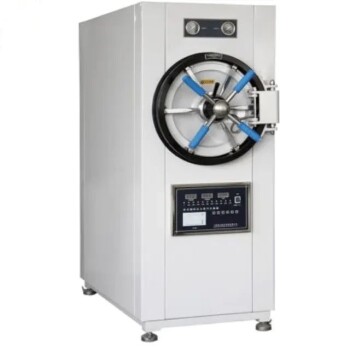
The high-pressure autoclave functions as a precision control environment to radically alter the surface topology of TiO2 nanobelts. By maintaining a constant temperature of 100 °C within a sealed, pressurized vessel, the autoclave ensures that the reaction with 0.02 M sulfuric acid is both uniform and consistent. This controlled etching process transforms the nanobelt surface into a rough, "island-like" structure, effectively doubling the specific surface area from 35 m²/g to 75 m²/g.
The autoclave's controlled environment drives a uniform etching process that maximizes specific surface area, creating the necessary structural foundation for high-performance composite materials.
Creating a Controlled Reaction Environment
Ensuring Thermal Stability
The primary function of the high-pressure autoclave during acid etching is to lock in a specific thermal profile. By maintaining the system strictly at 100 °C, the device prevents temperature fluctuations that could lead to uneven reaction rates.
Achieving Chemical Uniformity
In an open vessel, etching might occur randomly or aggressively in localized spots. The autoclave’s pressurized environment forces the 0.02 M sulfuric acid solution to interact evenly across the entire surface of the TiO2 nanobelts.
Enabling Structural Transformation
This uniform interaction is what physically alters the material. The process does not merely clean the surface; it re-engineers the morphology to create distinct "island-like" structures on the nanobelts.
Quantifiable Improvements in Material Properties
Drastic Increase in Surface Area
The most significant impact of using a high-pressure autoclave in this context is the expansion of surface area. The creation of the island-like texture increases the specific surface area from 35 m²/g to 75 m²/g.
Enhancing Active Nucleation Sites
This increase in surface area is not just a geometric statistic; it is a functional upgrade. The roughened, high-surface-area texture provides significantly more "anchoring points" or active nucleation sites.
Facilitating Secondary Particle Loading
These nucleation sites are critical for the next stage of material synthesis. They allow for the effective and uniform loading of secondary nanoparticles, such as Ag3PO4, ensuring a robust composite material.
Understanding the Trade-offs
Material Compatibility and Corrosion
While the stainless steel body of an autoclave handles pressure well, it is vulnerable to corrosion. When working with corrosive agents like sulfuric acid (or strong alkalis used in synthesis), a Teflon liner is mandatory to prevent contamination and damage to the reactor vessel.
Balancing Etching Severity
Precision is required when setting autoclave parameters. If the temperature or pressure exceeds the optimal range (e.g., significantly above 100 °C for this specific acid concentration), the etching could become destructive, dissolving the nanobelts entirely rather than just texturing them.
Equipment Complexity
Unlike simple glassware, high-pressure autoclaves are complex systems designed to withstand internal pressures of 50 to 350 bars. They require strict safety protocols and careful assembly to ensure the seal holds during the heating phase.
Making the Right Choice for Your Goal
To maximize the utility of the high-pressure autoclave in your TiO2 processing, consider your specific end-goals:
- If your primary focus is Surface Activation: Maintain the temperature strictly at 100 °C with 0.02 M acid to double the surface area without compromising the structural integrity of the belts.
- If your primary focus is Composite Synthesis: Utilize this etching method specifically to prepare the nanobelts for loading secondary agents like Ag3PO4, as the roughened surface is essential for adhesion.
By leveraging the high-pressure autoclave for controlled etching, you convert standard nanobelts into highly reactive platforms for advanced material applications.
Summary Table:
| Parameter | Standard TiO2 Nanobelts | Autoclave-Etched TiO2 Nanobelts |
|---|---|---|
| Temperature | Ambient | Constant 100 °C |
| Surface Morphology | Smooth | Rough, "Island-like" Structure |
| Specific Surface Area | 35 m²/g | 75 m²/g |
| Nucleation Sites | Low | High (Enhanced Particle Loading) |
| Reaction Medium | N/A | 0.02 M Sulfuric Acid |
| Key Outcome | Raw Material | High-Performance Composite Base |
Elevate Your Nanomaterial Synthesis with KINTEK
Precise control over pressure and temperature is non-negotiable for high-performance material engineering. KINTEK specializes in advanced laboratory equipment, providing the precision high-temperature high-pressure reactors and autoclaves required to achieve uniform etching and maximized surface area in TiO2 research.
Whether you are developing photocatalysts, battery technologies, or advanced composites, our portfolio—including muffle furnaces, vacuum systems, and specialized PTFE-lined reactors—is engineered for reliability and safety.
Ready to optimize your material properties? Contact our laboratory specialists today to find the perfect autoclave solution for your research goals.
References
- Neerugatti KrishnaRao Eswar, Giridhar Madras. Enhanced sunlight photocatalytic activity of Ag3PO4 decorated novel combustion synthesis derived TiO2 nanobelts for dye and bacterial degradation. DOI: 10.1039/c5pp00092k
This article is also based on technical information from Kintek Solution Knowledge Base .
Related Products
- Mini SS High Pressure Autoclave Reactor for Laboratory Use
- High Pressure Laboratory Autoclave Reactor for Hydrothermal Synthesis
- Stainless High Pressure Autoclave Reactor Laboratory Pressure Reactor
- Desktop Fast High Pressure Laboratory Autoclave Sterilizer 16L 24L for Lab Use
- Portable High Pressure Laboratory Autoclave Steam Sterilizer for Lab Use
People Also Ask
- Why use high-pressure reactors for molecular sieve synthesis? Unlock Superior Crystallinity and Framework Control
- What are the advantages of using a high-pressure reactor like an autoclave? Maximize Liquefaction Speed & Yield
- Why are high-pressure reactors or autoclaves necessary for the synthesis of new functional materials? Unlock Precision.
- What is the function of a high-pressure reactor autoclave? Enhancing Cu/N Co-Doped Carbon Catalyst Synthesis
- How are high-pressure reactors used to prepare metaphosphate electrocatalysts? Master In-Situ Precursor Growth