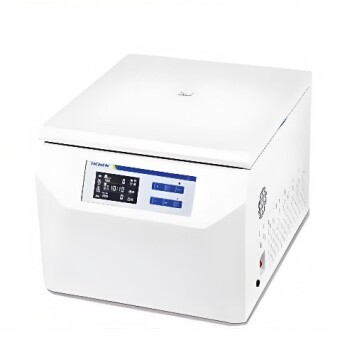
A high-pressure reactor facilitates the synthesis of alpha-manganese dioxide (alpha-MnO2) by creating a sealed, elevated-temperature environment. By maintaining conditions such as 120 °C under autogenous pressure, the reactor forces the solvent into a state that supports the supersaturation of manganese salt precursors. This specific environment is critical for driving crystal growth along precise orientations.
The reactor's ability to sustain high-pressure hydrothermal conditions enables the formation of stable tunnel structures and nanorod morphologies. These structural features significantly enhance the material's ability to facilitate rapid zinc ion (Zn²⁺) insertion and extraction, directly improving battery rate performance.
The Mechanism of Hydrothermal Synthesis
Creating a Supersaturated Environment
In standard atmospheric conditions, water boils at 100°C, limiting the reaction kinetics. A high-pressure reactor overcomes this by maintaining a sealed environment.
This allows the temperature to exceed the boiling point while keeping the solvent in a liquid state. Under these conditions, the solubility and reactivity of the manganese salt precursors are significantly altered.
This creates a supersaturated solution, which is the fundamental requirement for initiating the precipitation and growth of solid materials from a liquid phase.
Driving Directional Crystal Growth
Once supersaturation is achieved, the specific pressure and temperature conditions guide the organization of atoms.
The hydrothermal environment encourages the manganese precursors to grow along specific crystalline orientations.
Instead of forming random aggregates, the crystals develop into ordered structures. In the case of alpha-MnO2, this results in the specific "tunnel" structure inherent to this polymorph.
Structural Benefits for Battery Performance
Formation of Stable Tunnel Structures
The primary value of alpha-MnO2 lies in its crystallographic tunnels. The high-pressure reactor ensures the synthesis of this specific phase.
These tunnels are mechanically stable, providing a robust framework that can withstand repeated electrochemical cycling without collapsing.
Achieving Nanorod Morphology
Beyond the internal crystal structure, the reactor influences the macroscopic shape of the particles. The directional growth promoted by the hydrothermal process typically results in nanorod morphologies.
Nanorods offer a high aspect ratio, which is advantageous for electrochemical applications.
Enhancing Ion Kinetics
The combination of tunnel structures and nanorod morphology directly impacts battery efficiency.
These features facilitate the rapid insertion and extraction of Zinc ions (Zn²⁺). The open tunnels provide pathways for ions to move, while the nanorod shape shortens the diffusion distance, ultimately improving the rate performance of the battery.
Understanding the Trade-offs
Process Sensitivity
While the high-pressure reactor enables precise control, the process is highly sensitive. Slight deviations in temperature or pressure distribution can alter the phase purity or morphology.
If the environment is not strictly controlled, you may inadvertently synthesize a different manganese oxide polymorph or create particles with lower specific surface areas, degrading performance.
Scalability and Throughput
Hydrothermal synthesis in high-pressure reactors is typically a batch process.
While excellent for producing high-quality, high-crystallinity materials in a lab or pilot setting, scaling this to industrial mass production requires overcoming significant throughput limitations compared to continuous flow methods.
Making the Right Choice for Your Goal
To maximize the utility of alpha-MnO2 synthesis, align your process parameters with your specific electrochemical targets:
- If your primary focus is High Rate Performance: Prioritize parameters that yield uniform nanorods, as this morphology minimizes ion diffusion paths for faster Zn²⁺ kinetics.
- If your primary focus is Cycle Stability: Focus on maintaining precise temperature control to ensure phase purity of the tunnel structures, preventing structural degradation over time.
By leveraging the high-pressure environment to control crystal orientation, you transform raw precursors into a highly active cathode material capable of meeting demanding energy storage needs.
Summary Table:
| Parameter | Role in alpha-MnO2 Synthesis | Impact on Battery Performance |
|---|---|---|
| Sealed Pressure | Enables temperatures >100°C without solvent loss | Creates supersaturation for uniform precipitation |
| Hydrothermal Temp | Drives directional crystal growth | Forms stable 1D tunnel structures for ion transport |
| Morphology Control | Promotes nanorod development | Shortens ion diffusion paths for higher rate capability |
| Phase Purity | Ensures consistent polymorph formation | Enhances long-term structural and cycling stability |
Elevate Your Energy Storage Research with KINTEK
Precise control over crystal morphology is the key to unlocking next-generation battery performance. KINTEK specializes in advanced laboratory solutions, providing the high-performance high-pressure reactors and autoclaves essential for successful alpha-MnO2 hydrothermal synthesis.
Our comprehensive range of equipment—from high-temperature furnaces and ball milling systems to battery research tools and ceramic crucibles—is designed to meet the rigorous demands of material science. Partner with KINTEK to ensure phase purity and superior nanostructure development in your lab.
Contact KINTEK Today to Optimize Your Synthesis Process!
References
- Xiaoying Yan, Wenbin Hu. Highly Reversible Zn Anodes through a Hydrophobic Interface Formed by Electrolyte Additive. DOI: 10.3390/nano13091547
This article is also based on technical information from Kintek Solution Knowledge Base .
Related Products
- Customizable Laboratory High Temperature High Pressure Reactors for Diverse Scientific Applications
- Customizable High Pressure Reactors for Advanced Scientific and Industrial Applications
- Stainless High Pressure Autoclave Reactor Laboratory Pressure Reactor
- Mini SS High Pressure Autoclave Reactor for Laboratory Use
- High Pressure Laboratory Autoclave Reactor for Hydrothermal Synthesis
People Also Ask
- How do high-pressure and high-temperature reactors ensure the effective treatment of lignocellulosic wastewater in WAO?
- What equipment is required for high-pressure high-temperature reactions? Master Extreme Chemistry Safely
- How do you control high pressure in a reactor? A Guide to Safe & Stable Operation
- Why is argon better than nitrogen for inert atmosphere? Ensure Absolute Reactivity & Stability
- How does initial oxygen pressure affect the wet oxidation of pharmaceutical sludge? Master Your Oxidation Depth