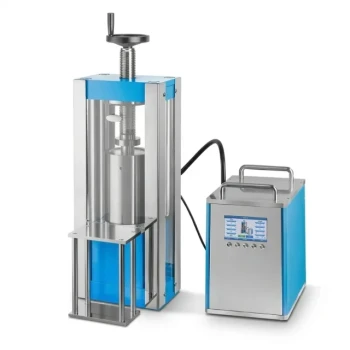
Hot Isostatic Pressing (HIP) elevates the performance of Silicon Nitride and Boron Nitride composites by subjecting pre-sintered materials to intense, uniform gas pressure at high temperatures. By applying forces typically between 150 and 200 MPa, HIP mechanically forces closed residual micropores, resulting in a ceramic structure with superior density and hardness compared to pressureless sintering.
Core Takeaway Achieving full density in complex ceramics is difficult due to particle resistance. HIP overcomes this by using high-pressure gas to eliminate density gradients and internal voids, pushing the material's relative density to over 95% and ensuring its mechanical properties are consistent in all directions (isotropy).
The Mechanics of Densification
Uniform Pressure Application
Unlike techniques that apply force from a single direction, a HIP unit utilizes a gaseous medium to apply pressure isostatically.
This means the material experiences equal force from every angle simultaneously.
Operating at pressures of 150–200 MPa, this environment is powerful enough to compress the ceramic material at the microstructural level.
Eliminating Micropores
The primary function of this pressure is to close residual micropores that remain after the initial sintering phase.
These microscopic voids are stress concentrators that can lead to material failure.
By mechanically collapsing these pores, HIP removes the internal flaws that compromise the structural integrity of the composite.
Enhancing Material Properties
Increasing Relative Density
The most immediate benefit of HIP treatment is a significant boost in relative density.
For h-BN-based ceramics, which are notoriously difficult to densify, HIP can increase relative density to over 95%.
This high density is directly correlated with improved mechanical strength and thermal performance.
Improving Hardness
As porosity decreases, the material's hardness increases.
The elimination of voids creates a continuous solid matrix of Silicon Nitride (Si3N4) and hexagonal Boron Nitride (h-BN).
This results in a harder, more wear-resistant surface suitable for demanding industrial applications.
Ensuring Isotropy
Because the pressure is applied uniformly, the resulting material properties are isotropic.
This means the ceramic exhibits the same strength, thermal conductivity, and electrical properties in all directions.
This is a distinct advantage over uniaxial pressing, which often results in direction-dependent properties.
Overcoming Structural Challenges
The 'House of Cards' Effect
Hexagonal Boron Nitride (h-BN) has a plate-like particle structure.
During processing, these plates can arrange themselves haphazardly, creating a "house of cards" structure with large gaps that are difficult to close.
While uniaxial Hot Pressing uses mechanical force to induce flow, HIP ensures that even pre-sintered components with these complex internal structures are compressed uniformly to eliminate remaining gaps.
Understanding the Trade-offs
HIP vs. Uniaxial Hot Pressing
It is critical to distinguish HIP from a standard Hot Press Furnace.
A Hot Press applies uniaxial mechanical pressure (e.g., 30 MPa), which is effective for simple shapes and inducing plastic flow in specific directions.
However, uniaxial pressure can lead to density gradients (uneven density) in complex shapes.
The Cost of Perfection
HIP is typically a secondary process performed on pre-sintered parts.
This adds a step to the manufacturing workflow compared to simultaneous forming and sintering.
However, for components requiring uniform density distribution and the elimination of all internal gradients, this additional step is often necessary.
Making the Right Choice for Your Goal
To maximize the performance of your Si3N4 and h-BN composites, align your processing method with your performance requirements:
- If your primary focus is uniform reliability: Use HIP to ensure isotropic properties and eliminate density gradients that could cause failure in complex stress environments.
- If your primary focus is maximum density: Use HIP to push relative density beyond 95%, closing the stubborn micropores that standard sintering leaves behind.
Ultimately, HIP transforms a porous, variable ceramic into a dense, homogeneous component capable of withstanding extreme operational environments.
Summary Table:
| Property Feature | Standard Sintering | Hot Isostatic Pressing (HIP) |
|---|---|---|
| Relative Density | Variable / Lower | > 95% (Near-theoretical) |
| Internal Porosity | Residual Micropores | Eliminated / Closed |
| Pressure Type | Pressureless or Uniaxial | Isostatic (Uniform Gas Pressure) |
| Material Texture | Anisotropic (Directional) | Isotropic (Uniform in all directions) |
| Pressure Level | Lower Mechanical Force | 150 – 200 MPa |
| Hardness/Wear | Moderate | Significantly Enhanced |
Elevate Your Ceramic Performance with KINTEK Precision
Unlock the full potential of your Silicon Nitride and Boron Nitride composites with KINTEK’s advanced thermal processing solutions. Whether you need to eliminate internal voids or achieve isotropic material properties, our specialized hot isostatic presses (HIP) and high-temperature furnaces deliver the uniform density your critical applications demand.
From crushing and milling systems for powder preparation to isostatic and hydraulic presses for forming, KINTEK provides a comprehensive ecosystem for advanced material research.
Ready to achieve 95%+ relative density in your laboratory or production line?
Contact Our Technical Experts Today to find the perfect equipment for your high-performance ceramic workflows.
Related Products
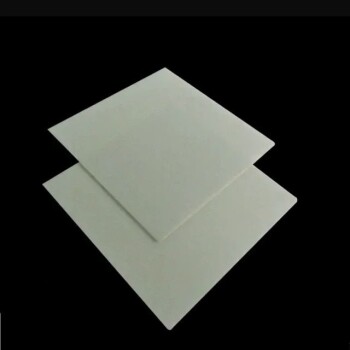
- Precision Machined Silicon Nitride (SiN) Ceramic Sheet for Engineering Advanced Fine Ceramics
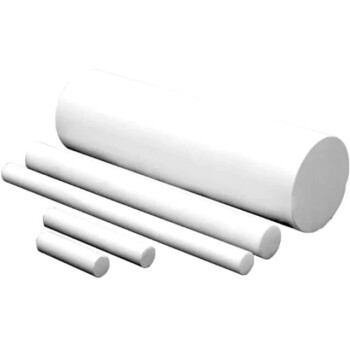
- Boron Nitride (BN) Ceramic Rod for High Temperature Applications
- Conductive Boron Nitride BN Ceramics Composite for Advanced Applications
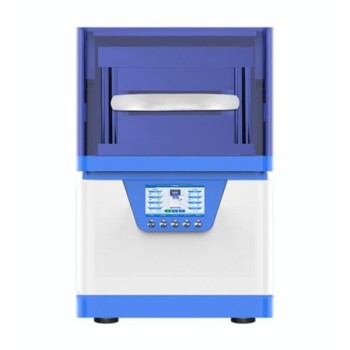
- Automatic Laboratory Heat Press Machine
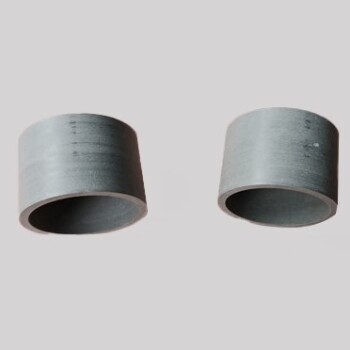
- Advanced Engineering Fine Ceramics Boron Nitride (BN) Ceramic Parts
People Also Ask
- What are the methods of high temperature ceramic? Master the 3-Stage Process for Durable Components
- What are pure silicon sputtering targets? Precision Source for High-Performance Thin Films
- Can silicon be sputtered? A Guide to RF & DC Methods for Thin Film Deposition
- What is the most commonly used in semiconductors? Discover Why Silicon Dominates Modern Electronics
- Which is the most preferred material for manufacturing of a semiconductor? Silicon's Dominance Explained