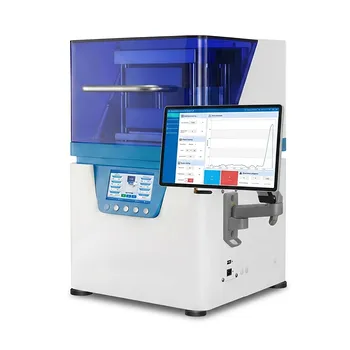
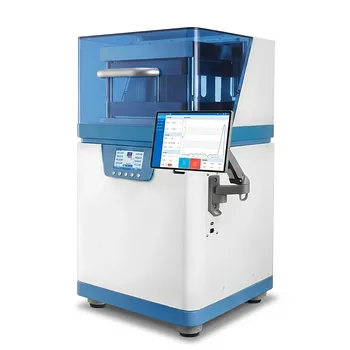
The laboratory hydraulic press is the critical instrument for transforming loose composite powders into stable, high-density green bodies.
By applying controlled axial pressure—ranging from 20 MPa to upwards of 120 MPa—the press compresses mixed powders within a precision mold. This process facilitates particle rearrangement, eliminates trapped air voids, and establishes the initial geometric shape and mechanical integrity required for successful downstream sintering or thermal processing.
The central takeaway: A laboratory hydraulic press provides the foundational density and structural consistency necessary for composite fuel samples to survive further thermal treatment and yield reliable test data.
Mechanisms of Powder Consolidation
Particle Rearrangement and Packing
At the initial stage of pressing, the hydraulic press applies a constant static pressure that forces individual powder particles to slide and rotate. This physical rearrangement leads to tight packing, where particles occupy the empty spaces between one another at room temperature.
Air Expulsion and Void Reduction
High-pressure application is vital for the preliminary expulsion of air trapped between powder particles. By minimizing internal voids and residual air bubbles, the press ensures a dense microstructure that prevents defects during later stages of fuel fabrication.
Mechanical Interlocking
As pressure increases, the close contact between particles promotes mechanical interlocking. This creates a "green body" with sufficient mechanical strength to be handled and removed from the mold without crumbling before it reaches the furnace.
Establishing Physical Integrity
Precise Geometric Standardization
The use of high-precision molds allows the press to form powders into specific shapes, such as cylindrical pellets or thin plates, with uniform thickness. This standardization is critical for ensuring that every sample meets the exact dimensions required for standardized mechanical or chemical analysis.
Density Consistency
A laboratory hydraulic press provides the stable and adjustable tonnage necessary to achieve a uniform density gradient across the entire sample. Consistent density is the primary factor in ensuring that the final composite fuel performs predictably during combustion or radiation testing.
Thermal Molding Capabilities
In some composite applications, the press utilizes precisely controlled heating (reaching temperatures like 190°C) alongside pressure. This thermal molding effectively fuses compounded pellets into specimens with flat surfaces and eliminated internal pores, which is essential for accurate mechanical property testing.
Understanding the Trade-offs
Pressure Gradients and Friction
One of the primary challenges in hydraulic pressing is the friction between the powder and the mold walls. This can lead to internal pressure gradients, resulting in a sample that is denser at the edges than in the center, potentially causing warping during sintering.
Material Over-Compression
Applying excessive pressure can lead to "capping" or laminating, where the sample splits into layers upon release from the mold. This occurs when the elastic recovery of the material exceeds its internal bond strength after the pressure is removed.
The Role of Lubricants
While lubricants can improve particle flow and reduce wall friction, they can also leave behind impurities or residual pores if not properly burned off during the sintering phase. Balancing lubricant volume with the required green body density is a frequent technical hurdle.
Making the Right Choice for Your Goal
How to Apply This to Your Project
- If your primary focus is subsequent sintering: Utilize the press to achieve maximum green body density (e.g., 20 MPa or higher) to provide a robust foundation for recrystallization.
- If your primary focus is mechanical property testing: Prioritize thermal molding to eliminate internal voids and ensure a perfectly flat, uniform surface for accurate data.
- If your primary focus is infrared spectroscopy (IR) or aging tests: Use high-precision molds to create standardized pellets with consistent geometric dimensions and minimal thickness variation.
The laboratory hydraulic press serves as the bridge between raw composite powders and the structurally sound specimens required for advanced fuel research.
Summary Table:
| Feature | Function in Molding | Key Research Benefit |
|---|---|---|
| Static Pressure (20-120 MPa) | Forces particle rearrangement and tight packing | Achieves high-density green bodies |
| Air Expulsion | Minimizes internal voids and trapped air bubbles | Prevents defects during sintering/thermal processing |
| Mechanical Interlocking | Creates structural integrity through particle contact | Ensures samples can be handled without crumbling |
| Thermal Capability | Fuses compounded pellets (up to 190°C) | Eliminates internal pores for mechanical testing |
| Precision Molds | Standardizes shapes (cylinders or plates) | Guarantees consistent dimensions for IR/aging tests |
Elevate Your Fuel Research with KINTEK Precision
Achieving consistent density and structural integrity in composite fuel samples requires more than just pressure—it requires precision engineering. KINTEK specializes in high-performance laboratory equipment designed to bridge the gap between raw powders and test-ready specimens.
Whether you need manual pellet presses, heated hydraulic presses, or isostatic systems, our solutions ensure your green bodies are defect-free and ready for downstream analysis. Beyond pressing, KINTEK offers a full suite of laboratory essentials, including:
- High-Temperature Furnaces: Muffle, vacuum, and atmosphere furnaces for sintering.
- Material Preparation: Crushing, milling systems, and sieving equipment.
- Specialized Reactors: High-temperature high-pressure reactors and autoclaves.
- Consumables: High-quality PTFE products, ceramics, and crucibles.
Ready to optimize your sample preparation workflow? Contact our technical experts today to find the perfect hydraulic press and consumables tailored to your specific research requirements.
References
- Yuqi Li, Yu Zhang. Experimental Investigation on Plume Characteristics of PTFE-Filled Carbon, Graphite, Graphene for Laser-Assisted Pulsed Plasma Thruster. DOI: 10.3390/app13169283
This article is also based on technical information from Kintek Solution Knowledge Base .
Related Products
- Laboratory Hydraulic Press Lab Pellet Press Machine for Glove Box
- Laboratory Hydraulic Press Split Electric Lab Pellet Press
- Fully Automatic Heated Hydraulic Lab Press for Materials Sintering and Sample Preparation
- Automatic Laboratory Hydraulic Press for XRF & KBR Pellet Press
- Laboratory Hydraulic Press Lab Pellet Press for Button Battery
People Also Ask
- How do laboratory hydraulic presses contribute to zero-gap electrolyzers? Optimize Performance & Safety
- Why is a laboratory hydraulic press necessary for ZrO2/Cr2O3 interface analysis? Optimize Sample Density and Accuracy
- How do a precision laboratory hydraulic press and specialized molds contribute to the fabrication of spherical ceramic samples? Achieving High-Density Material Precision
- What is the role of a laboratory hydraulic press in the preparation of rare earth denitrification catalysts?
- How does pressure control of a laboratory hydraulic press affect W-Ti alloys? Optimize Grain Structure & Density