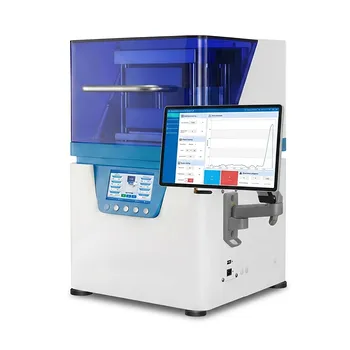
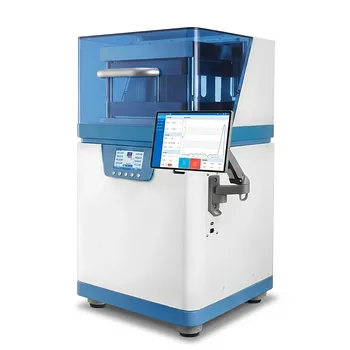
A laboratory hydraulic press is fundamental for optimizing supercapacitor electrodes. It applies precise, uniform pressure to compact active materials, conductive additives, and binders onto a current collector like nickel foam or mesh. This physical compression minimizes interfacial contact resistance and establishes a robust mechanical bond, which is essential for achieving high charge-transfer efficiency and long-term cycling stability.
Core Takeaway: By applying controlled force (typically ranging from 10 to 30 MPa), a hydraulic press transforms a loose slurry coating into a dense, integrated electrode structure. This process ensures the electrical continuity and structural durability required for high-performance energy storage.
The Mechanics of Electrode Compaction
Strengthening Mechanical Adhesion
The primary role of the hydraulic press is to physically embed the active material composite into the pores of the current collector. This mechanical interlocking prevents the active material from delaminating or shedding during electrolyte immersion.
A strong bond ensures that the electrode maintains its structural integrity even under the mechanical stress of ion intercalation. This is particularly vital when using 3D substrates like nickel foam, where material must be forced into the internal scaffold.
Reducing Interfacial Contact Resistance
High-pressure compaction eliminates microscopic gaps between the active material particles and the metal substrate. By creating a seamless transition zone, the press significantly reduces contact resistance at the interface.
Lower resistance facilitates faster electron transmission from the active material to the external circuit. This is a prerequisite for supercapacitors intended for high-power applications where rapid energy release is required.
Performance Improvements in Supercapacitors
Enhanced Rate Performance
By minimizing both electrical resistance and ion transport impedance, the hydraulic press allows the electrode to maintain high capacity at high current densities.
Without proper pressing, the "rate performance" of the device suffers, meaning its storage capacity drops sharply as the charge/discharge speed increases. Compaction ensures the conductive network remains intact throughout the entire electrode volume.
Improved Cycling Stability
Supercapacitors are expected to undergo hundreds of thousands of charge-discharge cycles. The hydraulic press ensures that the conductive additives and binders remain in tight contact with the active materials over time.
This prevents the gradual rise in internal resistance that typically leads to device failure. A well-pressed electrode resists the structural degradation caused by the repeated expansion and contraction of materials during use.
Understanding the Trade-offs
The Risk of Over-Compaction
While high pressure is beneficial, exceeding the optimal limit (often above 30 MPa) can permanently deform or crush the porous structure of the current collector.
If the pores of a nickel foam or mesh are completely collapsed, the electrolyte accessibility is reduced. This limits the "active surface area" available for ion adsorption, which can ironically decrease the overall capacitance.
Impact on Mass Loading
Applying pressure changes the density of the electrode, which must be carefully accounted for when calculating gravimetric and volumetric capacity.
Researchers must find the "sweet spot" where the pressure is high enough to ensure conductivity but low enough to maintain the porosity needed for efficient ion diffusion.
Optimizing the Pressing Process for Your Project
Recommendations for Electrode Fabrication
- If your primary focus is High Power Density: Utilize higher pressures (up to 30 MPa) to minimize resistance and maximize electron transfer rates.
- If your primary focus is Maximum Specific Capacitance: Use moderate pressure (around 10 MPa) to ensure the electrode remains porous enough for full electrolyte penetration.
- If your primary focus is Long-Term Durability: Prioritize a consistent pressing duration to ensure the binder and active materials are fully integrated into the substrate mesh.
The strategic use of a laboratory hydraulic press turns a chemical composite into a high-performance electrode capable of meeting the rigorous demands of modern energy storage.
Summary Table:
| Key Benefit | Mechanism of Action | Impact on Performance |
|---|---|---|
| Mechanical Adhesion | Physically embeds material into current collector pores | Prevents delamination and active material shedding |
| Reduced Resistance | Eliminates microscopic gaps between particles and substrate | Enhances electron transfer for high-power density |
| Structural Density | Compresses slurry into a dense, integrated network | Improves rate performance at high current densities |
| Cycling Stability | Maintains tight contact between additives and binders | Ensures long-term durability and structural integrity |
Advance Your Energy Storage Research with KINTEK's Precision Engineering
At KINTEK, we understand that high-performance supercapacitors and batteries require absolute precision. Our range of laboratory hydraulic presses (pellet, hot, and isostatic) is designed to deliver the controlled, uniform pressure necessary for superior electrode compaction and reduced interfacial resistance.
Beyond compaction, KINTEK offers a comprehensive ecosystem for material science and electrochemical research, including:
- High-Temperature Furnaces: Muffle, tube, vacuum, CVD, and PECVD systems for advanced material synthesis.
- Sample Preparation: Crushing, milling, and sieving equipment for consistent powder quality.
- Specialized Reactors: High-temperature high-pressure reactors and autoclaves.
- Battery Research Tools: Electrolytic cells, electrodes, and essential consumables like PTFE, ceramics, and crucibles.
Don't compromise on your research outcomes. Contact KINTEK today to discuss your specific laboratory requirements and discover how our professional-grade equipment can enhance your lab's efficiency and innovation.
References
- Mingjie Yi, Jiaheng Zhang. Ionic Liquid Meets MOF: A Facile Method to Optimize the Structure of CoSe2‐NiSe2 Heterojunctions with N, P, and F Triple‐Doped Carbon Using Ionic Liquid for Efficient Hydrogen Evolution and Flexible Supercapacitors. DOI: 10.1002/advs.202206029
This article is also based on technical information from Kintek Solution Knowledge Base .
Related Products
- Laboratory Hydraulic Press Lab Pellet Press Machine for Glove Box
- Laboratory Hydraulic Press Split Electric Lab Pellet Press
- Fully Automatic Heated Hydraulic Lab Press for Materials Sintering and Sample Preparation
- Automatic Laboratory Hydraulic Press for XRF & KBR Pellet Press
- Laboratory Hydraulic Press Lab Pellet Press for Button Battery
People Also Ask
- How do laboratory hydraulic presses contribute to zero-gap electrolyzers? Optimize Performance & Safety
- Why is a laboratory hydraulic press necessary for ZrO2/Cr2O3 interface analysis? Optimize Sample Density and Accuracy
- How do a precision laboratory hydraulic press and specialized molds contribute to the fabrication of spherical ceramic samples? Achieving High-Density Material Precision
- What is the role of a laboratory hydraulic press in the preparation of rare earth denitrification catalysts?
- How does pressure control of a laboratory hydraulic press affect W-Ti alloys? Optimize Grain Structure & Density