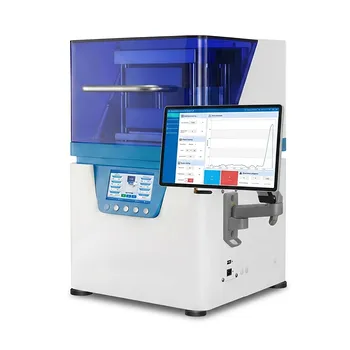
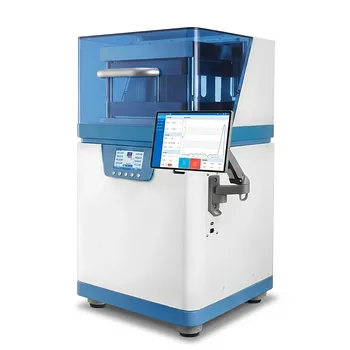
Precision compaction is the cornerstone of powder metallurgy. A laboratory hydraulic press ensures the quality of Magnesium-based green compacts by applying controlled unidirectional pressure to induce plastic deformation and particle rearrangement within a mold. This process effectively excludes trapped air and reduces internal stress, creating a cohesive "green" body with the precise density and structural integrity required to survive high-temperature sintering without cracking or warping.
The laboratory hydraulic press serves as the critical bridge between loose powder and a solid component by providing the mechanical force necessary to eliminate porosity and establish strong interfacial contact between magnesium particles and reinforcements.
The Mechanics of Particle Transformation
Inducing Plastic Deformation and Rearrangement
The press applies a specific axial load—often ranging from 45 MPa to 450 MPa—to force dry mixed powders into the geometry of a precision mold.
This high-pressure environment causes magnesium particles to overcome internal friction, leading to displacement rearrangement and significant plastic flow.
As particles deform, they interlock mechanically, providing the green strength necessary for the compact to be handled without crumbling.
Eliminating Micron-Scale Porosity
High-pressure compaction is essential for magnesium composites to exclude air and eliminate micron-scale pores between particles.
By maximizing the surface contact area, the press creates a dense physical foundation that facilitates atomic diffusion during the subsequent sintering stage.
For composites utilizing low-density additives like Carbon Nanotubes (CNTs) or Graphene Nanoplatelets (GNPs), this step is vital to prevent delamination and ensure the reinforcement is properly embedded in the matrix.
Ensuring Structural Uniformity
Reducing Internal Density Gradients
Advanced laboratory presses utilize closed-loop pressure control and specialized techniques like double-sided pressing to ensure pressure is distributed evenly.
Uniform pressure distribution reduces density gradients, which are the primary cause of uneven shrinkage or "hour-glassing" during sintering.
Consistency in the internal density of the green compact ensures that the final component maintains its intended dimensions and reaches its theoretical density limit.
Managing Internal Stress and Air Exclusion
The press maintains a specific "hold time" under high pressure to allow the powder bed to stabilize and for internal stresses to dissipate.
This controlled maintenance of pressure prevents the formation of micro-cracks that can expand into structural failures when the material is heated.
Effective air exclusion during this phase is critical, as trapped gases can expand during sintering, leading to surface bloating or internal voids.
Understanding the Trade-offs
The Friction Limitation
Even with high-precision equipment, wall friction between the powder and the mold can lead to pressure losses. This often results in the top of the compact being denser than the bottom unless double-sided pressing or specialized lubricants are used.
Pressure vs. Tooling Wear
While higher pressures (up to 450 MPa) significantly enhance density and interfacial bonding, they also accelerate the wear and tear on high-strength alloy steel molds. Excessive pressure can occasionally lead to "spring-back" effects, where the compact expands slightly upon release, potentially causing hairline fractures.
How to Optimize Your Compaction Process
Making the Right Choice for Your Goal
- If your primary focus is maximizing final density: Utilize high-pressure settings (400+ MPa) and extended hold times to eliminate as much micro-porosity as possible before sintering.
- If your primary focus is structural uniformity in tall parts: Implement double-sided pressing techniques to minimize the density gradients caused by axial friction.
- If your primary focus is processing CNT or GNP reinforcements: Use high-precision closed-loop control to apply pressure gradually, preventing delamination or uneven stress distribution in the low-density additive zones.
- If your primary focus is high-volume consistency: Standardize your compaction parameters to calculate the Carr index and Hausner ratio, ensuring your powder flowability remains within tolerance.
The laboratory hydraulic press is not merely a tool for shaping; it is a precision instrument that dictates the final mechanical properties of magnesium composites by establishing a flawless internal microstructure.
Summary Table:
| Key Mechanism | Technical Action | Impact on Final Composite |
|---|---|---|
| Plastic Deformation | Particle rearrangement (45-450 MPa) | Increases green strength and handleability |
| Porosity Elimination | Exclusion of trapped air/gases | Prevents surface bloating and internal voids |
| Pressure Control | Uniform axial load distribution | Reduces density gradients and warping |
| Stabilized Hold Time | Internal stress dissipation | Prevents micro-cracks during sintering |
Elevate Your Material Research with KINTEK Precision
Achieving the theoretical density limit in magnesium-based composites requires more than just force—it requires precision. KINTEK specializes in high-performance laboratory equipment designed to bridge the gap between raw powder and structural perfection.
Whether you need advanced hydraulic presses (pellet, hot, or isostatic) for flawless compaction, or high-temperature furnaces (muffle, vacuum, or atmosphere) for critical sintering stages, our solutions are engineered for researchers who cannot compromise on quality. We also offer a full suite of crushing and milling systems, PTFE products, and crucibles to support your entire workflow.
Ready to optimize your powder metallurgy process? Contact our technical experts today to discover how KINTEK’s comprehensive range of lab tools and consumables can enhance your research outcomes.
References
- Zhou Yan, Youwen Yang. Biodegradation and Cell Behavior of a Mg-Based Composite with Mesoporous Bioglass. DOI: 10.3390/ma16186248
This article is also based on technical information from Kintek Solution Knowledge Base .
Related Products
- Laboratory Hydraulic Press Lab Pellet Press Machine for Glove Box
- Laboratory Hydraulic Press Split Electric Lab Pellet Press
- Fully Automatic Heated Hydraulic Lab Press for Materials Sintering and Sample Preparation
- Laboratory Hydraulic Press Lab Pellet Press for Button Battery
- Automatic Laboratory Hydraulic Press for XRF & KBR Pellet Press
People Also Ask
- What is the function of a laboratory hydraulic press in W-Cu composites? Control Porosity and Material Ratio
- What is the role of a laboratory hydraulic press in the initial stages of Li6PS5Cl preparation? Key to Green Pellets
- What role does a laboratory hydraulic press play in triboelectric testing? Achieve Precision Alloy Sample Prep
- How can a laboratory hydraulic press be applied to chitosan for wastewater treatment? Optimize Pores & Strength
- How do a precision laboratory hydraulic press and specialized molds contribute to the fabrication of spherical ceramic samples? Achieving High-Density Material Precision