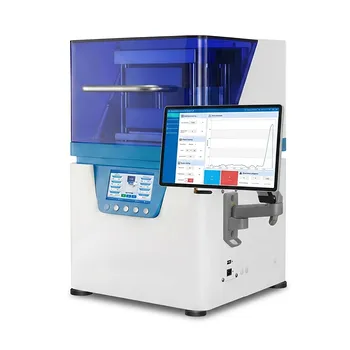
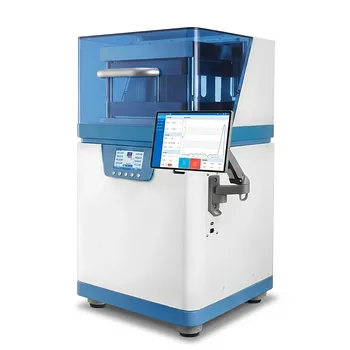
The laboratory hydraulic press serves as the critical bridge between loose copper powders and a structurally sound "green compact."
By applying precise axial pressure—often ranging from 60 MPa to 120 MPa—the press forces copper microspheres or powders into a mold to induce mechanical interlocking and thermoplastic deformation. This process establishes the initial geometric shape, density, and structural integrity required for subsequent sintering or high-temperature thermal processing.
The core function of the hydraulic press and its molds is to transform loose particles into a standardized, high-density sample by maximizing particle contact area and reducing internal voids. This "pre-pressing" stage is essential for ensuring predictable sintering kinetics and high-quality bonding in the final porous material.
The Mechanics of Structural Foundation
Creating the "Green Compact"
The primary role of the hydraulic press is to produce a green compact, which is a compressed powder block with sufficient mechanical strength to be handled. This is achieved by applying controlled force that causes the copper particles to rearrange and physically interlock.
Inducing Thermoplastic Deformation
In some applications, moderate heating is applied alongside pressure to facilitate thermoplastic deformation between copper microspheres. This specialized compaction method creates mechanical bonds that are more robust than simple physical stacking, preparing the material for advanced sintering studies.
Managing Air Expulsion and Voids
High-pressure compaction effectively reduces the voids between powder particles and assists in the preliminary expulsion of trapped air. Reducing these internal gaps is vital for achieving a uniform density and preventing defects during subsequent vacuum hot pressing or sintering.
Precision Molding and Geometric Control
Establishing Standardized Dimensions
Associated precision molds, typically ranging from 6.5 mm to 15 mm in diameter, define the final geometric shape of the sample. These molds ensure that every pellet produced is identical in thickness and diameter, which is a prerequisite for accurate data collection in kinetic studies.
Defining Initial Porosity
The mold and press combination allows researchers to calibrate the initial porosity of the copper structure. By adjusting the applied tonnage or pressure duration (e.g., 3 tons for 4 minutes), technicians can dictate the starting density before the material undergoes secondary densification.
Facilitating Multi-Layered Structures
For complex materials like Cu-Y composites, the press enables the creation of layered structures by pre-pressing individual powder layers at lower pressures (around 60 MPa). This ensures high-quality bonding at the interlayer interface, preventing delamination during the final production stages.
Understanding the Trade-offs
Compaction Force vs. Final Porosity
There is a critical balance between applying enough pressure to ensure structural integrity and maintaining the desired porous characteristics. Excessive pressure can over-compact the copper, eliminating the interconnected pores that define the material's functional performance.
Internal Stress and Springback
Rapidly releasing pressure from the mold can lead to internal stresses or "springback," where the copper compact slightly expands. If not managed through controlled decompression or proper lubricant use, this can result in micro-cracks that compromise the structural foundation.
Interface Area vs. Reaction Kinetics
While increasing the phase interface area via high pressure accelerates reaction kinetics, it can also cause premature reactions in sensitive chemical mixtures. Researchers must precisely calibrate the pressure to ensure thermodynamic equilibrium is reached at the intended experimental stage.
How to Apply This to Your Project
Recommendations Based on Project Goals
- If your primary focus is studying sintering kinetics: Use a standardized 12 mm mold and apply exactly 100 MPa to ensure consistency across all test samples.
- If your primary focus is high-porosity filtration: Opt for lower compaction pressures (approx. 60 MPa) and shorter hold times to prevent excessive particle deformation.
- If your primary focus is layered composite bonding: Utilize a multi-stage pre-pressing technique to establish a strong mechanical bond between the copper base and the composite top layer before sintering.
A laboratory hydraulic press is not merely a shaping tool, but a precision instrument that dictates the mechanical and structural potential of the final porous copper component.
Summary Table:
| Key Function | Role in Porous Copper Molding | Typical Parameters/Results |
|---|---|---|
| Green Compact Creation | Establishes mechanical strength for handling | 60 MPa - 120 MPa pressure |
| Geometric Control | Defines precise shape and standardized dimensions | 6.5 mm to 15 mm mold sizes |
| Porosity Calibration | Dictates initial density and interconnected voids | Pressure hold time (e.g., 4 mins) |
| Layered Bonding | Ensures interface integrity in composite materials | Multi-stage pre-pressing |
| Deformation Control | Facilitates particle interlocking and air expulsion | Reduces internal defects |
Elevate Your Material Research with KINTEK Precision
Ready to achieve perfect sintering kinetics and structural integrity for your porous copper projects? KINTEK specializes in high-performance laboratory equipment designed for precision. Our range includes:
- Advanced Hydraulic Presses: Pellet, hot, and isostatic presses for consistent green compact density.
- Thermal Processing: High-temperature muffle, vacuum, and atmosphere furnaces for superior sintering.
- Support Systems: Precision crushing and milling systems, alongside essential consumables like PTFE, ceramics, and crucibles.
Whether you are developing high-porosity filtration or layered composites, KINTEK provides the reliable tools and expert support to optimize your workflow. Contact us today to find the perfect equipment for your lab!
References
- Braden Jones, Mark A. Atwater. Hybrid Pore Formation in Copper Spheres by Gas Entrapment and Oxide Reduction. DOI: 10.1002/adem.202301198
This article is also based on technical information from Kintek Solution Knowledge Base .
Related Products
- Laboratory Hydraulic Press Split Electric Lab Pellet Press
- Laboratory Hydraulic Press Lab Pellet Press Machine for Glove Box
- Laboratory Hydraulic Press Lab Pellet Press for Button Battery
- Automatic Laboratory Hydraulic Pellet Press Machine for Lab Use
- Fully Automatic Heated Hydraulic Lab Press for Materials Sintering and Sample Preparation
People Also Ask
- What is the purpose of using a laboratory hydraulic press for polyricinoleate films? Ensure Precision Density
- Why Use a Laboratory Hydraulic Press for Catalyst Pelletization? Optimize OCM Research & Data Accuracy
- What role does a laboratory hydraulic press play in foam glass research? Achieve Precise Green Body Standardization
- What are the specific applications of a lab hydraulic press in biochar evaluation? Optimize density and data accuracy.
- How does a laboratory hydraulic press contribute to Fe-Cu-Ni-Sn-VN green bodies? Master High-Density Compaction