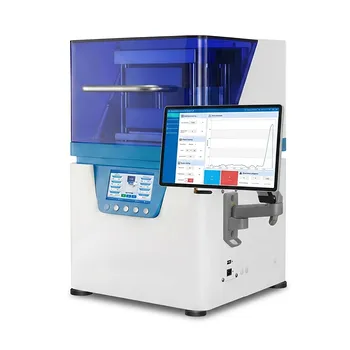
The laboratory hydraulic press acts as the mechanical catalyst for atomic interaction in material science. It applies controlled compressive force—often in the range of 5 MPa—to transform loose powder mixtures into a singular, dense solid block. This process is the critical first step in ensuring that iron particles are forced into direct, intimate contact with the diamond surface.
The core function of the hydraulic press is to eliminate microscopic voids and establish a continuous physical interface between iron and diamond. This intimate contact is the mandatory prerequisite for atomic cross-interface diffusion during the high-temperature annealing phase.
The Mechanics of Interfacial Contact
Eliminating Voids and Porosity
At the microscopic level, loose powders contain significant air gaps and "voids" that prevent uniform contact. The hydraulic press uses precise pressure to collapse these gaps, packing the iron particles tightly against the diamond’s crystalline lattice.
Without this initial compression, the lack of physical pathways would prevent atoms from moving between materials. By creating a dense "green body," the press ensures the materials are positioned for a successful reaction.
Facilitating Atomic Diffusion
The ultimate goal of diamond-iron experiments is often to study how atoms move across the interface at high temperatures. The press creates the "physical bridge" necessary for this process to occur.
When the sample is later heated, the lack of space between the iron and diamond allows carbon and iron atoms to interact immediately. This cross-interface diffusion is what eventually leads to chemical bonding or phase changes.
Pressure Requirements and Material Stability
Precision Control and Consistency
Modern laboratory presses allow for highly specific pressure settings, which is vital for reproducibility. For diamond-iron mixtures, maintaining a consistent 5 MPa ensures that every sample has the same density and contact area.
This precision prevents variations in the experiment that could lead to inconsistent diffusion data. The ability to control the direction and speed of the ram helps maintain the integrity of the powder mixture.
Pre-tightening for Thermal Processing
In some advanced setups, the hydraulic press is used to apply "pre-tightening" pressure to mechanical fixtures. This ensures that the diamond and metal layers remain under constant tension before they even enter the furnace.
By tightening fixture bolts while under hydraulic load, researchers can maintain microscopic contact throughout the entire heating cycle. This prevents the materials from shifting or separating as they expand due to heat.
Understanding the Trade-offs and Limitations
The Risk of Diamond Fracture
While high pressure is necessary for contact, excessive force can lead to the structural failure of the diamond particles. Diamond is exceptionally hard but brittle; exceeding the material's compressive limits can cause micro-cracking.
Researchers must balance the need for "intimate contact" with the physical limits of the diamond grade being used. Finding the "sweet spot" of pressure is essential for maintaining the diamond's original crystal structure.
Pressure Non-Uniformity
In simple die-and-plunger setups, pressure may not be distributed perfectly throughout the sample. This can result in "density gradients," where the center of the pellet is more compressed than the edges.
Non-uniform compression leads to uneven reaction zones during annealing. To mitigate this, many researchers use specialized lubricants or floating die systems to ensure the iron-diamond contact is consistent across the entire interface.
Applying This Technology to Your Research Goals
How to Optimize Your Pressing Process
The effectiveness of your diamond-iron reaction depends on selecting the right pressing parameters for your specific material composition.
- If your primary focus is Maximum Bond Strength: Prioritize higher pre-tightening pressures (up to 15 MPa) within mechanical fixtures to ensure the tightest possible atomic proximity before heating.
- If your primary focus is Analytical Precision (XRF/XRD): Focus on the consistency of the pellet density by using a press with automated pressure hold functions to eliminate internal voids.
- If your primary focus is High-Pressure Synthesis (HPHT): Utilize hydraulic systems capable of gigapascal (GPa) ranges to simulate the extreme environments required for carbon phase transitions.
The laboratory hydraulic press is the indispensable bridge that moves an experiment from a mere mixture of powders to a unified reactive system.
Summary Table:
| Feature/Process | Mechanism of Action | Experimental Benefit |
|---|---|---|
| Void Elimination | Collapses air gaps between loose powders | Creates a continuous physical interface |
| Atomic Diffusion | Establishes a "physical bridge" for atoms | Enables chemical bonding during annealing |
| Pressure Control | Precision application (e.g., 5 MPa) | Ensures sample reproducibility and density |
| Pre-tightening | Maintains constant tension on fixtures | Prevents material shifting during heating |
| Fracture Management | Balanced load application | Protects brittle diamond crystal structures |
Elevate Your Material Research with KINTEK Precision
Success in diamond-iron reactions and high-pressure synthesis starts with flawless sample preparation. KINTEK specializes in high-performance laboratory equipment designed to meet the rigorous demands of material science.
Whether you require manual, automated, or isostatic hydraulic presses to create perfect "green bodies," or high-temperature furnaces (muffle, vacuum, or CVD) for the annealing phase, KINTEK provides the reliability your research deserves. Our portfolio also features essential consumables, including PTFE products, ceramics, and crucibles, ensuring a seamless workflow from preparation to analysis.
Ready to optimize your lab’s efficiency and experimental accuracy?
Contact KINTEK Today to Consult with Our Experts
References
- Yalun Ku, Chongxin Shan. Revealing the atomic mechanism of diamond–iron interfacial reaction. DOI: 10.1002/cey2.440
This article is also based on technical information from Kintek Solution Knowledge Base .
Related Products
- Laboratory Hydraulic Press Lab Pellet Press Machine for Glove Box
- Laboratory Hydraulic Press Split Electric Lab Pellet Press
- Fully Automatic Heated Hydraulic Lab Press for Materials Sintering and Sample Preparation
- Laboratory Hydraulic Press Lab Pellet Press for Button Battery
- Automatic Laboratory Hydraulic Press for XRF & KBR Pellet Press
People Also Ask
- How do laboratory hydraulic presses contribute to zero-gap electrolyzers? Optimize Performance & Safety
- Why is a laboratory hydraulic press necessary for ZrO2/Cr2O3 interface analysis? Optimize Sample Density and Accuracy
- How do a precision laboratory hydraulic press and specialized molds contribute to the fabrication of spherical ceramic samples? Achieving High-Density Material Precision
- What is the role of a laboratory hydraulic press in the preparation of rare earth denitrification catalysts?
- How does pressure control of a laboratory hydraulic press affect W-Ti alloys? Optimize Grain Structure & Density