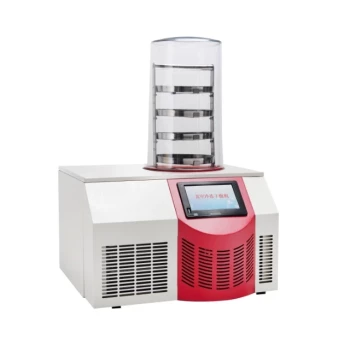
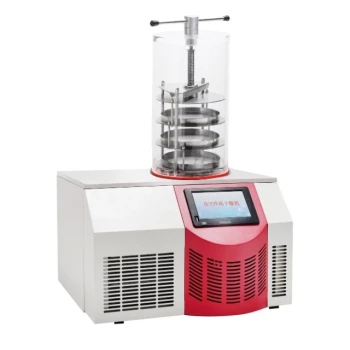
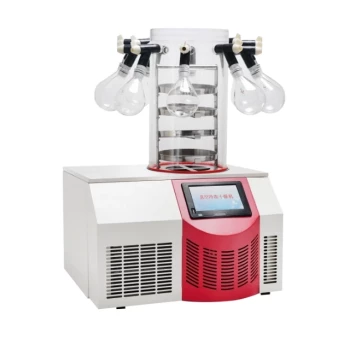
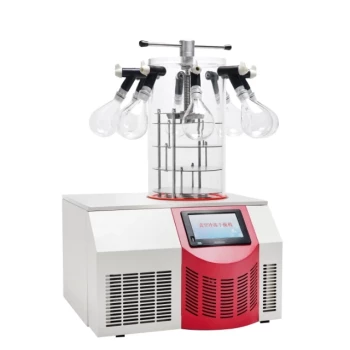
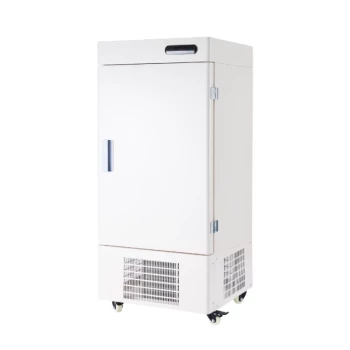
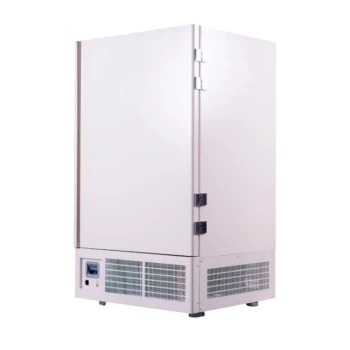
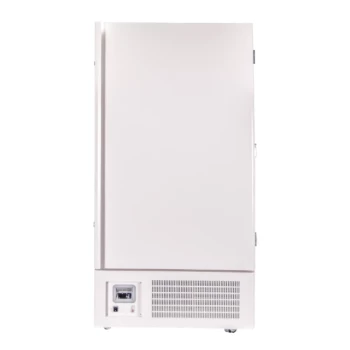
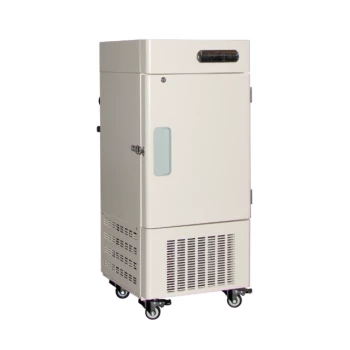
A laboratory precision vacuum freeze dryer prevents structural collapse by utilizing the principle of sublimation to remove solvents from the MXene framework. Instead of allowing the solvent to evaporate as a liquid, which generates destructive surface tension, the machine transitions the frozen solvent directly from a solid state into a gas under a vacuum.
Core Takeaway By bypassing the liquid phase entirely, freeze drying eliminates the capillary pressure that causes interlayer shrinkage in conventional drying methods. This process is the only reliable way to preserve the intricate, high-porosity 3D network essential for MXene aerogels to function as lightweight electromagnetic loss materials.
The Physics of Structural Collapse
The Enemy: Liquid Surface Tension
In conventional drying methods, solvents are removed via evaporation. As the liquid leaves the material, surface tension creates strong capillary forces between the nanomaterial layers.
These forces pull the internal structures together, causing interlayer shrinkage. For a delicate material like an MXene aerogel, this results in the total collapse of the internal framework and a significant loss of porosity.
The Solution: Sublimation
The freeze dryer solves this by fundamentally changing the phase transition of the solvent. Rather than going from Liquid $\to$ Gas, the vacuum environment forces the solvent to go from Solid $\to$ Gas.
Because the solvent never becomes liquid during removal, surface tension is effectively zero. The destructive forces that would typically crush the aerogel are removed from the equation.
How the Process Protects Architecture
Locking the Structure via Rapid Freezing
The process begins before the vacuum is applied. The hybrid MXene suspension is rapidly frozen.
This step "locks" the solid structure in place. The ice crystals act as a temporary scaffold, holding the MXene sheets in their intended 3D configuration.
Eliminating Capillary Pressure
Once frozen and placed under vacuum, the ice sublimates directly into water vapor. Since there is no liquid interface moving through the pores, there is no capillary pressure.
This ensures the microporous structure remains intact. The result is a material that retains its intended low density and an extremely high specific surface area.
Understanding the Trade-offs
Density vs. Structural Integrity
The primary trade-off in aerogel fabrication is between density and structural stability. Conventional drying produces a denser, collapsed material which may be mechanically stronger but lacks the desired aerogel properties.
The Necessity of Precision
Freeze drying is not a passive process; it requires precise vacuum control. If the vacuum pressure is not maintained correctly, the ice may melt back into liquid before sublimating.
If this reversion to liquid occurs, even momentarily, capillary forces will return, and the delicate MXene framework will collapse.
Making the Right Choice for Your Goal
To maximize the performance of your MXene aerogels, align your drying strategy with your end-use requirements:
- If your primary focus is Electromagnetic Performance: Utilize vacuum freeze drying to maximize specific surface area, which is critical for lightweight electromagnetic loss applications.
- If your primary focus is Ultra-Low Density: Ensure your process includes a rapid freezing stage to lock the suspension structure before sublimation to prevent micropore collapse.
By controlling the state of the solvent, you ultimately control the architecture of the solid.
Summary Table:
| Feature | Conventional Drying | Vacuum Freeze Drying |
|---|---|---|
| Phase Transition | Liquid to Gas (Evaporation) | Solid to Gas (Sublimation) |
| Internal Forces | High Capillary Pressure | Negligible Surface Tension |
| Structural Result | Interlayer Shrinkage & Collapse | Preserved 3D Porous Network |
| Density | High (Dense/Compact) | Ultra-Low (Lightweight) |
| Key Application | Basic Bulk Materials | Electromagnetic Loss Materials |
Elevate Your Material Science with KINTEK Precision
Preserving the delicate architecture of MXene aerogels requires more than just equipment—it requires absolute precision. KINTEK specializes in high-performance laboratory equipment, providing the advanced vacuum freeze dryers and cooling solutions (ULT freezers and cold traps) necessary to eliminate structural collapse and maximize surface area.
Whether you are developing lightweight electromagnetic materials or high-porosity scaffolds, our team is ready to support your research with industry-leading reliability. Explore our full range of high-temperature furnaces, crushing systems, and advanced battery research tools designed for the most demanding lab environments.
Ready to optimize your aerogel fabrication? Contact KINTEK today for a consultation and secure the structural integrity of your next breakthrough!
References
- Vineeta Shukla. The tunable electric and magnetic properties of 2D MXenes and their potential applications. DOI: 10.1039/d0ma00548g
This article is also based on technical information from Kintek Solution Knowledge Base .
Related Products
- Benchtop Laboratory Vacuum Freeze Dryer
- High Performance Laboratory Freeze Dryer for Research and Development
- High Performance Laboratory Freeze Dryer
- Benchtop Laboratory Freeze Dryer for Lab Use
- 56L Vertical Laboratory Vacuum Drying Oven
People Also Ask
- What are the technical advantages of using a laboratory freeze dryer for porous carbon precursors? Preserve 3D Networks
- How do laboratory freeze dryers support scientific research? Preserve Sample Integrity for Reproducible Results
- Why is a laboratory freeze dryer preferred over traditional heating? Preserve Biochar Structure & Maximize Porosity
- What types of liquid samples can be processed using a laboratory freeze dryer? Preserve Your Sensitive Materials
- What role do laboratory freeze dryers play in the food industry? Unlock Superior Food Preservation