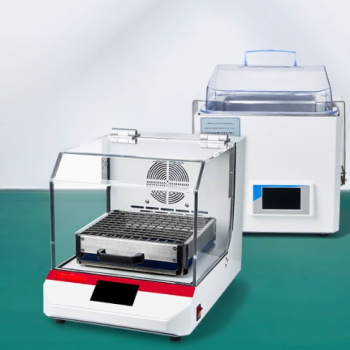
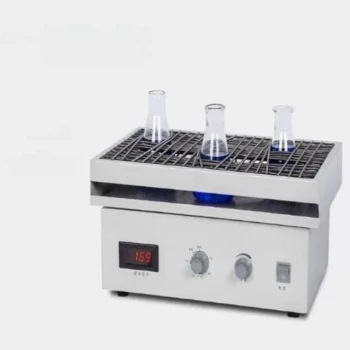
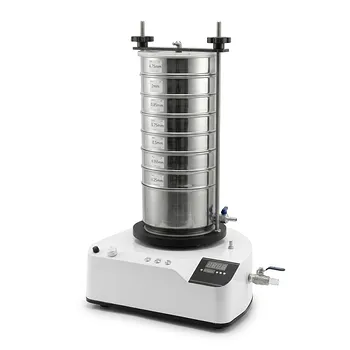
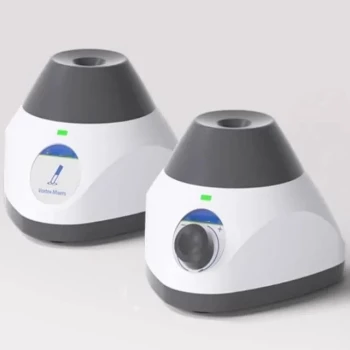
A laboratory shaker functions as the primary mechanism for standardization in niobium adsorption research, providing the constant mechanical power necessary to maintain uniform interaction between anion exchange resins and niobium-bearing chloride solutions. By ensuring continuous agitation, the shaker prevents particle settling and creates a homogeneous mixture, which is a prerequisite for reliable kinetic data.
Core Takeaway The laboratory shaker is not merely a mixing device; it is a tool for eliminating external mass transfer resistance. By neutralizing local concentration gradients and breaking down liquid film resistance, it ensures that measured data reflects the true chemical kinetics of the resin rather than physical diffusion limitations.
The Mechanics of Efficient Adsorption
Ensuring Continuous Contact
In static adsorption experiments, the natural tendency of solid resin particles is to settle, separating them from the niobium ions in the solution.
A laboratory shaker creates a dynamic environment where the solid adsorbent and the aqueous solution remain in full, continuous contact. This constant suspension is vital for exposing the maximum surface area of the resin to the niobium-bearing solution throughout the entire experiment.
Driving Interior Diffusion
Adsorption is not limited to the outer shell of the resin; niobium ions must penetrate the particle.
The mechanical power provided by the shaker facilitates the efficient diffusion of ions from the bulk liquid phase to the interior of the resin particles. This deep penetration is essential for utilizing the full capacity of the anion exchange resin.
Overcoming Diffusion Barriers
Eliminating Concentration Gradients
Without adequate mixing, "dead zones" can form where the concentration of niobium is locally depleted near the resin surface.
The uniform mixing provided by the shaker creates a homogeneous solution, effectively eliminating local concentration gradients. This ensures that the concentration of niobium contacting the resin remains consistent with the bulk solution, preventing skewed results.
Reducing Film Resistance
Surrounding every resin particle is a stagnant layer of liquid known as the "liquid film," which acts as a barrier to ion transfer.
Continuous mechanical agitation reduces the thickness of this film, thereby minimizing external mass transfer resistance. By thinning this layer, the shaker ensures that the rate-limiting step of the experiment is the actual adsorption process, not the physical movement of ions through the liquid.
Enabling Precise Data Analysis
Accurate Equilibrium Determination
To understand how an adsorbent performs, researchers must determine exactly how long it takes to reach maximum saturation.
By removing physical barriers to diffusion, the shaker allows for the accurate determination of the time required to reach adsorption equilibrium. This precision is critical for calculating the distribution coefficient and understanding the material's efficiency.
Validating Kinetic Models
Research relies on mathematical models, such as pseudo-second-order or Sips isotherm models, to predict scaling and performance.
Data collected under proper agitation reflects the true interaction between the niobium and the resin. This allows researchers to calculate the material's maximum theoretical adsorption capacity with confidence, knowing the data is not corrupted by poor mixing.
Common Pitfalls to Avoid
Inconsistent Mechanical Power
The reliability of kinetic data is directly tied to the stability of the mechanical power applied.
If the shaker speed fluctuates or is set too low, the resin may not be fully suspended, leading to false equilibrium values. The data will suggest the reaction is complete when, in reality, the reagents simply lacked sufficient contact.
Ignoring Hydrodynamic Shear
While the references emphasize the need for "thorough contact," it is important to note that agitation must be optimized for the specific resin type.
Standard speeds (e.g., 120 rev/min as noted in comparative studies) are generally effective, but the goal is to achieve suspension without causing physical attrition to the resin particles, which could alter the surface area and skew results.
Making the Right Choice for Your Goal
To ensure your niobium adsorption data is defensible and reproducible, align your equipment settings with your specific research objectives:
- If your primary focus is Kinetics Modeling: Ensure the shaker speed is high enough to completely eliminate film resistance, allowing you to fit data accurately to pseudo-second-order models.
- If your primary focus is Capacity Determination: Maintain constant, moderate power over long durations to ensure diffusion reaches the deep interior of the resin particles for a true maximum capacity reading.
Ultimately, the laboratory shaker transforms a heterogeneous mixture into a controlled system, ensuring your data measures chemical capability rather than physical limitations.
Summary Table:
| Feature | Impact on Niobium Research | Benefit to Kinetic Data |
|---|---|---|
| Continuous Agitation | Prevents resin particle settling | Ensures maximum surface area exposure |
| Homogeneous Mixing | Eliminates local concentration gradients | Prevents skewed results from 'dead zones' |
| Film Reduction | Minimizes external mass transfer resistance | Ensures measured rate reflects true chemical kinetics |
| Mechanical Power | Drives ion diffusion into resin interior | Accurate determination of maximum capacity |
Elevate Your Adsorption Research with KINTEK Precision
Precise kinetic modeling requires equipment that delivers consistent, reliable mechanical power. At KINTEK, we specialize in high-performance laboratory shakers, homogenizers, and crushing systems designed to eliminate physical diffusion barriers and ensure your data reflects true chemical performance.
Whether you are focusing on niobium adsorption, battery research, or material synthesis, our comprehensive range of laboratory equipment—including high-temperature furnaces, hydraulic presses, and specialized reactors—provides the control you need for reproducible results.
Ready to optimize your lab's efficiency? Contact KINTEK Today to Find Your Solution
References
- Almagul Ultarakova, Arailym Mukangaliyeva. Studies of Niobium Sorption from Chloride Solutions with the Use of Anion-Exchange Resins. DOI: 10.3390/pr11041288
This article is also based on technical information from Kintek Solution Knowledge Base .
Related Products
- Shaking Incubators for Diverse Laboratory Applications
- Laboratory Multifunctional Small Speed-Adjustable Horizontal Mechanical Shaker for Lab
- Laboratory Oscillating Orbital Shaker
- Laboratory Vibratory Sieve Shaker Machine for Dry and Wet Three-Dimensional Sieving
- Laboratory Vortex Mixer Orbital Shaker Multifunctional Rotation Oscillation Mixer
People Also Ask
- What physical conditions does a shaking incubator provide for bioethanol fermentation? Optimize Yeast Productivity
- Why is the mechanical agitation provided by a shaking incubator necessary for the enzymatic hydrolysis of biomass?
- What critical reaction conditions does a shaking incubator provide? Optimize Cassava Cellulose Enzymatic Hydrolysis
- What are the primary functions of a shaking incubator? Optimize Biomass Fenton Pretreatment Efficiency
- What function does a laboratory shaking incubator serve for halophilic archaea? Optimize Your Seed Cultivation Today