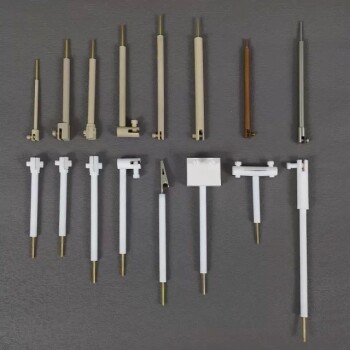
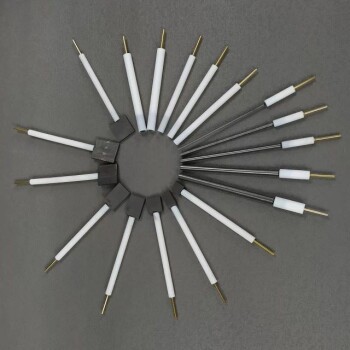
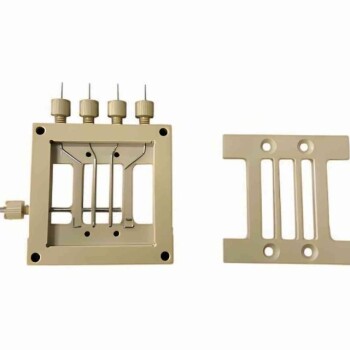
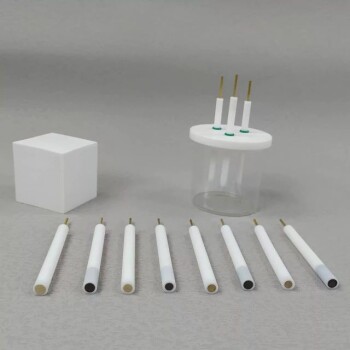
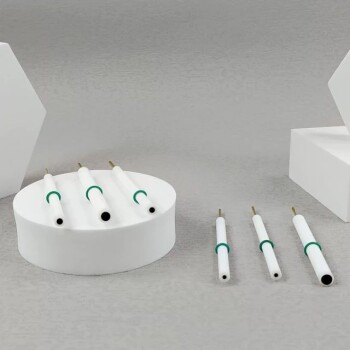
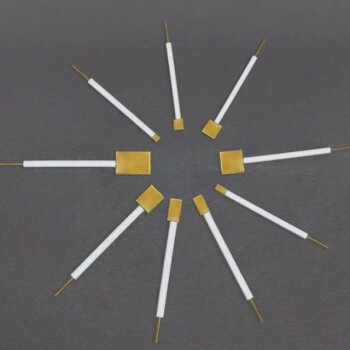
A single-granule electrochemical fixture isolates specific particles to measure their electrochemical behavior independent of the surrounding bed. By utilizing a precision-clamping structure to hold individual granules against a simulated current collector, this tool allows researchers to pinpoint performance variations that are typically averaged out in bulk measurements.
Core Takeaway Bulk measurements often mask specific inefficiencies within a fixed bed reactor. By treating individual granules as distinct electrodes, this fixture reveals critical spatial differences in redox potential and current density, exposing the specific locations where bed performance may be degrading.
The Mechanics of Single-Granule Isolation
Precision Clamping Structure
To analyze a single particle effectively, mechanical stability is required. The fixture employs a precision-clamping structure designed to hold a solitary graphite granule securely in place.
Simulating the Current Collector
The clamping mechanism presses the granule against a platinum plate contact. This plate serves as a mimic for the reactor's actual current collector connection, ensuring the electrical interface simulates real-world conditions.
Independent Cyclic Voltammetry
Once isolated, the granule is subjected to cyclic voltammetry (CV) scans. Because the granule is electrically isolated from the rest of the bed, the resulting data represents the pure electrochemical signature of that specific particle.
Methodology for Mapping Bed Performance
Spatial Harvesting
To understand the bed as a whole, researchers must sample its parts. Granules are harvested from different locations within the fixed bed, allowing for a comparative analysis based on spatial positioning.
Identifying Redox Potential
The CV scans pinpoint the specific redox potential of each granule. This metric identifies the precise voltage at which the desired chemical reactions are occurring for that specific particle.
Measuring Current Density
The fixture determines the maximum current density the individual granule can support. This data point is critical for understanding the peak reaction rate capabilities at the particle level.
Understanding the Trade-offs
The Constraint of Ex-Situ Analysis
This method requires granules to be removed from the bed. Therefore, the analysis is inherently a "snapshot" of the granule's state after operation, rather than a real-time monitor of the active process.
Statistical Representation
Because the fixture analyzes one granule at a time, mapping a large bed is labor-intensive. Researchers must test a sufficient number of granules to differentiate between anomalies and true systemic heterogeneity.
Making the Right Choice for Your Goal
To maximize the value of this analysis, align your testing strategy with your specific engineering objectives:
- If your primary focus is failure analysis: Use the fixture to compare granules from low-activity zones against fresh granules to identify degradation mechanisms.
- If your primary focus is reactor design: Use the maximum current density data to determine if your current collector design matches the electrochemical potential of the packing material.
By shifting focus from the whole bed to the single granule, you transform vague performance issues into solvable, location-specific engineering challenges.
Summary Table:
| Feature | Single-Granule Analysis Detail |
|---|---|
| Core Mechanism | Precision-clamping against a platinum plate contact |
| Key Measurements | Redox potential and maximum current density via CV scans |
| Primary Benefit | Identifies spatial performance variations masked by bulk testing |
| Application | Failure analysis, reactor design optimization, and degradation mapping |
| Data Type | Ex-situ "snapshot" of individual particle electrochemical behavior |
Elevate Your Electrochemical Research with KINTEK
Don't let bulk measurements hide critical inefficiencies in your reactor design. KINTEK specializes in precision laboratory equipment and consumables designed to provide the granular data you need for a competitive edge.
Whether you are performing failure analysis on fixed beds or developing next-generation energy storage, our comprehensive portfolio—including electrolytic cells, electrodes, battery research tools, and high-temperature reactors—is engineered for accuracy and durability.
Ready to transform your material testing? Contact our technical experts today to find the perfect fixture, milling system, or high-temperature solution for your lab’s unique requirements.
References
- Jose Rodrigo Quejigo, Falk Harnisch. Redox Potential Heterogeneity in Fixed‐Bed Electrodes Leads to Microbial Stratification and Inhomogeneous Performance. DOI: 10.1002/cssc.202002611
This article is also based on technical information from Kintek Solution Knowledge Base .
Related Products
- Electrode Fixture for Electrochemical Experiments
- Multifunctional Electrolytic Electrochemical Cell Water Bath Single Layer Double Layer
- Graphite Disc Rod and Sheet Electrode Electrochemical Graphite Electrode
- Custom Ion Conductivity Test Fixtures for Fuel Cell Research
- Electrolytic Electrochemical Cell with Five-Port
People Also Ask
- What criteria are used during the visual inspection of electrodes? Essential Quality Assessment for Your Lab
- How should an electrode holder be cleaned as part of regular maintenance? Ensure Reliable Electrochemical Measurements
- What is a critical precaution regarding electrolyte contact when using an electrode holder? Ensure Accurate and Safe Electrochemical Measurements
- What are the proper procedures for post-treatment and storage of an electrode holder after an experiment? Ensure Accuracy and Longevity
- What maintenance check is required for the electrical connections of an electrode holder? Ensure Reliable Data and Lab Safety