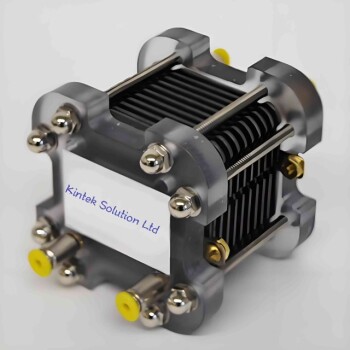
A standard electrolytic cell ensures accuracy by utilizing a specialized three-electrode configuration that isolates the potential measurement from the current-carrying circuit. By using the SnO2/MoS2 catalyst-loaded Carbon Cloth as the working electrode within an acidic electrolyte, the system allows for precise control over the current path and potential distribution.
The core mechanism for accuracy lies in the use of a specialized three-electrode apparatus. This setup enables the precise separation of the working electrode's potential from the counter electrode's current, ensuring that measurements like overpotential and Tafel slopes reflect only the catalyst's intrinsic performance.
The Architecture of Precision
The Three-Electrode Advantage
To evaluate the Hydrogen Evolution Reaction (HER), a standard two-electrode setup is often insufficient due to voltage drops across the counter electrode.
The three-electrode system resolves this by introducing a reference electrode. This configuration isolates the working electrode (the catalyst), ensuring the data collected represents the specific activity of the SnO2/MoS2 without external interference.
Control of Current Path and Potential
The specialized apparatus mentioned in your reference is designed to strictly manage the current path.
By controlling how current flows between the counter and working electrodes, the system stabilizes the potential distribution. This uniformity is critical for generating reproducible data across different testing cycles.
The Role of Specific Components
The Working Electrode (SnO2/MoS2)
In this specific setup, the SnO2/MoS2 catalyst is loaded onto Carbon Cloth.
The Carbon Cloth serves as a conductive substrate that functions as the working electrode. Its interaction with the acidic electrolyte provides the necessary environment for proton reduction during HER.
Reference and Counter Electrodes
To ensure measurement stability, the system typically employs a Saturated Calomel Electrode (SCE) as the reference.
Simultaneously, a Carbon Rod often acts as the counter electrode to complete the circuit. This pairing allows the system to measure voltage changes solely at the working electrode surface.
Ensuring Data Reliability
Accurate Overpotential Measurement
One of the primary metrics for HER performance is overpotential—the extra voltage required to drive the reaction.
Because the three-electrode cell controls the potential distribution so precisely, it allows for the accurate determination of overpotential at specific current densities.
Determining Tafel Slopes
The system is also essential for calculating Tafel slopes, which indicate the reaction kinetics (speed).
The isolation provided by the electrolytic apparatus ensures that the relationship between current and potential is mapped correctly. This data is vital for understanding the catalytic efficiency of the SnO2/MoS2 material.
Understanding the Trade-offs
System Complexity vs. Data Quality
While accurate, a three-electrode system is more complex to assemble than a two-electrode coin cell.
You must ensure precise placement of the reference electrode relative to the working electrode. Poor positioning can introduce uncompensated resistance, skewing your high-current data.
Material Compatibility
The reliance on acidic electrolytes requires that all components, particularly the Carbon Cloth and Carbon Rod, remain chemically stable.
If the substrate degrades in the acid before the catalyst does, it will produce false positives regarding the catalyst's durability.
Making the Right Choice for Your Goal
To maximize the accuracy of your HER testing with SnO2/MoS2, structure your approach based on your specific analytical needs:
- If your primary focus is Benchmarking Efficiency: Prioritize the accurate measurement of overpotential at fixed current densities (e.g., 10 mA/cm²) to compare against industry standards.
- If your primary focus is Reaction Mechanism: Focus on the precision of your Tafel slope calculations to understand the rate-limiting steps of the reaction.
Success in HER testing depends not just on the catalyst, but on the rigorous isolation of variables provided by a well-calibrated three-electrode cell.
Summary Table:
| Component | Role in HER Testing Accuracy | Key Material Used |
|---|---|---|
| Working Electrode | Directs reaction at catalyst surface | SnO2/MoS2 on Carbon Cloth |
| Reference Electrode | Isolates potential measurements | Saturated Calomel Electrode (SCE) |
| Counter Electrode | Completes the circuit/manages current | Carbon Rod |
| Electrolyte | Provides proton source for reduction | Acidic Solution |
| Configuration | Eliminates voltage drop interference | Three-Electrode System |
Elevate Your Electrochemical Research with KINTEK
Precision in hydrogen evolution reaction (HER) testing starts with the right equipment. KINTEK specializes in high-quality electrolytic cells and electrodes, providing the stability and accuracy required for benchmarking catalysts like SnO2/MoS2.
Our extensive portfolio supports advanced energy research with:
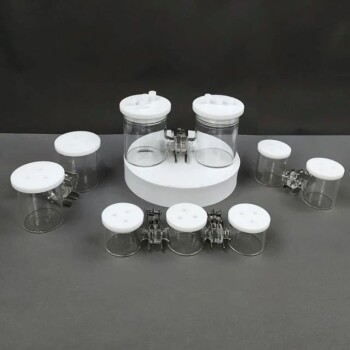
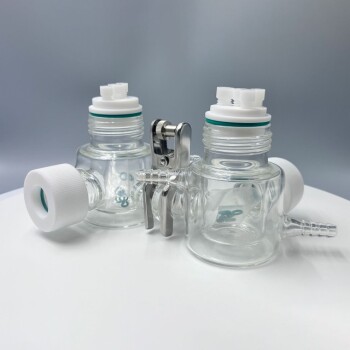
- Specialized Electrolytic Cells: Designed for precise three-electrode configurations.
- High-Performance Electrodes: Platinum, gold, and carbon-based solutions for reliable data.
- Lab Essentials: From high-temperature furnaces and autoclaves to battery research tools and consumables.
Don't let measurement interference compromise your findings. Contact KINTEK today to equip your laboratory with the tools for breakthrough discovery!
References
- Kun Huang, Fangzhi Huang. Super-stable SnO<sub>2</sub>/MoS<sub>2</sub> enhanced the electrocatalytic hydrogen evolution in acidic environments. DOI: 10.1039/d2ra03627d
This article is also based on technical information from Kintek Solution Knowledge Base .
Related Products
- H Type Electrolytic Cell Triple Electrochemical Cell
- Electrolytic Electrochemical Cell for Coating Evaluation
- Electrolytic Electrochemical Cell Gas Diffusion Liquid Flow Reaction Cell
- Thin-Layer Spectral Electrolysis Electrochemical Cell
- PTFE Electrolytic Cell Electrochemical Cell Corrosion-Resistant Sealed and Non-Sealed
People Also Ask
- What is a H type cell? A Guide to Divided Electrochemical Cells for Accurate Experiments
- How should the electrolyte be prepared and added to the H-type electrolytic cell? Best Practices for Purity and Safety
- What is the technical necessity of using an H-type electrolytic cell for NO3RR tests? Protect Your Ammonia Yields
- How does the design of an H-type electrolytic cell benefit the neutral water electrolysis process for metal recovery?
- What is the primary function of an H-type electrolytic cell in NitRR? Ensure Accurate Product Yields