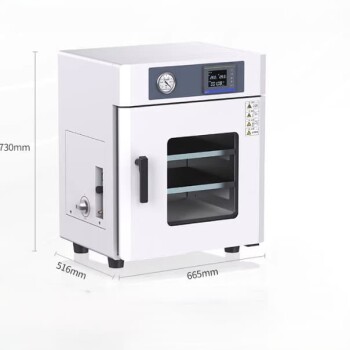
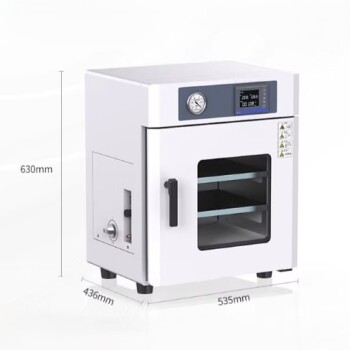
A vacuum drying oven is the critical purification step in preparing cathodes for all-solid-state batteries, serving to eliminate volatile contaminants from the electrode structure. By subjecting the coated electrode sheets to elevated temperatures (typically around 120°C) within a negative pressure environment, the oven efficiently evaporates residual organic solvents like N-methyl-2-pyrrolidone (NMP) and extracts deep-seated environmental moisture.
Core Takeaway The vacuum drying process is not merely about drying; it is a stabilization step that ensures chemical compatibility. By removing trace moisture and solvents that would otherwise react with sensitive solid electrolytes, the oven prevents internal degradation and guarantees the long-term cycling stability of the battery.
The Mechanisms of Purification
Lowering Solvent Boiling Points
The primary function of the oven is to remove the organic solvents used to create the electrode slurry, such as NMP or DMAc.
Under standard atmospheric pressure, these solvents require high heat to evaporate. By creating a vacuum, the oven lowers the boiling point of these liquids, allowing them to be removed rapidly and thoroughly without requiring excessive temperatures that might damage the material.
Deep Extraction of Moisture
Water is a critical contaminant in battery chemistry.
The vacuum environment exerts a strong pull that extracts trace moisture trapped within the micropores of the electrode material. This is far more effective than standard thermal drying, which may leave adsorbed water molecules on the surface of active materials.
Preventing Oxidation
Applying high heat to metal oxides in the presence of air can lead to unwanted oxidation.
Because the vacuum drying oven operates in an oxygen-deprived environment, it allows for the necessary heating (baking) of the electrode without exposing the materials to atmospheric oxygen. This preserves the chemical integrity of cathode materials like NCM (Nickel Cobalt Manganese) or TiS2.
Critical Importance for Solid-State Systems
Protecting Sulfide Electrolytes
All-solid-state batteries, particularly those using sulfide-based electrolytes (like LGPS), are uniquely sensitive to moisture.
If the cathode retains even trace amounts of water, it will react with the sulfide electrolyte to generate toxic hydrogen sulfide ($H_2S$) gas. This reaction destroys the electrolyte and compromises the safety of the cell.
Ensuring Interfacial Contact
Solid-state batteries rely on perfect physical contact between the cathode and the solid electrolyte.
Residual solvents or moisture can create void spaces or resistive layers at this interface. Vacuum drying ensures the electrode layer is dense and chemically clean, facilitating better ionic conductivity and mechanical bonding.
Long-Term Cycling Stability
Contaminants are the primary drivers of parasitic side reactions that occur over time.
By ensuring the electrode is completely free of NMP and water before assembly, the vacuum drying process removes the variables that cause gradual capacity fade. This is essential for achieving the long cycle life expected of solid-state technologies.
Understanding the Trade-offs
Process Duration and Throughput
Vacuum drying is rarely a fast process.
To ensure the removal of deep-seated solvents from micropores, electrodes often require "baking" for extended periods, such as 12 hours or overnight. This creates a bottleneck in manufacturing throughput compared to continuous air-drying methods.
Temperature Constraints
While high heat speeds up drying, there is a limit to what the materials can withstand.
Operators must balance the need for drying against the thermal stability of the binder (e.g., PTFE or PVDF) and the active material. Temperatures must be carefully controlled (typically 60°C to 120°C, occasionally up to 250°C for specific materials) to avoid degrading the electrode structure.
Making the Right Choice for Your Goal
When configuring your drying protocols, align your parameters with the specific sensitivities of your chemistry.
- If your primary focus is Sulfide-Based Solid-State Batteries: Prioritize moisture removal above all else to prevent $H_2S$ generation, potentially utilizing higher temperatures or longer duration cycles to ensure zero water retention.
- If your primary focus is Standard Oxide Cathodes (NCM): Focus on the efficient removal of NMP at roughly 120°C to ensure the structural density of the electrode layer.
- If your primary focus is Polymer-Based Binders: Limit your maximum temperature to prevent the thermal degradation or melting of the binder matrix while relying on the vacuum level to drive solvent evaporation.
Ultimately, the vacuum drying oven is the gatekeeper of quality, ensuring that the chemical purity of your cathode matches the high-performance demands of solid-state architecture.
Summary Table:
| Feature | Function in Cathode Preparation | Impact on Solid-State Battery |
|---|---|---|
| Vacuum Pressure | Lowers solvent boiling points | Prevents thermal damage to binders/active materials |
| Moisture Extraction | Deep removal of H2O from micropores | Prevents H2S gas formation with sulfide electrolytes |
| Oxygen-Free Heating | Baking in an inert/vacuum environment | Prevents oxidation of sensitive NCM or TiS2 materials |
| Solvent Removal | Complete evaporation of NMP/DMAc | Ensures dense electrode layers and low interface resistance |
Elevate your solid-state battery research with KINTEK’s precision vacuum drying solutions. From advanced high-temperature ovens to specialized battery research tools, we provide the purification technology necessary to prevent parasitic reactions and ensure long-term cycling stability. Whether you are working with sulfide-based electrolytes or polymer binders, our laboratory equipment is designed to meet the rigorous demands of next-generation energy storage. Contact us today to optimize your electrode preparation workflow!
Related Products
- 56L Vertical Laboratory Vacuum Drying Oven
- 23L Laboratory Vacuum Drying Oven
- Laboratory Scientific Electric Heating Blast Drying Oven
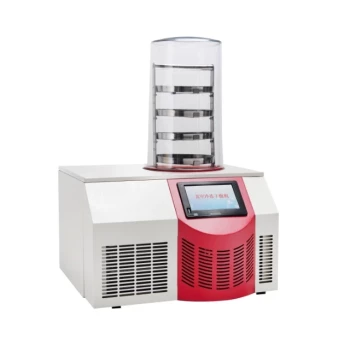
- Benchtop Laboratory Vacuum Freeze Dryer
- Dental Porcelain Zirconia Sintering Ceramic Vacuum Press Furnace
People Also Ask
- Why is a laboratory vacuum drying oven recommended for rice straw residues? Protect Your Biomass Integrity
- What role does a laboratory vacuum drying oven play in the preparation of modified multi-walled carbon nanotubes?
- What is the importance of using a laboratory vacuum drying oven? Preserving Slow-Release Microcapsule Integrity
- Why is a Laboratory Vacuum Drying Oven recommended for PBAT microspheres? Protect Sensitive Polymer Integrity
- What role does a laboratory vacuum drying oven play in processing nanoparticle powder samples? Protect Sample Integrity