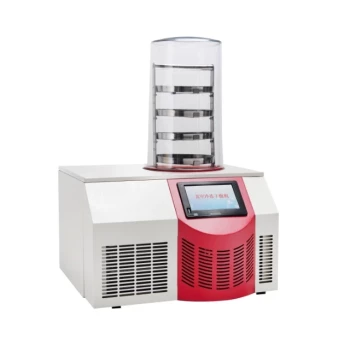
The vacuum drying oven functions by creating a low-pressure, warm environment that forces trapped air to physically exit the composite mixture. Specifically, by heating the Bismuth Oxybromide (BiOBr)/epoxy resin preform to approximately 50°C under vacuum, the oven causes internal air bubbles to expand rapidly, rise to the surface, and escape.
The core value of this process is the elimination of micro-voids prior to curing. By removing trapped air, the vacuum oven prevents the formation of structural pores, ensuring the final material achieves the necessary dielectric stability and continuous heat transfer capabilities required for high-frequency applications.
The Physics of the Degassing Process
To understand how the vacuum drying oven improves the BiOBr/epoxy preform, it is necessary to look at the physical interaction between pressure, temperature, and resin viscosity.
Pressure-Induced Bubble Expansion
The primary mechanism is the reduction of atmospheric pressure surrounding the preform. When the vacuum is applied, the external pressure drops below the internal pressure of the air pockets trapped within the viscous resin mixture.
This pressure differential causes the trapped air bubbles to expand rapidly. As the bubbles increase in volume, their buoyancy increases significantly, forcing them to rise through the epoxy matrix and escape at the surface.
Thermal Assistance
While the vacuum drives expansion, the application of moderate heat (e.g., 50°C) plays a critical supporting role. This temperature is carefully selected to lower the viscosity of the epoxy resin without triggering premature curing or degradation.
A lower viscosity reduces the resistance against the rising bubbles. This ensures that even smaller micro-voids can travel to the surface and be evacuated effectively before the resin sets.
Critical Performance Outcomes
The degassing phase is not merely about aesthetics; it is the defining step for the material's functional reliability in electronic applications.
Elimination of Structural Defects
The immediate result of effective degassing is the removal of micro-voids within the composite. If left untreated, these voids would become permanent pores after the resin cures.
Ensuring Dielectric Stability
For materials used in high-frequency electric fields, air pockets are catastrophic. Air has a different dielectric constant than the BiOBr/epoxy composite, which can lead to localized electrical stress and eventual dielectric breakdown. Vacuum degassing ensures a homogeneous insulation layer.
Optimizing Heat Transfer
The process guarantees continuous heat flow transfer. Air is a thermal insulator; its presence interrupts the conductive pathway established by the material. By removing the air, the oven ensures the composite creates a solid, uninterrupted thermal path.
Understanding the Process Trade-offs
While vacuum degassing is essential, it requires precise control over environmental variables to avoid damaging the sensitive composite materials.
Temperature Balance
The process must maintain a delicate balance regarding temperature. As indicated by the handling of similar sensitive materials, low-temperature operations (around 50°C to 60°C) are crucial to prevent oxidation or degradation of the components.
If the temperature is too high, you risk curing the epoxy before the gas escapes or degrading the surface properties of the BiOBr. If the temperature is too low, the resin may remain too thick for bubbles to escape efficiently.
Aggressive vs. Controlled Vacuum
Rapid expansion of bubbles is desired, but an uncontrolled vacuum can cause the mixture to foam or splatter. The goal is to expand bubbles enough to escape, not to violently disrupt the distribution of the BiOBr particles within the resin matrix.
Making the Right Choice for Your Goal
The way you utilize the vacuum drying oven should depend on the specific failure mode you are trying to prevent in your final application.
- If your primary focus is High-Voltage Insulation: Prioritize maximum vacuum duration to ensure the absolute removal of micro-voids, as even microscopic pores can cause dielectric failure.
- If your primary focus is Thermal Management: Focus on the temperature-viscosity relationship (maintaining ~50°C) to ensure the resin flows perfectly into all gaps, creating a seamless thermal path.
Summary: The vacuum drying oven acts as a critical purification stage, utilizing low heat and reduced pressure to physically extract failure-causing air pockets, thereby transforming a porous mixture into a high-performance, dielectric composite.
Summary Table:
| Process Component | Role in Degassing | Impact on Material Quality |
|---|---|---|
| Vacuum (Low Pressure) | Forces trapped air bubbles to expand and rise | Eliminates micro-voids and structural defects |
| Moderate Heat (~50°C) | Lowers resin viscosity for easier bubble escape | Ensures homogeneous insulation and density |
| Time Control | Allows full evacuation before curing begins | Prevents dielectric breakdown and thermal gaps |
| Environmental Control | Prevents oxidation and component degradation | Maintains material purity and thermal pathways |
Elevate Your Material Research with KINTEK Precision
Achieve flawless dielectric stability and thermal performance in your composite preforms with KINTEK’s advanced laboratory solutions. Our vacuum drying ovens are engineered for precise temperature and pressure control, ensuring the complete elimination of micro-voids in sensitive resins.
Beyond degassing, KINTEK specializes in a comprehensive range of laboratory equipment including:
- High-Temperature Furnaces: Muffle, Tube, and Vacuum systems for specialized curing.
- Processing Equipment: Crushing, milling, and hydraulic pellet presses for sample preparation.
- Thermal Solutions: ULT freezers, cold traps, and freeze dryers.
Don't let micro-pores compromise your high-frequency applications. Contact KINTEK today to find the perfect equipment for your lab and ensure your materials meet the highest industrial standards.
References
- Yuan Jia, Zhen Liu. The Enhancement of the Thermal Conductivity of Epoxy Resin Reinforced by Bromo-Oxybismuth. DOI: 10.3390/polym15234616
This article is also based on technical information from Kintek Solution Knowledge Base .
Related Products
- 56L Vertical Laboratory Vacuum Drying Oven
- 23L Laboratory Vacuum Drying Oven
- Laboratory Scientific Electric Heating Blast Drying Oven
- Benchtop Laboratory Vacuum Freeze Dryer
- Dental Porcelain Zirconia Sintering Ceramic Vacuum Press Furnace
People Also Ask
- Why is a laboratory vacuum drying oven recommended for rice straw residues? Protect Your Biomass Integrity
- What role does a laboratory vacuum drying oven play in the preparation of modified multi-walled carbon nanotubes?
- What is the importance of using a laboratory vacuum drying oven? Preserving Slow-Release Microcapsule Integrity
- Why is a Laboratory Vacuum Drying Oven recommended for PBAT microspheres? Protect Sensitive Polymer Integrity
- What role does a laboratory vacuum drying oven play in processing nanoparticle powder samples? Protect Sample Integrity