Knowledge How does catalyst work in pyrolysis? A Guide to Efficient and Selective Fuel Production
Author avatar

Tech Team · Kintek Solution

Updated 6 days ago

How does catalyst work in pyrolysis? A Guide to Efficient and Selective Fuel Production


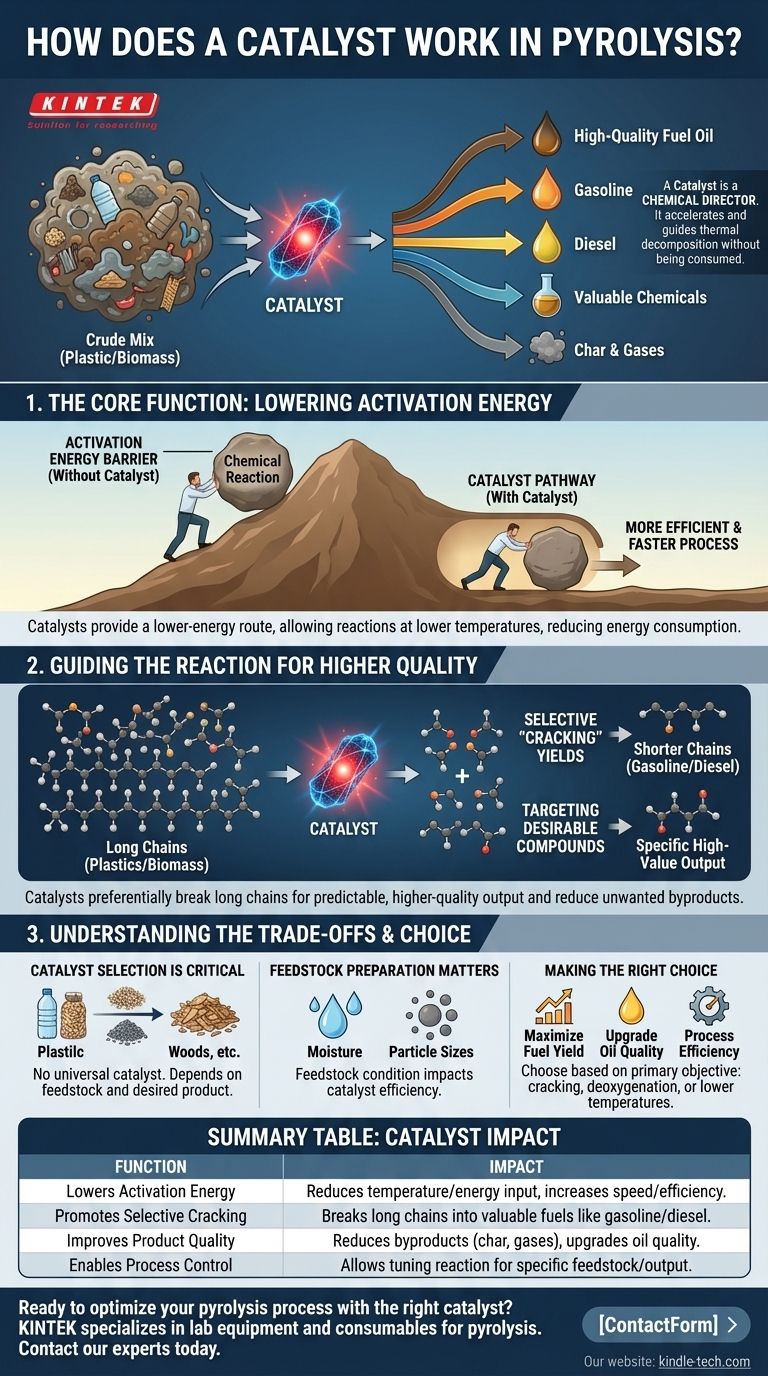
In short, a catalyst in pyrolysis acts as a chemical director. It is a substance that accelerates and guides the thermal decomposition of materials like plastic or biomass, promoting specific reactions that break down large, complex molecules into smaller, more valuable ones, such as those found in high-quality fuel oil. The catalyst achieves this without being consumed in the process itself.

The fundamental role of a catalyst is to lower the energy barrier for desired chemical reactions. This makes the pyrolysis process more efficient, faster, and allows for precise control over the final product, steering the outcome away from a crude mix of substances and towards valuable, upgradable fuels.
How does catalyst work in pyrolysis? A Guide to Efficient and Selective Fuel Production

The Core Function: Lowering Activation Energy

Pyrolysis involves breaking strong chemical bonds, which requires a significant amount of energy. A catalyst fundamentally changes the energy equation of this process.

What is Activation Energy?

Think of a chemical reaction as pushing a boulder over a hill to get it to the valley on the other side. The height of that hill is the activation energy—the minimum energy required to get the reaction started.

How Catalysts Reduce This Barrier

A catalyst provides an entirely different route for the boulder—a lower pass or a tunnel through the hill. It creates an alternative pathway for the chemical reaction to follow, one that requires substantially less energy to initiate.

The Result: A More Efficient Process

By lowering the activation energy, the desired chemical reactions can occur at a faster rate and often at lower temperatures. This directly translates to reduced energy consumption and higher throughput for the entire pyrolysis system.

Guiding the Reaction for Higher Quality Output

Beyond just speeding things up, a catalyst's true power lies in its selectivity. It doesn't just break bonds randomly; it can be designed to target specific bonds to produce a predictable and higher-quality output.

Promoting Selective "Cracking"

The primary goal in fuel production is to "crack" the long, heavy hydrocarbon chains found in plastics or biomass into the shorter, lighter chains that make up gasoline and diesel. A well-chosen catalyst preferentially breaks these long chains while leaving smaller, more valuable molecules intact.

Targeting Desirable Compounds

Modern catalysts can be highly specialized or "tunable." For variable feedstocks like biomass, catalysts can be designed to favor reactions that yield specific high-value compounds, turning a basic decomposition process into a precise chemical manufacturing operation.

Reducing Unwanted Byproducts

Without a catalyst, pyrolysis can produce a significant amount of unwanted solid residue (char) and non-condensable gases. By directing the reaction pathways towards liquid fuel production, a catalyst inherently minimizes the formation of these less valuable byproducts.

Understanding the Trade-offs and Context

A catalyst is a powerful tool, but it is not a standalone solution. Its effectiveness is deeply interconnected with the entire pyrolysis system.

Catalyst Selection is Critical

There is no universal catalyst for pyrolysis. The choice depends entirely on the input material (the feedstock) and the desired final product. A catalyst that works wonders for turning plastics into diesel might be entirely ineffective for converting wood waste into bio-oil.

Feedstock Preparation Matters

The efficiency of any catalyst is influenced by the condition of the feedstock. Factors like moisture content and particle size must be carefully controlled. A catalyst cannot overcome the problems caused by poorly prepared input materials; it can only optimize the reaction of what it is given.

Making the Right Choice for Your Goal

Selecting and implementing a catalyst requires a clear understanding of your primary objective.

  • If your primary focus is maximizing liquid fuel yield: You need a catalyst designed for efficient cracking of long-chain hydrocarbons, such as a zeolite-based catalyst.
  • If your primary focus is upgrading oil quality: Choose a catalyst that promotes deoxygenation and the removal of impurities to create a product closer to a "drop-in" fuel.
  • If your primary focus is process efficiency: The right catalyst can lower operating temperatures and reduce residence time, but this must be balanced with proper feedstock preparation to realize the full benefit.

Ultimately, a catalyst transforms pyrolysis from a brute-force thermal process into a refined and controllable engineering tool.

Summary Table:

Function Impact on Pyrolysis Process
Lowers Activation Energy Reduces required temperature and energy input, increasing speed and efficiency.
Promotes Selective Cracking Breaks long hydrocarbon chains into valuable fuels like gasoline/diesel.
Improves Product Quality Reduces unwanted byproducts (char, gases) and upgrades oil quality.
Enables Process Control Allows for tuning the reaction based on feedstock and desired output.

Ready to optimize your pyrolysis process with the right catalyst?

KINTEK specializes in providing high-performance lab equipment and consumables for testing and scaling pyrolysis reactions. Our expertise helps you select the ideal catalyst for your specific feedstock—whether plastic, biomass, or other materials—to maximize fuel yield and quality.

Contact our experts today to discuss how we can enhance your pyrolysis efficiency and output.

Visual Guide
How does catalyst work in pyrolysis? A Guide to Efficient and Selective Fuel Production Visual Guide

Related Products

People Also Ask

Related Products

Custom PTFE Teflon Parts Manufacturer for PTFE Mesh F4 Sieve

Custom PTFE Teflon Parts Manufacturer for PTFE Mesh F4 Sieve

PTFE mesh sieve is a specialized test sieve designed for particle analysis in various industries, featuring a non-metallic mesh woven from PTFE filament. This synthetic mesh is ideal for applications where metal contamination is a concern . PTFE sieves are crucial for maintaining the integrity of samples in sensitive environments, ensuring accurate and reliable results in particle size distribution analysis.

Custom PTFE Teflon Parts Manufacturer Adjustable Height Flower Basket

Custom PTFE Teflon Parts Manufacturer Adjustable Height Flower Basket

The flower basket is made of PTFE, which is a chemically inert material. This makes it resistant to most acids and bases, and it can be used in a wide variety of applications.

Multifunctional Electrolytic Electrochemical Cell Water Bath Single Layer Double Layer

Multifunctional Electrolytic Electrochemical Cell Water Bath Single Layer Double Layer

Discover our high-quality Multifunctional Electrolytic Cell Water Baths. Choose from single or double-layer options with superior corrosion resistance. Available in 30ml to 1000ml sizes.

Customizable CO2 Reduction Flow Cell for NRR ORR and CO2RR Research

Customizable CO2 Reduction Flow Cell for NRR ORR and CO2RR Research

The cell is meticulously crafted from high-quality materials to ensure chemical stability and experimental accuracy.

Custom PTFE Teflon Parts Manufacturer for PTFE Measuring Cylinder 10/50/100ml

Custom PTFE Teflon Parts Manufacturer for PTFE Measuring Cylinder 10/50/100ml

PTFE measuring cylinder are a rugged alternative to traditional glass cylinders. They are chemically inert over a wide temperature range (up to 260º C), have excellent corrosion resistance and maintain a low coefficient of friction, ensuring ease of use and cleaning.

Customizable PEM Electrolysis Cells for Diverse Research Applications

Customizable PEM Electrolysis Cells for Diverse Research Applications

Custom PEM test cell for electrochemical research. Durable, versatile, for fuel cells & CO2 reduction. Fully customizable. Get a quote!

Advanced Engineering Fine Ceramics Alumina Ceramic Saggar for Fine Corundum

Advanced Engineering Fine Ceramics Alumina Ceramic Saggar for Fine Corundum

Alumina sagger products have the characteristics of high temperature resistance, good thermal shock stability, small expansion coefficient, anti-stripping, and good anti-powdering performance.

Custom PTFE Teflon Parts Manufacturer for PTFE Buchner Funnel and Triangular Funnel

Custom PTFE Teflon Parts Manufacturer for PTFE Buchner Funnel and Triangular Funnel

The PTFE funnel is a piece of laboratory equipment used primarily for filtration processes, particularly in the separation of solid and liquid phases in a mixture. This setup allows for efficient and rapid filtration, making it indispensable in various chemical and biological applications.

Advanced Engineering Fine Ceramics Boron Nitride (BN) Ceramic Parts

Advanced Engineering Fine Ceramics Boron Nitride (BN) Ceramic Parts

Boron nitride ((BN) is a compound with high melting point, high hardness, high thermal conductivity and high electrical resistivity. Its crystal structure is similar to graphene and harder than diamond.

Rubber Vulcanizer Vulcanizing Machine Plate Vulcanizing Press for Lab

Rubber Vulcanizer Vulcanizing Machine Plate Vulcanizing Press for Lab

The Plate vulcanizing press is a kind of equipment used in the production of rubber products, mainly used for the vulcanization of rubber products. Vulcanization is a key step in rubber processing.

Custom PTFE Teflon Parts Manufacturer for Magnetic Stirring Bar

Custom PTFE Teflon Parts Manufacturer for Magnetic Stirring Bar

The PTFE magnetic stirring bar, made from high-quality PTFE, offers exceptional resistance to acids, alkalis, and organic solvents, coupled with high-temperature stability and low friction. Ideal for laboratory use, these stirring bars are compatible with standard flask ports, ensuring stability and safety during operations.

Custom PTFE Teflon Parts Manufacturer for Hollow Etching Flower Basket ITO FTO Developing Glue Removal

Custom PTFE Teflon Parts Manufacturer for Hollow Etching Flower Basket ITO FTO Developing Glue Removal

PTFE adjustable height flower basket (Teflon flower baskets) are made of high-purity experimental grade PTFE, with excellent chemical stability, corrosion resistance, sealing and high and low temperature resistance.

RF PECVD System Radio Frequency Plasma-Enhanced Chemical Vapor Deposition RF PECVD

RF PECVD System Radio Frequency Plasma-Enhanced Chemical Vapor Deposition RF PECVD

RF-PECVD is an acronym for "Radio Frequency Plasma-Enhanced Chemical Vapor Deposition." It deposits DLC (Diamond-like carbon film) on germanium and silicon substrates. It is utilized in the 3-12um infrared wavelength range.

High Purity Zinc Foil for Battery Lab Applications

High Purity Zinc Foil for Battery Lab Applications

There are very few harmful impurities in the chemical composition of zinc foil, and the surface of the product is straight and smooth; it has good comprehensive properties, processability, electroplating colorability, oxidation resistance and corrosion resistance, etc.

Customizable High Pressure Reactors for Advanced Scientific and Industrial Applications

Customizable High Pressure Reactors for Advanced Scientific and Industrial Applications

This laboratory-scale high-pressure reactor is a high-performance autoclave engineered for precision and safety in demanding research and development environments.

Glassy Carbon Sheet RVC for Electrochemical Experiments

Glassy Carbon Sheet RVC for Electrochemical Experiments

Discover our Glassy Carbon Sheet - RVC. Perfect for your experiments, this high-quality material will elevate your research to the next level.

CVD Diamond Domes for Industrial and Scientific Applications

CVD Diamond Domes for Industrial and Scientific Applications

Discover CVD diamond domes, the ultimate solution for high-performance loudspeakers. Made with DC Arc Plasma Jet technology, these domes deliver exceptional sound quality, durability, and power handling.

Laboratory Vibratory Sieve Shaker Machine Slap Vibrating Sieve

Laboratory Vibratory Sieve Shaker Machine Slap Vibrating Sieve

KT-T200TAP is a slapping and oscillating sieving instrument for laboratory desktop use, with 300 rpm horizontal circular motion and 300 vertical slapping motions to simulate manual sieving to help sample particles pass through better.

Laboratory Disc Rotary Mixer for Efficient Sample Mixing and Homogenization

Laboratory Disc Rotary Mixer for Efficient Sample Mixing and Homogenization

Efficient Laboratory Disc Rotary Mixer for Precise Sample Mixing, Versatile for Various Applications, DC Motor and Microcomputer Control, Adjustable Speed and Angle.

Single Punch Electric Tablet Press Machine Laboratory Powder Tablet Punching TDP Tablet Press

Single Punch Electric Tablet Press Machine Laboratory Powder Tablet Punching TDP Tablet Press

The single-punch electric tablet press is a laboratory-scale tablet press suitable for corporate laboratories in pharmaceutical, chemical, food, metallurgical and other industries.


Leave Your Message