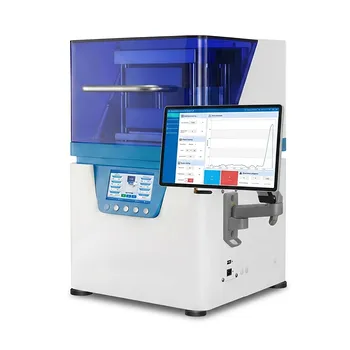
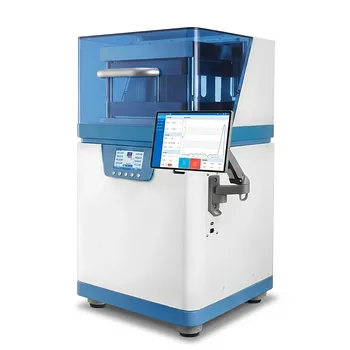
High pressure is the critical catalyst for achieving microstructural integrity and functional synergy in composite ceramics. By applying pressures typically ranging from 300 MPa to 500 MPa, a laboratory hydraulic press compresses $\text{BaTiO}_3$/ferrite powders into high-density green bodies. This process minimizes inter-particle gaps and establishes the necessary mechanical coupling required to drive significant electromagnetic correlation effects during the final sintering stage.
The application of high pressure determines the initial packing density and particle proximity, which are the primary factors governing sintering kinetics. Accurate pressure control ensures a uniform density distribution, preventing macroscopic defects while enabling the mechanical interactions between ferroelectric and magnetic phases that define the material's final performance.
Enhancing Microstructural Density and Connectivity
Mechanisms of Particle Rearrangement
High-pressure application, such as 300 MPa via a uniaxial double-action method, forces loose powder particles to rearrange and undergo plastic deformation. This process overcomes internal friction between particles, leading to a tightly packed green body with a defined geometric shape.
Eliminating Internal Porosity
Increasing the molding pressure significantly reduces the volume of internal voids and macro defects. By minimizing these gaps, the hydraulic press provides a solid physical prototype that facilitates more efficient densification during high-temperature sintering.
Establishing Mechanical Coupling
In $\text{BaTiO}_3$/ferrite composites, high green density is essential for ensuring intimate contact between the different grain types. This proximity promotes mechanical coupling between the ferrite and ferroelectric barium titanate grains, which is the foundation for enhanced electromagnetic correlation.
Influence on Sintering and Phase Stability
Mitigating Sintering Defects
Precise control of hydraulic pressure reduces density gradients within the green body. Uniform density is critical for preventing uneven shrinkage, warping, or cracking when the material is subjected to temperatures as high as 1600°C.
Inhibiting Unwanted Phase Transitions
High-pressure compaction generates internal compressive stress that can influence crystalline stability. In certain perovskite systems, this stress helps inhibit volume expansion associated with phase transitions, effectively stabilizing the preferred crystalline phases for better electrical performance.
Driving Final Densification
A dense green body structure provides the optimal starting state for achieving a fully densified ceramic microstructure. This leads to improved mechanical strength and ensures the final ceramic blocks maintain their intended geometric integrity without macroscopic flaws.
Understanding the Trade-offs
The Risk of Density Gradients
While high pressure is beneficial, uniaxial pressing can introduce friction between the powder and the mold walls. This often results in a non-uniform pressure distribution, where the center of the pellet may be less dense than the edges, potentially leading to differential shrinkage during sintering.
Pressure Limits and Tooling Wear
Exceeding the optimal pressure range (often above 500 MPa) can lead to "capping" or laminations, where the green body cracks upon ejection due to stored elastic energy. Additionally, consistent use of extremely high pressures increases wear on precision steel molds, requiring more frequent maintenance and calibration.
Optimizing Pressure for Your Material Goals
How to Apply This to Your Project
To achieve the best results with $\text{BaTiO}_3$/ferrite green bodies, the pressure should be calibrated based on your specific performance requirements.
- If your primary focus is maximizing electromagnetic coupling: Utilize higher pressures near 300–400 MPa to ensure the tightest possible contact between ferroelectric and ferrite grains.
- If your primary focus is preventing structural cracking or warping: Prioritize "double-action" pressing or lower compression speeds to ensure a more uniform density distribution throughout the green body.
- If your primary focus is phase stability and conductivity control: Aim for the upper limit of your press’s capability (up to 500 MPa) to utilize compressive stress for stabilizing specific crystalline structures.
The precision of the laboratory hydraulic press is the fundamental link between raw powder characteristics and the sophisticated functional properties of the finished ceramic.
Summary Table:
| Parameter | Effect of High Pressure (300-500 MPa) | Impact on Final Ceramic Performance |
|---|---|---|
| Microstructure | Forces particle rearrangement and plastic deformation | Maximizes green density and eliminates internal voids |
| Connectivity | Establishes intimate contact between grain types | Enables electromagnetic correlation and mechanical coupling |
| Sintering | Reduces density gradients and internal friction | Prevents warping, cracking, and uneven shrinkage |
| Phase Stability | Generates internal compressive stress | Stabilizes preferred crystalline phases and electrical properties |
| Mechanicals | Minimizes macro defects and inter-particle gaps | Increases final strength and geometric integrity |
Elevate Your Advanced Ceramic Research with KINTEK
Precision in pressure application is the foundation of high-performance electronic ceramics. KINTEK specializes in laboratory equipment designed for meticulous material science, offering a comprehensive range of manual, electric, and isostatic hydraulic presses specifically engineered for pelletizing and green body compaction.
Beyond compaction, we support your entire workflow with high-performance crushing and milling systems for powder preparation, and high-temperature furnaces (muffle, vacuum, and atmosphere) to ensure optimal sintering kinetics. Whether you are researching BaTiO3 composites or advanced ferrite materials, our tools provide the uniform density and precise control required to achieve superior electromagnetic coupling.
Ready to optimize your ceramic fabrication process? Contact our technical experts today to discover how KINTEK’s laboratory solutions can enhance your material performance and research efficiency.
References
- Marija Šuljagić, Ljubica Andjelković. BaTiO3/NixZn1−xFe2O4 (x = 0, 0.5, 1) Composites Synthesized by Thermal Decomposition: Magnetic, Dielectric and Ferroelectric Properties. DOI: 10.3390/inorganics11020051
This article is also based on technical information from Kintek Solution Knowledge Base .
Related Products
- Laboratory Hydraulic Press Lab Pellet Press Machine for Glove Box
- Laboratory Hydraulic Press Split Electric Lab Pellet Press
- Fully Automatic Heated Hydraulic Lab Press for Materials Sintering and Sample Preparation
- Laboratory Hydraulic Press Lab Pellet Press for Button Battery
- Automatic Laboratory Hydraulic Press for XRF & KBR Pellet Press
People Also Ask
- How do laboratory hydraulic presses contribute to zero-gap electrolyzers? Optimize Performance & Safety
- Why is a laboratory hydraulic press necessary for ZrO2/Cr2O3 interface analysis? Optimize Sample Density and Accuracy
- How do a precision laboratory hydraulic press and specialized molds contribute to the fabrication of spherical ceramic samples? Achieving High-Density Material Precision
- What is the role of a laboratory hydraulic press in the preparation of rare earth denitrification catalysts?
- How does pressure control of a laboratory hydraulic press affect W-Ti alloys? Optimize Grain Structure & Density