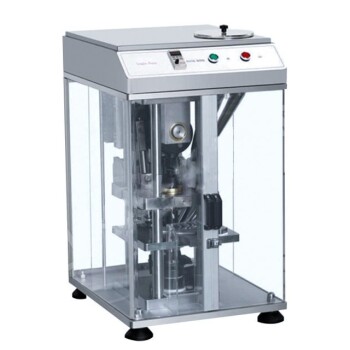
Precise pressure control is the fundamental driver of structural integrity and chemical reactivity in Fir-Derived Carbon/Silicon Carbide (FSCC) green bodies. By applying a specific load over a set duration, a pellet press eliminates internal voids and maximizes the contact area between carbon and silicon particles. This dense arrangement is essential for ensuring a uniform and efficient in-situ reaction during the subsequent formation of silicon carbide.
High-quality FSCC green bodies require a balance of mechanical bonding and particle proximity. Effective pressure control transforms loose powder into a dense matrix, utilizing mechanical interlocking to ensure the material remains stable and reactive.
Optimizing the Reactive Interface
Eliminating Internal Porosity
A powder pellet press uses precise pressure, such as 10 MPa, to rearrange mixed powders within a mold. This process effectively removes air pockets and eliminates internal voids that would otherwise weaken the structure.
Maximizing Reactive Contact Area
The quality of the final silicon carbide depends on the contact area between the fir-derived carbon and silicon powder. Controlled pressure ensures these materials are tightly bonded, which directly enhances the efficiency and uniformity of the in-situ reaction.
Ensuring Chemical Homogeneity
Consistent pressure application across the entire mold (e.g., a 20 mm diameter die) prevents localized density variations. This homogeneity is critical for preventing "dead zones" where the chemical transformation to silicon carbide might fail to occur.
Structural Bonding and Stability
Leveraging Intermolecular Forces
The molding process utilizes mechanical interlocking and Van der Waals forces to bind fir fibers and silicon particles together. These forces are activated only when particles are forced into extreme proximity through high-pressure compaction.
Increasing Volumetric Energy Density
High-pressure molding densifies loose biomass and silicon powder into a regular, compact shape. This significantly increases the volumetric energy density of the green body, making the material more robust.
Enhancing Durability for Handling
Properly pressurized pellets exhibit superior transport and storage stability. The tight bonding of fibers ensures that the green bodies do not crumble or degrade before they reach the furnace for thermal processing.
Understanding the Trade-offs and Constraints
The Relationship Between Load and Surface Area
Pressure is not determined by force alone, but by the load relative to the sample area. If you change the diameter of your pellet die, you must adjust the applied load to maintain the same compaction pressure and green body quality.
Risks of Inadequate Dwell Time
Applying the correct pressure is only half the battle; the duration of the press (e.g., one minute) is equally vital. Inadequate dwell time can lead to "spring back," where the particles expand slightly after the load is removed, reintroducing voids.
Limitations of High-Pressure Extrusion
While high pressures (up to 40 kg/cm² in some biomass applications) increase density, excessive force can cause internal stresses. If the pressure is too high, the green body may delaminate or crack during the subsequent heating phase.
How to Apply This to Your Project
When configuring your powder pellet press for FSCC production, your settings must align with your specific material characteristics and final performance requirements.
- If your primary focus is Maximum Reaction Efficiency: Prioritize a precise, sustained load (e.g., 10 MPa) to ensure the highest possible contact area between reactive carbon and silicon powders.
- If your primary focus is Handling and Durability: Focus on optimizing the mechanical interlocking of fibers by ensuring the pressure is high enough to maximize volumetric density without causing material fracture.
- If your primary focus is Consistency Across Batch Sizes: Always recalibrate your applied force when changing die diameters to ensure the actual pressure experienced by the sample remains constant.
Mastering the pressure profile of your green bodies is the most effective way to guarantee the structural and chemical success of your silicon carbide ceramics.
Summary Table:
| Key Pressure Factor | Effect on FSCC Green Body | Primary Benefit |
|---|---|---|
| Void Elimination | Removes internal air pockets | Enhanced structural integrity & strength |
| Contact Area | Maximizes carbon-silicon interface | Higher in-situ reaction efficiency |
| Homogeneity | Prevents localized density variations | Uniform chemical transformation |
| Volumetric Density | Compacts biomass and silicon powder | Increased durability and handling stability |
| Dwell Time | Prevents material "spring back" | Long-term dimensional stability |
Elevate Your Material Research with KINTEK Precision
Achieving the perfect green body requires more than just force—it requires the precision and reliability that KINTEK laboratory equipment provides. Whether you are developing Fir-Derived Carbon/Silicon Carbide (FSCC) or advanced ceramics, our high-performance hydraulic pellet presses (manual, electric, and isostatic) ensure the exact pressure control and dwell time needed for superior structural integrity.
Beyond pelletizing, KINTEK offers a comprehensive ecosystem for material science, including:
- High-Temperature Furnaces: Muffle, vacuum, and CVD systems for seamless in-situ reactions.
- Processing Tools: Advanced crushing, milling, and sieving systems for perfect powder preparation.
- Specialized Consumables: High-purity ceramics, crucibles, and PTFE products designed for extreme environments.
Ready to optimize your reactive interface and maximize density? Contact our technical experts today to find the ideal pressing solution for your laboratory’s unique requirements.
References
- Fuling Liu, Jinbo Hu. Fabrication and Process Optimization of Chinese Fir-Derived SiC Ceramic with High-Performance Friction Properties. DOI: 10.3390/ma16124487
This article is also based on technical information from Kintek Solution Knowledge Base .
Related Products
- XRF & KBR steel ring lab Powder Pellet Pressing Mold for FTIR
- XRF & KBR plastic ring lab Powder Pellet Pressing Mold for FTIR
- XRF Boric Acid Lab Powder Pellet Pressing Mold for Laboratory Use
- kbr pellet press 2t
- Automatic Fluorescent Pellet Press for XRF Sample Preparation
People Also Ask
- What is the purpose of using a mold for pellet pressing when preparing catalyst test samples? Ensure Data Consistency
- What are the advantages of using the pressed pellet method for XRF sample preparation? Optimize Your XRF Analysis
- What is the pressed powder pellet method? A Guide to Accurate FTIR Sample Preparation
- How does the selection of a pressure mold affect the performance of all-solid-state batteries? Expert Pelletizing Guide
- What are the different types of XRF samples? A Guide to Solid, Powder, and Liquid Prep