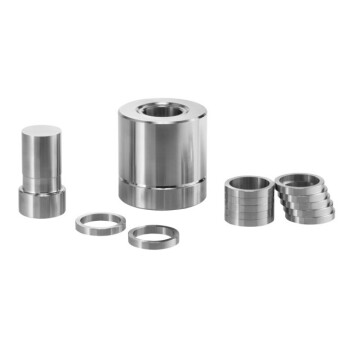
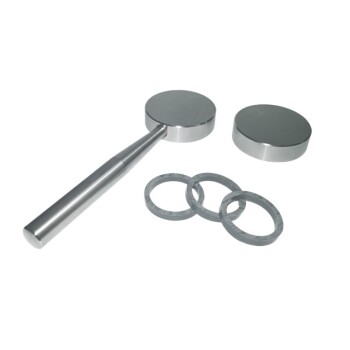
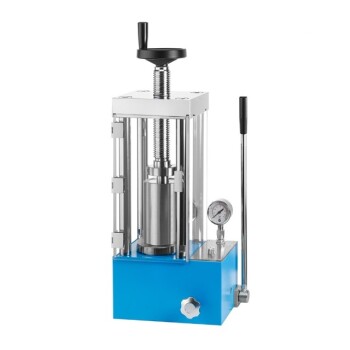
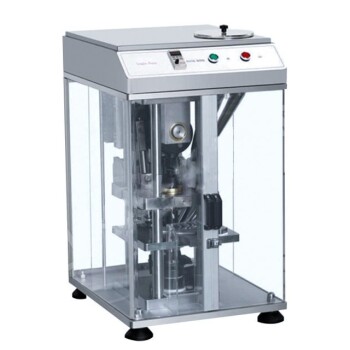
The primary function of a powder pellet press is to mechanically compress loose mixtures of alpha-alumina ($\alpha-Al_2O_3$) and silica ($SiO_2$) into solid, pre-formed units known as green bodies. By transforming the raw powder into a compact shape with specific dimensions, the press ensures the filler material achieves the consistent density required for reliable processing.
The pellet press acts as a standardization tool. By converting variable loose powders into uniform solids, it creates a stable material foundation that is essential for controlling the formation of the molten pool during subsequent laser welding.
Transforming Raw Powder into Production-Ready Fillers
To understand the value of the pellet press, one must look at the transition from raw ingredients to a structural component.
Creating the Green Body
The initial mixture of alumina and silica powders lacks structural integrity. The pellet press applies force to consolidate these loose particles into a green body.
This "green" state refers to the compacted material before it is fully fired. It allows the filler to hold a specific geometric shape, which is easier to handle and position than loose powder.
Establishing Consistent Density
Uniformity is the ultimate goal of this process. If the powder were loosely applied, air gaps and packing variations would lead to unpredictable results.
The press eliminates these variables by compressing the material to a consistent density. This ensures that every millimeter of the filler contains the same amount of material, laying the groundwork for predictable thermal behavior.
The Critical Link to Welding Quality
The physical compression of the filler is not an end in itself; it is a prerequisite for high-quality laser welding.
Enhancing Process Stability
The output of the pellet press serves as the input for pre-sintering and laser welding. Because the pellets have specific dimensions, the automated equipment can interact with them predictably.
This geometric stability reduces the likelihood of alignment errors or feed issues during the joining of alumina ceramic linings.
Guaranteeing Molten Pool Uniformity
The most critical impact of the pellet press occurs during the welding phase. Laser welding relies on the precise melting of the filler material.
Because the press ensures the filler has a uniform density, the laser energy is absorbed evenly. This guarantees the uniformity of the molten pool formation, preventing defects such as erratic melting or weak bonding points in the final ceramic joint.
Common Pitfalls to Avoid
While the pellet press adds necessary structure, it introduces specific process requirements that must be managed.
The Risk of Density Gradients
It is not enough to simply compress the powder; the pressure must be applied correctly. If the pressing process is flawed, the green body may have uneven density (harder on the outside, softer in the center).
Dimensional Inconsistencies
The effectiveness of the subsequent laser welding depends on the specific geometry of the pellet. Variations in the pressing stage can lead to dimensional inaccuracies, which disrupts the stability of the molten pool and compromises the integrity of the connection.
Making the Right Choice for Your Goal
To maximize the effectiveness of your ceramic lining connections, consider how the pressing stage aligns with your specific objectives.
- If your primary focus is Process Reliability: Ensure your pellet press settings are calibrated to produce green bodies with identical dimensions to prevent automation failures.
- If your primary focus is Joint Strength: Prioritize density uniformity in the pressing stage to guarantee a stable, consistent molten pool during laser welding.
The quality of your final ceramic weld is directly determined by the geometric and physical consistency of the pressed filler pellet.
Summary Table:
| Stage of Preparation | Role of the Pellet Press | Impact on Quality |
|---|---|---|
| Powder Consolidation | Compresses $\alpha-Al_2O_3$ and $SiO_2$ into green bodies | Converts loose powder into manageable, solid shapes |
| Density Control | Eliminates air gaps and packing variations | Ensures consistent material volume for predictable thermal behavior |
| Geometric Shaping | Creates pellets with specific dimensions | Facilitates automated handling and reduces alignment errors |
| Welding Preparation | Guarantees molten pool uniformity | Prevents defects like erratic melting or weak bonding points |
Elevate Your Material Preparation with KINTEK
Precision in the pressing stage is the foundation of high-strength ceramic joints. KINTEK specializes in advanced laboratory equipment, offering high-performance hydraulic pellet presses (manual, electric, and isostatic) designed to produce green bodies with the perfect density and dimensional accuracy your research demands.
From high-temperature furnaces and crushing systems to our specialized pellet presses and crucibles, KINTEK provides the end-to-end solutions needed for battery research, material science, and industrial ceramic processing.
Ready to optimize your pellet production? Contact our technical experts today to find the ideal pressing solution for your laboratory.
References
- Bowei Luo, Yanfei Bao. Optimization on the diode laser joining process of Al2O3 liners. DOI: 10.54097/hset.v43i.7448
This article is also based on technical information from Kintek Solution Knowledge Base .
Related Products
- XRF & KBR steel ring lab Powder Pellet Pressing Mold for FTIR
- XRF & KBR plastic ring lab Powder Pellet Pressing Mold for FTIR
- XRF Boric Acid Lab Powder Pellet Pressing Mold for Laboratory Use
- kbr pellet press 2t
- Automatic Laboratory Hydraulic Pellet Press Machine for Lab Use
People Also Ask
- What is the purpose of using a mold for pellet pressing when preparing catalyst test samples? Ensure Data Consistency
- What are the advantages of using the pressed pellet method for XRF sample preparation? Optimize Your XRF Analysis
- What is the pressed powder pellet method? A Guide to Accurate FTIR Sample Preparation
- How does the selection of a pressure mold affect the performance of all-solid-state batteries? Expert Pelletizing Guide
- What are the different types of XRF samples? A Guide to Solid, Powder, and Liquid Prep