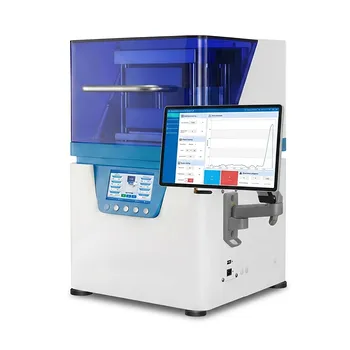
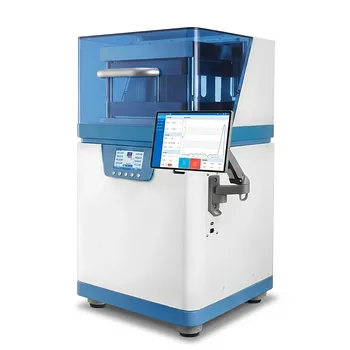
The use of a laboratory hydraulic press or pelletizer is essential for standardizing biomass samples prior to thermochemical testing. By compressing raw materials into uniform shapes, these tools ensure consistent fuel packing within reactors and stabilize the flow of gases during experiments. This process transforms loose, irregular fibers into high-density samples, enabling researchers to achieve the repeatable and reliable data necessary for both torrefaction and combustion studies.
Pelletization creates a standardized physical environment that eliminates variability in gas penetration and heat transfer. This densification is critical for ensuring that experimental results reflect the inherent properties of the biomass rather than the inconsistencies of loose material packing.
Enhancing Experimental Precision through Standardization
Uniform Packing in Fixed-Bed Reactors
A hydraulic press compresses raw biomass to reduce its volume and increase its bulk density. This creates a standardized shape that ensures uniform fuel packing within a fixed-bed reactor. Without this uniformity, irregular gaps between particles can cause "channeling," where gases bypass sections of the fuel.
Stabilizing Gas Penetration and Air Flow
During torrefaction, a pelletized sample allows for the stabilized penetration of the torrefaction atmosphere throughout the material. In combustion experiments, this creates a more consistent primary air flow field. These stabilized conditions are the foundation for obtaining reliable, repeatable experimental results.
Controlling Sample Dimensions
Pelletizers allow researchers to produce samples with standardized dimensions. This control is vital for studying how particle size and shape influence thermochemical conversion rates. It ensures that the data collected is comparable across different material batches.
Optimizing Physical and Thermal Characteristics
Increasing Bulk and Energy Density
Torrefied biomass naturally has a very low bulk density, making it difficult to handle and transport. Physical compression molding significantly improves the mechanical strength and energy density of the fuel. This process simulates the logistical advantages of densified biomass in industrial applications.
Mechanical Bonding and Binder Activation
The high pressure of a hydraulic press (often ranging from 200 to 555 MPa) forces particles to bond tightly. In some cases, the use of precise mold temperature control (around 230°C) allows residual lignin to soften. This softened lignin acts as a natural binder, ensuring high-strength densification without the need for external additives.
Impact on Combustion Behavior
High-density briquettes possess a higher volumetric thermal value than loose fibers. However, this density also results in a delayed ignition time and an extended combustion duration. Researchers use pelletizers to study these shifts in thermal output to optimize fuel performance.
Simulating Industrial-Scale Behavior
Quantifying Pressure and Temperature Variables
Laboratory presses allow researchers to quantitatively study how different pressures and holding times affect molding density. By accurately controlling these variables, scientists can determine optimal pressure curves. This data is essential for the design of industrial-scale pellet mill dies.
Modeling Material Stability and Swelling
Pelletization provides controllable samples for studying complex behaviors like particle swelling, which can reach 50-80 percent during conversion. It also allows researchers to observe how released tars act as binders during the process. These insights are critical for predicting how materials will behave in large-scale gasification or combustion plants.
Understanding the Trade-offs
The Impact of High Density on Reaction Kinetics
While high density improves storage and transport, it can create mass transfer limitations. The tight packing may slow down the release of volatiles during torrefaction. This requires researchers to carefully balance density with the need for accurate kinetic modeling.
Lignin Depletion Challenges
The torrefaction process removes some of the lignin components that naturally act as binders. Consequently, pelletizing biomass after torrefaction often requires higher compression forces or specialized heating. If the pressure is insufficient, the resulting pellets may lack the impact strength required for stable experimentation.
Making the Right Choice for Your Goal
How to Apply This to Your Project
The specific settings of your laboratory press should align with the primary objective of your biomass study.
- If your primary focus is experimental repeatability: Use a hydraulic press to create uniform pellets that ensure a consistent air flow field and eliminate reactor channeling.
- If your primary focus is industrial process optimization: Utilize precise pressure and temperature controls (e.g., 230°C) to simulate and find the optimal stability boundaries for commercial die designs.
- If your primary focus is maximizing energy output: Focus on achieving the highest possible bulk density to study extended combustion durations and increased volumetric thermal values.
By mastering the densification process, researchers transform volatile raw biomass into a predictable, high-performance fuel source for advanced energy research.
Summary Table:
| Factor | Impact on Experiments | Key Benefit for Researchers |
|---|---|---|
| Sample Uniformity | Eliminates gas channeling and inconsistent packing | Higher data repeatability and precision |
| Bulk Density | Increases mechanical strength and volumetric thermal value | Simulates industrial-scale energy density |
| Gas Penetration | Stabilizes air flow and the torrefaction atmosphere | Accurate control of thermal conversion rates |
| Mechanical Bonding | Softens lignin at high pressure/temp to act as binder | Creates durable pellets without external additives |
Elevate Your Biomass Research with KINTEK Precision
Precision in biomass torrefaction and combustion starts with perfectly standardized samples. KINTEK specializes in high-performance laboratory equipment designed for rigorous material science. Our range of manual and automated hydraulic presses (pellet, hot, and isostatic) ensures your samples achieve optimal density and uniformity, while our advanced high-temperature furnaces (muffle, vacuum, tube, and rotary) provide the stable thermal environments necessary for reliable data.
Whether you are optimizing industrial die designs or exploring the kinetics of thermochemical conversion, KINTEK offers a complete suite of tools—including crushing systems, milling equipment, and specialized ceramics—to support your workflow from preparation to analysis.
Ready to achieve repeatable, publication-quality results?
Contact KINTEK Today for a Professional Consultation
References
- Sajid Riaz, Ibukun Oluwoye. Partially Oxidative Torrefaction of Woody Biomass Pellets: Burning Behaviour and Emission Analysis. DOI: 10.1007/s12155-023-10572-z
This article is also based on technical information from Kintek Solution Knowledge Base .
Related Products
- Laboratory Hydraulic Press Lab Pellet Press Machine for Glove Box
- Laboratory Hydraulic Press Split Electric Lab Pellet Press
- Fully Automatic Heated Hydraulic Lab Press for Materials Sintering and Sample Preparation
- Laboratory Hydraulic Press Lab Pellet Press for Button Battery
- Automatic Laboratory Hydraulic Press for XRF & KBR Pellet Press
People Also Ask
- How do laboratory hydraulic presses contribute to zero-gap electrolyzers? Optimize Performance & Safety
- Why is a laboratory hydraulic press necessary for ZrO2/Cr2O3 interface analysis? Optimize Sample Density and Accuracy
- How do a precision laboratory hydraulic press and specialized molds contribute to the fabrication of spherical ceramic samples? Achieving High-Density Material Precision
- What is the role of a laboratory hydraulic press in the preparation of rare earth denitrification catalysts?
- How does pressure control of a laboratory hydraulic press affect W-Ti alloys? Optimize Grain Structure & Density