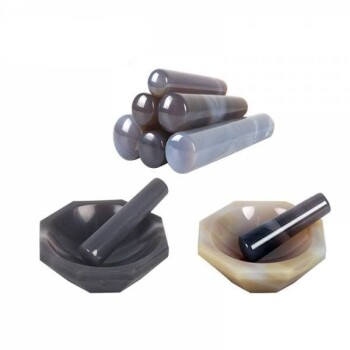
The use of grinding equipment, such as an agate mortar, is a critical post-processing step that directly transforms the physical microstructure of synthesized materials to enable efficient energy storage. By pulverizing the hard agglomerates that form during drying and calcination, grinding ensures the material reaches the fine, uniform consistency required for optimal thermochemical reactivity.
Core Insight: The effectiveness of iron-substituted manganese oxide relies heavily on its specific surface area. Grinding increases this area by reducing particle size, which significantly improves gas-solid contact and accelerates the rates of oxygen release and absorption during energy cycles.
Optimizing Physical Properties
Breaking Down Hard Agglomerates
During the synthesis of iron-substituted manganese oxide, the necessary steps of drying and calcination often cause particles to fuse together. This results in the formation of hard agglomerates that are chemically active but physically inaccessible. Grinding equipment provides the mechanical force needed to deconstruct these fused clusters back into individual grains.
Reducing Particle Size Distribution
Effective energy storage requires consistency. The use of an agate mortar allows for the production of particles with a narrow particle size distribution. Creating a fine, uniform powder ensures that the material behaves predictably during operation, rather than having a mix of large chunks and fine dust.
Enhancing Thermochemical Performance
Increasing Specific Surface Area
The primary chemical advantage of grinding is the geometric increase in surface area. By reducing the diameter of the particles, you significantly increase the specific surface area available for reaction. This exposes more of the active iron-substituted manganese oxide to the surrounding environment.
Improving Gas-Solid Contact
Thermochemical storage in this context relies on the material's ability to interact with the atmosphere. A higher surface area facilitates superior gas-solid contact. This ensures that the reactant gases can reach the active sites of the material without diffusion barriers caused by large, dense clumps.
Accelerating Reaction Rates
The ultimate goal of increasing surface area is to speed up kinetics. Fine particles allow for faster oxygen release and absorption. This directly translates to more efficient heat-charge and heat-discharge cycles, allowing the system to store and release energy more rapidly.
Understanding the Process Dependencies
The Consequence of Calcination
It is important to recognize that the calcination process, while vital for establishing the correct chemical phase, inherently degrades the material's physical surface properties by causing sintering or clustering.
The Necessity of Mechanical Intervention
Without the grinding step, the benefits of the chemical synthesis are lost. The material would remain in a coarse state with low surface area, leading to sluggish reaction kinetics and poor energy storage performance regardless of the chemical composition.
How to Apply This to Your Project
To maximize the efficiency of your iron-substituted manganese oxide, consider your specific performance targets:
- If your primary focus is increasing power density: Prioritize thorough grinding to maximize oxygen release rates through increased surface area.
- If your primary focus is material consistency: Use grinding to ensure a uniform particle distribution, eliminating hard agglomerates that could cause uneven reaction kinetics.
Precision in mechanical preparation is the bridge between a synthesized compound and a functional energy storage material.
Summary Table:
| Feature | Impact on Material Preparation | Benefit for Energy Storage |
|---|---|---|
| Agglomerate Reduction | Breaks down hard clusters from calcination | Ensures uniform material consistency |
| Particle Size Control | Creates narrow size distribution | Predictable and stable thermochemical behavior |
| Increased Surface Area | Maximizes gas-solid contact area | Improves accessibility of active chemical sites |
| Kinetic Acceleration | Facilitates faster oxygen exchange | Enables rapid heat-charge and discharge cycles |
Elevate Your Material Research with KINTEK Precision Solutions
Unlock the full potential of your energy storage materials by ensuring superior mechanical preparation. KINTEK specializes in high-performance laboratory equipment, offering a comprehensive range of crushing and milling systems, including premium agate mortars and sieving equipment, designed to achieve the precise particle size distribution your research demands.
From synthesizing compounds in our advanced muffle and vacuum furnaces to processing them with our robust hydraulic pellet presses, KINTEK provides the end-to-end tools necessary for cutting-edge battery and thermochemical research.
Ready to optimize your lab's efficiency and material performance? Contact our experts today to find the perfect equipment tailored to your specific application.
References
- Nobuyuki Gokon, Fumiya Ohashi. Long-Term Thermal Cycling Test and Heat-Charging Kinetics of Fe-Substituted Mn2O3 for Next-Generation Concentrated Solar Power Using Thermochemical Energy Storage at High Temperatures. DOI: 10.3390/en15134812
This article is also based on technical information from Kintek Solution Knowledge Base .
Related Products
- Nature Agate Mortar and Pestle for Grinding and Mixing
- Laboratory Jar Mill with Agate Grinding Jar and Balls
People Also Ask
- Why are agate mortars and pestles used for grinding iron oxide? Ensure Sample Purity for XRD Analysis
- What is the function of an agate mortar and pestle? Ensure Purity in Halide Solid-State Electrolyte Synthesis
- What is the primary function of an agate mortar and pestle? Optimize VO2+ CaZn2(PO4)2 Nanopowder Pre-Treatment
- Why is an agate mortar and pestle required for grinding Zr3(Al1-xSix)C2? Ensure Maximum Sample Purity
- Why is an agate mortar and pestle preferred for grinding MAX phase? Ensure Sample Purity & Zero Contamination