Knowledge Resources How does heat treatment affect metal microstructure? Unlock Desired Hardness, Toughness, and Ductility
Author avatar

Tech Team · Kintek Solution

Updated 3 months ago

How does heat treatment affect metal microstructure? Unlock Desired Hardness, Toughness, and Ductility


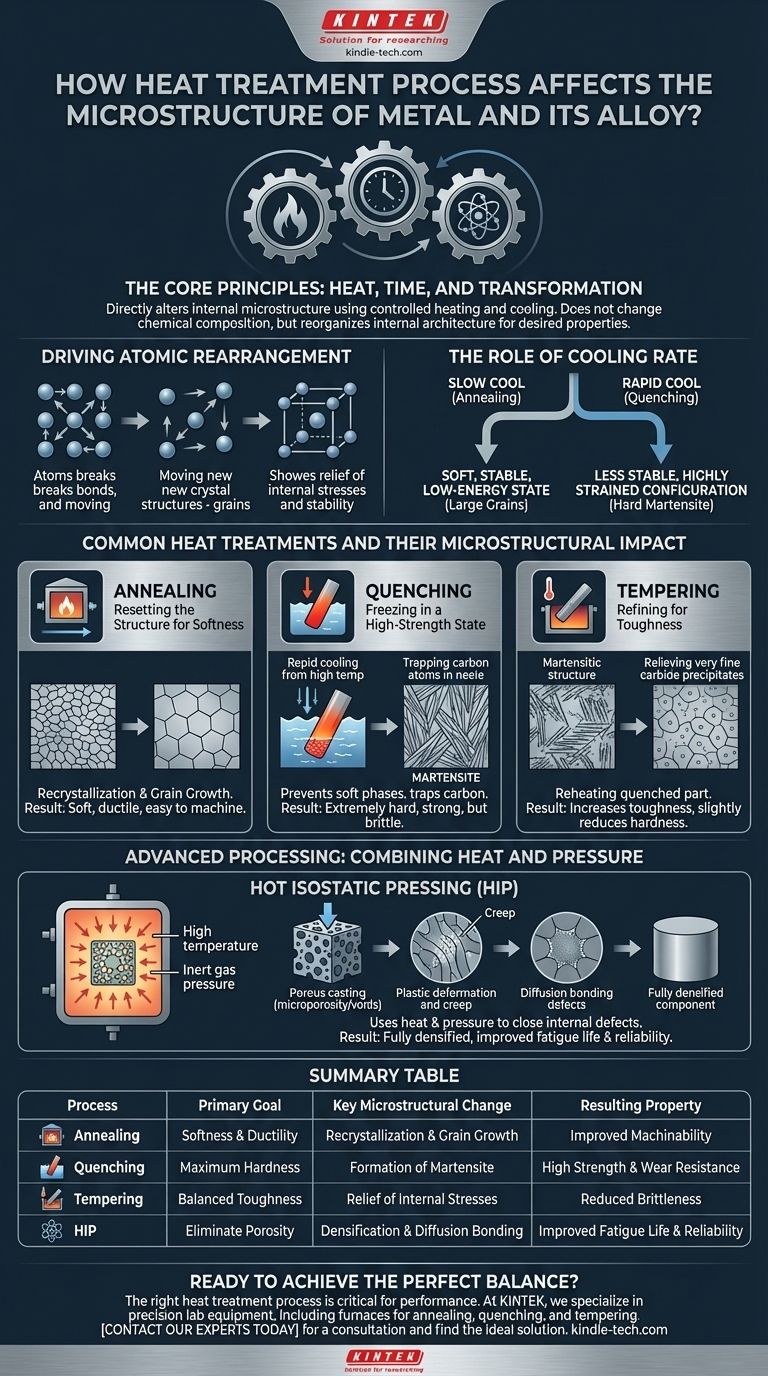
To be direct, heat treatment is the process of using controlled heating and cooling to deliberately alter the internal microstructure of a metal. This manipulation of the atomic arrangement—specifically the size, shape, and distribution of its crystal grains and phases—is what determines the material's final mechanical properties, such as its hardness, toughness, and ductility.

The core principle is this: heat treatment does not change a metal's chemical composition, but rather it reorganizes its internal architecture to achieve a desired set of engineering properties.
How does heat treatment affect metal microstructure? Unlock Desired Hardness, Toughness, and Ductility

The Core Principles: Heat, Time, and Transformation

Heat treatment works by providing thermal energy that allows the atoms within the metal's crystal lattice to move. By carefully controlling the temperature, the duration of heating, and especially the rate of cooling, we can dictate the final structure.

Driving Atomic Rearrangement

Heating a metal gives its atoms the energy needed to break bonds and move. This allows internal stresses to be relieved and for new, more stable crystal structures (grains) to form and grow.

The Role of Cooling Rate

The cooling rate is often the most critical variable. A slow cool allows atoms ample time to settle into a soft, stable, low-energy state. A rapid cool (quenching), however, can trap atoms in a less stable, highly strained configuration, creating a much harder and stronger microstructure.

Common Heat Treatments and Their Microstructural Impact

Different heat treatment processes are designed to produce specific microstructures and, therefore, specific material properties.

Annealing: Resetting the Structure for Softness

Annealing involves heating a metal to a specific temperature and then cooling it very slowly. This process causes recrystallization, where new, strain-free grains form, and grain growth, where these new grains grow larger. The result is a uniform microstructure with large, equiaxed grains, which makes the metal softer, more ductile, and easier to machine or form.

Quenching: Freezing in a High-Strength State

Quenching is the process of cooling a metal very rapidly from a high temperature, typically by immersing it in water, oil, or air. For steels, this rapid cooling prevents the formation of softer phases and instead traps the carbon atoms in a highly strained, needle-like crystal structure called martensite. This microstructure is extremely hard and strong but also very brittle.

Tempering: Refining for Toughness

A metal that has been quenched is often too brittle for practical use. Tempering is a secondary treatment where the quenched part is reheated to a lower temperature. This process provides just enough energy to relieve some of the internal strain from the martensite and allow for the formation of very fine carbide precipitates. This slightly reduces hardness but significantly increases the material's toughness.

Understanding the Trade-offs

Choosing a heat treatment process is always a matter of balancing competing properties. It is crucial to understand the inherent compromises.

Hardness vs. Toughness

This is the most fundamental trade-off. Processes that maximize hardness, like quenching, almost always reduce toughness, making the material more brittle. Processes that enhance toughness, like annealing, do so at the expense of hardness and strength. Tempering is the act of deliberately navigating this compromise.

Dimensional Control and Distortion

The rapid temperature changes involved in quenching cause significant internal stresses. This can lead to warping, distortion, or even cracking of the component, which requires careful process control to manage.

Advanced Processing: Combining Heat and Pressure

Some material challenges cannot be solved by heat alone. For these cases, thermomechanical processes that combine heat with high pressure offer unique solutions.

Hot Isostatic Pressing (HIP)

The HIP process uses both high temperature and inert gas pressure to fundamentally change the microstructure. It forces the plastic deformation and creep of the material at a microscopic level.

This mechanism physically closes and diffusion bonds internal defects like microporosity and voids that are common in castings or powder metallurgy parts. The result is a fully densified component with a clean, uniform microstructure, significantly improving fatigue life and reliability for critical applications.

Matching the Process to Your Engineering Goal

The right heat treatment is entirely dependent on the intended function of the component.

  • If your primary focus is maximum softness and formability: Annealing is the correct process to create a uniform, stress-free microstructure.
  • If your primary focus is maximum hardness and wear resistance: Quenching is required to create a hard martensitic structure, but be prepared to manage brittleness.
  • If your primary focus is a balanced combination of strength and toughness: A quench and temper process is the industry standard for achieving robust mechanical properties.
  • If your primary focus is eliminating internal defects like porosity in a cast part: An advanced process like Hot Isostatic Pressing (HIP) is necessary to achieve full densification.

Ultimately, understanding heat treatment is the key to unlocking the full performance potential of a metallic material for its intended application.

Summary Table:

Process Primary Goal Key Microstructural Change Resulting Property
Annealing Softness & Ductility Recrystallization & Grain Growth Improved Machinability
Quenching Maximum Hardness Formation of Martensite High Strength & Wear Resistance
Tempering Balanced Toughness Relief of Internal Stresses Reduced Brittleness
Hot Isostatic Pressing (HIP) Eliminate Porosity Densification & Diffusion Bonding Improved Fatigue Life & Reliability

Ready to achieve the perfect balance of properties in your metal components? The right heat treatment process is critical for performance. At KINTEK, we specialize in precision lab equipment, including furnaces for annealing, quenching, and tempering, to help you control microstructure and unlock your material's potential.

Let's discuss your application needs and find the ideal solution. Contact our experts today for a consultation!

Visual Guide
How does heat treatment affect metal microstructure? Unlock Desired Hardness, Toughness, and Ductility Visual Guide

Related Products

People Also Ask

Related Products

Vacuum Heat Treat Furnace with Ceramic Fiber Liner

Vacuum Heat Treat Furnace with Ceramic Fiber Liner

Vacuum furnace with polycrystalline ceramic fiber insulation liner for excellent heat insulation and uniform temperature field. Choose from 1200℃ or 1700℃ max. working temperature with high vacuum performance and precise temperature control.

600T Vacuum Induction Hot Press Furnace for Heat Treat and Sintering

600T Vacuum Induction Hot Press Furnace for Heat Treat and Sintering

Discover the 600T Vacuum Induction Hot Press Furnace, designed for high-temperature sintering experiments in vacuum or protected atmospheres. Its precise temperature and pressure control, adjustable working pressure, and advanced safety features make it ideal for nonmetal materials, carbon composites, ceramics, and metal powders.

1400℃ Controlled Atmosphere Furnace with Nitrogen and Inert Atmosphere

1400℃ Controlled Atmosphere Furnace with Nitrogen and Inert Atmosphere

Achieve precise heat treatment with KT-14A controlled atmosphere furnace. Vacuum sealed with a smart controller, it's ideal for lab and industrial use up to 1400℃.

Electric Heated Hydraulic Vacuum Heat Press for Lab

Electric Heated Hydraulic Vacuum Heat Press for Lab

The Electric Vacuum Heat Press is a specialized heat press equipment that operates in a vacuum environment, utilizing advanced infrared heating and precise temperature control for high quality, rugged and reliable performance.

High Temperature Constant Temperature Heating Circulator Water Bath Chiller Circulator for Reaction Bath

High Temperature Constant Temperature Heating Circulator Water Bath Chiller Circulator for Reaction Bath

Efficient and reliable, KinTek KHB Heating Circulator is perfect for your lab needs. With a max. heating temperature of up to 300℃, it features accurate temperature control and fast heating.

50L Heating Chilling Circulator Cooling Water Bath Circulator for High and Low Temperature Constant Temperature Reaction

50L Heating Chilling Circulator Cooling Water Bath Circulator for High and Low Temperature Constant Temperature Reaction

Experience versatile heating, chilling, and circulating capabilities with our KinTek KCBH 50L Heating Chilling Circulator. Ideal for labs and industrial settings, with efficient and reliable performance.

Automatic Heated Hydraulic Press Machine with Heated Plates for Laboratory Hot Press

Automatic Heated Hydraulic Press Machine with Heated Plates for Laboratory Hot Press

The Automatic High Temperature Heat Press is a sophisticated hydraulic hot press designed for efficient temperature control and product quality processing.

10L Heating Chilling Circulator Cooling Water Bath Circulator for High and Low Temperature Constant Temperature Reaction

10L Heating Chilling Circulator Cooling Water Bath Circulator for High and Low Temperature Constant Temperature Reaction

Experience efficient lab performance with KinTek KCBH 10L Heating Chilling Circulator. Its all-in-one design offers reliable heating, chilling, and circulating functions for industrial and lab use.

5L Heating Chilling Circulator Cooling Water Bath Circulator for High and Low Temperature Constant Temperature Reaction

5L Heating Chilling Circulator Cooling Water Bath Circulator for High and Low Temperature Constant Temperature Reaction

KinTek KCBH 5L Heating Chilling Circulator - Ideal for labs and industrial conditions with multi-functional design and reliable performance.

20L Heating Chilling Circulator Cooling Water Bath Circulator for High and Low Temperature Constant Temperature Reaction

20L Heating Chilling Circulator Cooling Water Bath Circulator for High and Low Temperature Constant Temperature Reaction

Maximize lab productivity with KinTek KCBH 20L Heating Chilling Circulator. Its all-in-one design offers reliable heating, chilling, and circulating functions for industrial and lab use.

100L Heating Chilling Circulator Cooling Water Bath Circulator for High and Low Temperature Constant Temperature Reaction

100L Heating Chilling Circulator Cooling Water Bath Circulator for High and Low Temperature Constant Temperature Reaction

Get all-in-one heating, chilling, and circulating capabilities with our KinTek KCBH 80L Heating Chilling Circulator. High efficiency, reliable performance for labs and industrial applications.

30L Heating Chilling Circulator Cooling Water Bath Circulator for High and Low Temperature Constant Temperature Reaction

30L Heating Chilling Circulator Cooling Water Bath Circulator for High and Low Temperature Constant Temperature Reaction

Get versatile lab performance with KinTek KCBH 30L Heating Chilling Circulator. With max. heating temp of 200℃ and max. chilling temp of -80℃, it's perfect for industrial needs.

Heated Hydraulic Press Machine with Integrated Manual Heated Plates for Lab Use

Heated Hydraulic Press Machine with Integrated Manual Heated Plates for Lab Use

Efficiently process heat-pressing samples with our Integrated Manual Heated Lab Press. With a heating range up to 500°C, it's perfect for various industries.

Laboratory Scientific Electric Heating Blast Drying Oven

Laboratory Scientific Electric Heating Blast Drying Oven

The desktop fast autoclave sterilizer is a compact and reliable device used for rapid sterilization of medical, pharmaceutical, and research items.

Double Plate Heating Press Mold for Lab

Double Plate Heating Press Mold for Lab

Discover precision in heating with our Double Plate Heating Mold, featuring high-quality steel and uniform temperature control for efficient lab processes. Ideal for various thermal applications.

Manual Heated Hydraulic Press Machine with Heated Plates for Laboratory Hot Press

Manual Heated Hydraulic Press Machine with Heated Plates for Laboratory Hot Press

The Manual Heat Press is a versatile piece of equipment suitable for a variety of applications, operated by a manual hydraulic system that applies controlled pressure and heat to the material placed on the piston.

Heated Hydraulic Press Machine with Heated Plates for Vacuum Box Laboratory Hot Press

Heated Hydraulic Press Machine with Heated Plates for Vacuum Box Laboratory Hot Press

The lab press for vacuum box is a specialized piece of equipment designed for laboratory use. Its main purpose is to press pills and powders according to specific requirements.

30T 40T Split Automatic Heated Hydraulic Press Machine with Heated Plates for Laboratory Hot Press

30T 40T Split Automatic Heated Hydraulic Press Machine with Heated Plates for Laboratory Hot Press

Discover our split automatic heated lab press 30T/40T for precise sample preparation in material research, pharmacy, ceramics, and electronics industries. With a small footprint and heating up to 300°C, it's perfect for processing under vacuum environment.

Manual High Temperature Heated Hydraulic Press Machine with Heated Plates for Lab

Manual High Temperature Heated Hydraulic Press Machine with Heated Plates for Lab

The High Temperature Hot Press is a machine specifically designed for pressing, sintering and processing materials in a high temperature environment. It is capable of operating in the range of hundreds of degrees Celsius to thousands of degrees Celsius for a variety of high temperature process requirements.

Automatic High Temperature Heated Hydraulic Press Machine with Heated Plates for Lab

Automatic High Temperature Heated Hydraulic Press Machine with Heated Plates for Lab

The High Temperature Hot Press is a machine specifically designed for pressing, sintering and processing materials in a high temperature environment. It is capable of operating in the range of hundreds of degrees Celsius to thousands of degrees Celsius for a variety of high temperature process requirements.


Leave Your Message