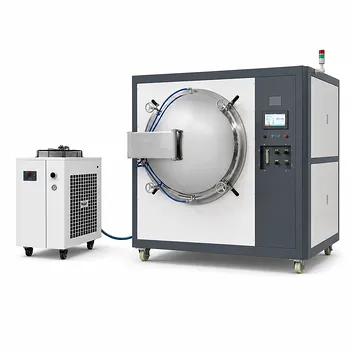
The primary function of a vacuum heating furnace in this context is to facilitate the controlled thermal decomposition of lithium hydroxide monohydrate (LiOH·H2O) into high-purity lithium oxide (Li2O).
By operating within a specific temperature range of 300°C to 450°C under vacuum, the furnace ensures the rapid and continuous removal of released moisture. This prevents the chemical reaction from reversing, securing a final product with a mass purity of 99.0% and extremely low carbonate content.
The vacuum environment is not just about isolation; it is an active processing tool that drives the reaction forward. By instantaneously extracting water vapor as it forms, the system physically prevents the lithium oxide from re-absorbing moisture, which is the single biggest threat to material purity.
The Mechanics of Thermal Decomposition
To understand why a vacuum furnace is essential, you must look at the specific chemical challenges of synthesizing lithium oxide passivators.
Precise Temperature Regulation
The synthesis relies on heating lithium hydroxide monohydrate to a specific window between 300°C and 450°C.
This temperature range provides the necessary thermal energy to break the chemical bonds holding the water molecules within the crystal structure.
Active Moisture Extraction
As the material heats up, it liberates moisture. In a standard furnace, this water vapor would linger around the material.
The vacuum environment lowers the boiling point of water and creates a pressure differential that pulls moisture away from the solid material immediately.
Preventing Reverse Reactions
Lithium oxide is highly hygroscopic; it wants to re-absorb water to become lithium hydroxide again.
By removing the moisture from the chamber instantly, the vacuum furnace makes the decomposition process irreversible during the heating cycle.
Ensuring Material Purity
The definition of "high purity" for passivators is stringent. The vacuum furnace addresses the two main contaminants: residual water and carbonates.
Achieving 99.0% Mass Purity
The primary reference indicates that this specific thermal vacuum process yields a purity level of 99.0%.
This level of purity is critical for passivators, where even minor impurities can degrade performance.
Minimizing Carbonate Contamination
Lithium compounds react readily with carbon dioxide in the air to form lithium carbonate.
Because the process occurs in a sealed vacuum rather than an open-air environment, atmospheric CO2 is excluded, keeping carbonate content extremely low.
Understanding the Trade-offs
While vacuum heating is superior for purity, it introduces specific operational challenges that must be managed.
Throughput vs. Atmosphere Control
Vacuum furnaces typically operate as batch processes rather than continuous flow systems.
This limits the volume of material you can produce per hour compared to conveyor-style atmospheric furnaces, necessitating a trade-off between volume and quality.
Thermal Transfer Efficiency
In a vacuum, there is no air to convect heat. Heat transfer relies primarily on radiation.
This requires careful arrangement of the heating elements and the load to ensure the material reaches the 300°C–450°C target uniformly without hot spots or cold spots.
Making the Right Choice for Your Goal
When selecting or operating a furnace for Li2O synthesis, your operational parameters should be dictated by your specific purity requirements.
- If your primary focus is preventing re-hydration: Ensure your vacuum pump system is sized to handle a high volume of water vapor specifically during the ramp-up phase.
- If your primary focus is minimizing carbonates: Prioritize the integrity of the furnace seals and the purity of any backfill gas used during the cooling phase.
The vacuum furnace is the definitive tool for converting lithium precursors into stable, high-purity oxides by strictly controlling the chemical equilibrium.
Summary Table:
| Feature | Function in Li2O Synthesis | Benefit to Final Product |
|---|---|---|
| Temperature Control | Sustains 300°C - 450°C range | Ensures complete bond breaking of LiOH·H2O |
| Vacuum Environment | Rapid moisture & vapor extraction | Prevents reverse reactions and re-hydration |
| Sealed Chamber | Exclusion of atmospheric CO2 | Minimizes carbonate contamination |
| Heat Transfer | Radiation-based heating | Uniform thermal decomposition of material |
Elevate Your Material Purity with KINTEK Solutions
Achieving 99.0% purity in lithium oxide synthesis requires more than just heat; it requires precision-engineered vacuum environments. KINTEK specializes in high-performance laboratory equipment, including advanced vacuum, atmosphere, and muffle furnaces designed for delicate thermal decomposition processes.
Whether you are producing battery-grade passivators or conducting cutting-edge research, our comprehensive range of high-temperature furnaces, high-pressure reactors, and ceramic consumables provide the reliability your lab demands. Don't let moisture or carbonates compromise your results.
Contact our specialists today to find the perfect vacuum heating solution or cooling system tailored to your specific research goals.
References
- Э. А. Карфидов, Alexey V. Dub. High-Temperature Passivation of the Surface of Candidate Materials for MSR by Adding Oxygen Ions to FLiNaK Salt. DOI: 10.3390/ma15155174
This article is also based on technical information from Kintek Solution Knowledge Base .
Related Products
- Vacuum Heat Treat Furnace with Ceramic Fiber Liner
- Vacuum Hot Press Furnace Heated Vacuum Press Machine Tube Furnace
- Molybdenum Vacuum Heat Treat Furnace
- 2200 ℃ Graphite Vacuum Heat Treat Furnace
- Vacuum Heat Treat and Pressure Sintering Furnace for High Temperature Applications
People Also Ask
- What is a vacuum heat treatment furnace? The Ultimate Guide to Controlled Atmosphere Processing
- What is vacuum heat treatment process? Achieve Superior Control, Cleanliness, and Quality
- What is the temperature of vacuum heat treatment? Achieve Superior Material Properties & Pristine Finishes
- How does a vacuum heat treatment work? Achieve Superior Material Properties in a Pristine Environment
- What is a vacuum heat treatment furnace? Achieve Unmatched Purity and Control