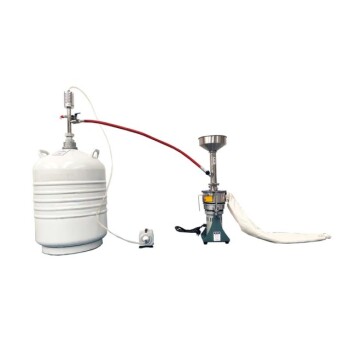
High energy nano milling offers a decisive advantage over traditional methods by dramatically reducing processing time while preventing particle agglomeration. It specifically enables the reduction of particles to the 20–50 nm range, fostering a uniform conductive carbon network that is critical for high-performance LiFePO4/C cathode materials.
Core Insight By utilizing intense shear forces to achieve nanoscale precision, high energy nano mills solve the persistent issue of agglomeration found in traditional milling. This creates a superior, uniform carbon coating that significantly enhances electron transport and lithium-ion diffusion for high-rate battery applications.
The Mechanics of Superior Milling
Utilizing Intense Shear Forces
Traditional ball mills generally rely on tumbling actions that can be slow and inefficient. In contrast, a high energy nano mill employs high rotational speeds combined with small-diameter grinding media. This configuration generates intense shear and impact forces that traditional methods cannot replicate.
Rapid Processing Speed
The operational mechanics of the nano mill allow for a significantly reduced processing time. The intense energy input refines precursor particles much faster than the passive tumbling of standard ball mills.
Structural Advantages in Cathode Fabrication
Eliminating Agglomeration
A primary failure point in cathode fabrication is the clumping of particles. The high energy nano mill effectively disperses and refines these agglomerated precursor particles. This ensures that the material is treated homogeneously rather than in clusters.
Achieving the 20–50 nm Range
Precision is key to performance. The nano mill successfully reduces particle sizes to the 20–50 nm range. This nanoscale refinement creates a larger surface area, which is essential for the material's reactivity.
Forming a Uniform Carbon Network
The process ensures a uniform coating of the carbon source on the LiFePO4 particles. This uniformity is vital for creating a consistent conductive network. It facilitates the formation of a porous structure with an even distribution of pores, which is difficult to achieve with lower-energy methods.
Electrochemical Performance Implications
Shortening Diffusion Paths
The structural changes driven by nano milling have a direct impact on battery chemistry. The resulting porous, nanostructured design shortens the lithium-ion diffusion path. This allows ions to travel through the cathode material with less resistance.
Increasing Specific Capacity
Because of the improved carbon network and shorter diffusion paths, the material performs better under stress. The specific capacity of the material increases notably, particularly during high-rate charging and discharging cycles.
The Trade-off: Traditional Milling Limitations
The Risk of Inconsistency
While traditional ball mills are common, they lack the shear force necessary for uniform nanoscale refinement. Relying on them for high-performance cathodes often leads to particle agglomeration. This results in uneven coatings and inconsistent pore distribution.
Impact on Rate Performance
If the particle size is not reduced sufficiently (to the 20-50 nm range), the lithium-ion diffusion path remains long. This compromise results in lower specific capacity, specifically when the battery is subjected to high-rate cycling.
Making the Right Choice for Your Goal
To maximize the performance of your LiFePO4/C cathode materials, align your fabrication method with your specific electrochemical targets.
- If your primary focus is High-Rate Performance: Prioritize high energy nano milling to ensure short lithium-ion diffusion paths and maximum specific capacity.
- If your primary focus is Structural Homogeneity: Use nano milling to prevent agglomeration and guarantee a uniform conductive carbon network across the material.
The precision of your milling process directly dictates the efficiency of your final energy storage solution.
Summary Table:
| Feature | High Energy Nano Mill | Traditional Ball Mill |
|---|---|---|
| Particle Size | 20–50 nm (Nanoscale) | Micron scale; prone to clumping |
| Mechanism | Intense shear and impact forces | Passive tumbling and gravity |
| Processing Speed | Significantly reduced | Slow and inefficient |
| Carbon Coating | Uniform and continuous network | Inconsistent and patchy |
| Rate Performance | High (Shortened ion diffusion) | Low (Longer diffusion paths) |
Elevate Your Battery Research with KINTEK Precision
Don't let particle agglomeration hinder your electrochemical breakthroughs. KINTEK specializes in advanced laboratory solutions designed to optimize every stage of material fabrication. From high-performance crushing and milling systems to precision hydraulic presses and vacuum furnaces, we provide the tools necessary to achieve the 20-50nm precision your LiFePO4/C cathode research demands.
Our value to you:
- Advanced Nano-Milling Solutions: Achieve uniform carbon networks and rapid processing times.
- Comprehensive Lab Portfolio: Access high-temperature furnaces, autoclaves, and specialized battery research tools.
- Tailored Technical Support: Expert guidance to match the right equipment to your specific material targets.
Ready to maximize your specific capacity and rate performance? Contact KINTEK today for a consultation and let us empower your next innovation.
Related Products
- High-Energy Omnidirectional Planetary Ball Mill Milling Machine for Laboratory
- High Energy Planetary Ball Mill Milling Machine for Laboratory
- High Energy Planetary Ball Mill Milling Machine for Laboratory
- High-Energy Omnidirectional Planetary Ball Mill Machine for Laboratory
- High Energy Vibratory Ball Mill for Lab Use
People Also Ask
- How does a planetary ball mill solve mixing challenges with PEO? Unlock solid-state synthesis for insoluble dopants
- What is the role of a planetary ball mill in preparing doped high-nickel cathode materials? Enhance Battery Stability
- Why is a planetary ball mill used for LNMO precursor powders? Optimize Particle Uniformity & Battery Performance
- What is the function of a planetary ball mill in the solid-state synthesis of LiTa2PO8? Achieve High-Purity Electrolytes
- What is the critical role of a planetary ball mill in the processing of inorganic fillers? Enhance Battery Performance