Knowledge Vacuum Furnace What are high temperature furnaces made of? Graphite vs. Refractory Metals Explained
Author avatar

Tech Team · Kintek Solution

Updated 2 months ago

What are high temperature furnaces made of? Graphite vs. Refractory Metals Explained


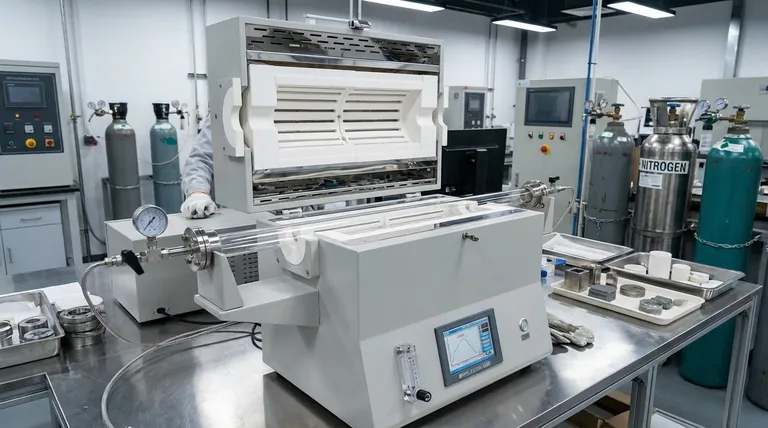
At their core, high-temperature furnaces are constructed from a system of specialized materials designed to contain extreme heat, with the internal "hot zone" typically made of either graphite or refractory metals. The outer body provides structural support, while internal systems manage the atmosphere to protect the materials being processed.

The choice of material for a high-temperature furnace is not merely about withstanding heat. It is a critical decision that dictates the furnace's cleanliness, operational cost, and suitability for processing specific materials like reactive alloys or common steels.
What are high temperature furnaces made of? Graphite vs. Refractory Metals Explained

Deconstructing the High-Temperature Furnace

A furnace is more than just a hot box; it's an engineered system. The materials for each component are chosen to fulfill a specific function, from structural integrity to chemical inertness at temperatures up to 1800°C.

The Internal Chamber (The "Hot Zone")

This is the heart of the furnace where the heat is generated and the work is done. The material choice here is paramount.

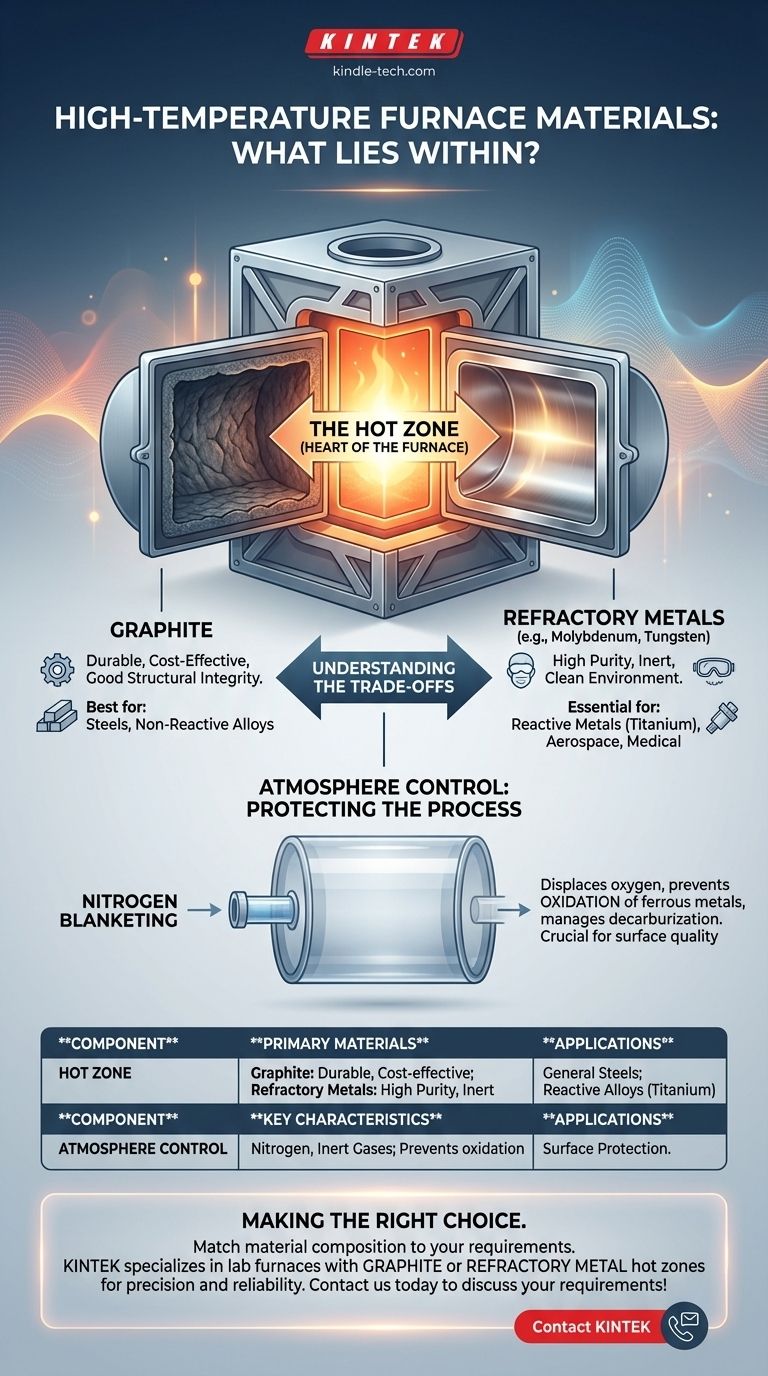
The most common material for the hot zone is graphite. Its popularity stems from its excellent durability, structural integrity at high temperatures, and relatively low cost.

The alternative is a hot zone constructed from refractory metals like molybdenum or tungsten. These are chosen for applications that demand an exceptionally clean environment, free from the carbon particles present in a graphite system.

The Role of Atmosphere Control

Simply reaching a high temperature is not enough; the chemical environment within the furnace is just as important. Uncontrolled atmospheres can lead to oxidation and ruin the materials being heat-treated.

This is why many furnaces use a nitrogen blanketing process. Nitrogen, an inert gas, is pumped into the chamber through inlets and flowmeters to displace oxygen.

This controlled atmosphere prevents the oxidation of ferrous metals and can help manage the carbon content on the surface of steel products, a process known as decarburization.

Understanding the Trade-offs: Graphite vs. Refractory Metals

The decision between a graphite or refractory metal hot zone is a fundamental engineering trade-off. There is no single "best" material; there is only the right material for the application.

The Cost and Durability Factor

For a wide range of applications involving carbon steels and other common alloys, graphite is the go-to choice. It offers the best balance of performance, long service life, and cost-effectiveness.

The Cleanliness and Reactivity Factor

When processing materials that can react with carbon, a graphite hot zone becomes a liability. For example, titanium and its alloys require an extremely clean environment.

In these cases, a refractory metal hot zone is essential. It provides the necessary inertness to prevent contamination and ensure the metallurgical purity of the final product. Other sensitive applications, such as in the medical or aerospace fields, also drive the need for refractory metals.

Making the Right Choice for Your Process

The material composition of a furnace directly defines its capabilities. To select the correct type, you must first define the requirements of the materials you intend to process.

  • If your primary focus is general-purpose heat treating of steels and other non-reactive alloys: A furnace with a graphite hot zone provides the most cost-effective and durable solution.
  • If your primary focus is processing reactive metals like titanium or applications demanding the highest purity: A furnace with a refractory metal hot zone is non-negotiable to prevent contamination.

Ultimately, understanding these material distinctions is the key to matching the furnace's capability to your specific engineering requirement.

Summary Table:

Component Primary Materials Key Characteristics
Hot Zone Graphite or Refractory Metals (Molybdenum, Tungsten) Graphite: Cost-effective, durable. Refractory Metals: High purity, inert.
Atmosphere Control Nitrogen, Inert Gases Prevents oxidation, controls surface chemistry.
Applications Steels, Reactive Alloys (e.g., Titanium) Graphite for general use; Refractory Metals for high-purity needs.

Need a high-temperature furnace tailored to your lab's specific materials? At KINTEK, we specialize in providing lab equipment and consumables, including furnaces with graphite or refractory metal hot zones designed for precision and reliability. Whether you're processing common steels or reactive alloys, our experts will help you select the right solution to enhance your lab's efficiency and ensure contamination-free results. Contact us today to discuss your requirements!

Visual Guide
What are high temperature furnaces made of? Graphite vs. Refractory Metals Explained Visual Guide

Related Products

People Also Ask

Related Products

1700℃ Laboratory High Temperature Tube Furnace with Alumina Tube

1700℃ Laboratory High Temperature Tube Furnace with Alumina Tube

Looking for a high-temperature tube furnace? Check out our 1700℃ Tube Furnace with Alumina Tube. Perfect for research and industrial applications up to 1700C.

1400℃ Controlled Atmosphere Furnace with Nitrogen and Inert Atmosphere

1400℃ Controlled Atmosphere Furnace with Nitrogen and Inert Atmosphere

Achieve precise heat treatment with KT-14A controlled atmosphere furnace. Vacuum sealed with a smart controller, it's ideal for lab and industrial use up to 1400℃.

1200℃ Muffle Furnace Oven for Laboratory

1200℃ Muffle Furnace Oven for Laboratory

Upgrade your lab with our 1200℃ Muffle Furnace. Achieve fast, precise heating with Japan alumina fibers and Molybdenum coils. Features TFT touch screen controller for easy programming and data analysis. Order now!

1700℃ Controlled Atmosphere Furnace Nitrogen Inert Atmosphere Furnace

1700℃ Controlled Atmosphere Furnace Nitrogen Inert Atmosphere Furnace

KT-17A Controlled atmosphere furnace: 1700℃ heating, vacuum sealing technology, PID temperature control, and versatile TFT smart touch screen controller for laboratory and industrial use.

1700℃ Muffle Oven Furnace for Laboratory

1700℃ Muffle Oven Furnace for Laboratory

Get superior heat control with our 1700℃ Muffle Furnace. Equipped with intelligent temperature microprocessor, TFT touch screen controller & advanced insulation materials for precise heating up to 1700C. Order now!

2200 ℃ Tungsten Vacuum Heat Treat and Sintering Furnace

2200 ℃ Tungsten Vacuum Heat Treat and Sintering Furnace

Experience the ultimate refractory metal furnace with our Tungsten vacuum furnace. Capable of reaching 2200℃, perfect for sintering advanced ceramics and refractory metals. Order now for high-quality results.

Vertical High Temperature Graphite Vacuum Graphitization Furnace

Vertical High Temperature Graphite Vacuum Graphitization Furnace

Vertical high temperature graphitization furnace for carbonization and graphitization of carbon materials up to 3100℃.Suitable for shaped graphitization of carbon fiber filaments and other materials sintered in a carbon environment.Applications in metallurgy, electronics, and aerospace for producing high-quality graphite products like electrodes and crucibles.

High Temperature Muffle Oven Furnace for Laboratory Debinding and Pre Sintering

High Temperature Muffle Oven Furnace for Laboratory Debinding and Pre Sintering

KT-MD High temperature debinding and pre-sintering furnace for ceramic materials with various molding processes. Ideal for electronic components such as MLCC and NFC.

Ultra-High Temperature Graphite Vacuum Graphitization Furnace

Ultra-High Temperature Graphite Vacuum Graphitization Furnace

The ultra-high temperature graphitization furnace utilizes medium frequency induction heating in a vacuum or inert gas environment. The induction coil generates an alternating magnetic field, inducing eddy currents in the graphite crucible, which heats up and radiates heat to the workpiece, bringing it to the desired temperature. This furnace is primarily used for graphitization and sintering of carbon materials, carbon fiber materials, and other composite materials.

2200 ℃ Graphite Vacuum Heat Treat Furnace

2200 ℃ Graphite Vacuum Heat Treat Furnace

Discover the power of the KT-VG Graphite Vacuum Furnace - with a maximum working temperature of 2200℃, it's perfect for vacuum sintering of various materials. Learn more now.

1400℃ Muffle Oven Furnace for Laboratory

1400℃ Muffle Oven Furnace for Laboratory

Get precise high-temperature control up to 1500℃ with KT-14M Muffle furnace. Equipped with a smart touch screen controller and advanced insulation materials.

Vacuum Heat Treat and Pressure Sintering Furnace for High Temperature Applications

Vacuum Heat Treat and Pressure Sintering Furnace for High Temperature Applications

Vacuum pressure sintering furnaces are designed for high temperature hot pressing applications in metal and ceramic sintering. Its advanced features ensure precise temperature control, reliable pressure maintenance, and a robust design for seamless operation.

1200℃ Split Tube Furnace with Quartz Tube Laboratory Tubular Furnace

1200℃ Split Tube Furnace with Quartz Tube Laboratory Tubular Furnace

KT-TF12 split tube furnace: high-purity insulation, embedded heating wire coils, and max. 1200C. Widely used for new materials and chemical vapour deposition.

Horizontal High Temperature Graphite Vacuum Graphitization Furnace

Horizontal High Temperature Graphite Vacuum Graphitization Furnace

Horizontal Graphitization Furnace: This type of furnace is designed with the heating elements placed horizontally, allowing for uniform heating of the sample. It's well-suited for graphitizing large or bulky samples that require precise temperature control and uniformity.

Laboratory High Pressure Vacuum Tube Furnace

Laboratory High Pressure Vacuum Tube Furnace

KT-PTF High Pressure Tube Furnace: Compact split tube furnace with strong positive pressure resistance. Working temp up to 1100°C and pressure up to 15Mpa. Also works under controller atmosphere or high vacuum.

Molybdenum Vacuum Heat Treat Furnace

Molybdenum Vacuum Heat Treat Furnace

Discover the benefits of a high-configuration molybdenum vacuum furnace with heat shield insulation. Ideal for high-purity, vacuum environments like sapphire crystal growth and heat treatment.

Large Vertical Graphite Vacuum Graphitization Furnace

Large Vertical Graphite Vacuum Graphitization Furnace

A large vertical high-temperature graphitization furnace is a type of industrial furnace used for the graphitization of carbon materials, such as carbon fiber and carbon black. It is a high-temperature furnace that can reach temperatures of up to 3100°C.

Laboratory Muffle Oven Furnace Bottom Lifting Muffle Furnace

Laboratory Muffle Oven Furnace Bottom Lifting Muffle Furnace

Efficiently produce batches with excellent temperature uniformity using our Bottom Lifting Furnace. Features two electric lifting stages and advanced temperature control up to 1600℃.

Graphite Vacuum Furnace Bottom Discharge Graphitization Furnace for Carbon Materials

Graphite Vacuum Furnace Bottom Discharge Graphitization Furnace for Carbon Materials

Bottom-out graphitization furnace for carbon materials, ultra-high temperature furnace up to 3100°C, suitable for graphitization and sintering of carbon rods and carbon blocks. Vertical design, bottom discharging, convenient feeding and discharging, high temperature uniformity, low energy consumption, good stability, hydraulic lifting system, convenient loading and unloading.

Graphite Vacuum Continuous Graphitization Furnace

Graphite Vacuum Continuous Graphitization Furnace

High-temperature graphitization furnace is a professional equipment for graphitization treatment of carbon materials. It is a key equipment for the production of high-quality graphite products. It has high temperature, high efficiency and uniform heating. It is suitable for various high-temperature treatments and graphitization treatments. It is widely used in metallurgy, electronics, aerospace, etc. industry.


Leave Your Message



















