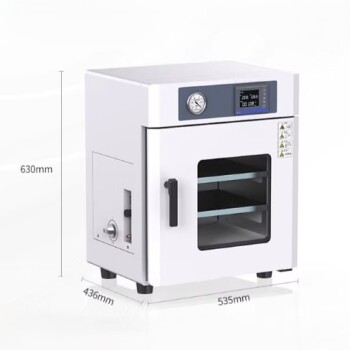
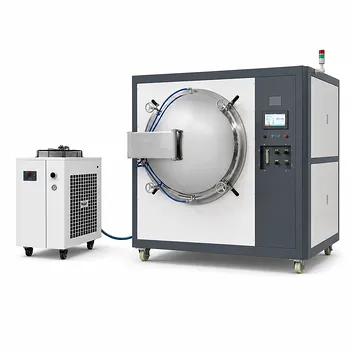
Vacuum drying ovens offer a critical advantage by utilizing negative pressure to remove moisture and solvents at significantly lower temperatures than standard ovens. In the synthesis of multi-interface Carbon Nitride (CN) materials, this process prevents high-temperature oxidation and the structural collapse of delicate nanostructures. By operating in a low-oxygen, low-heat environment, vacuum drying maximizes the preservation of porosity and multi-interface active sites that are essential for the material's performance.
Core Takeaway: Vacuum drying is the superior choice for Carbon Nitride preparation because it protects the material’s microscopic morphology and chemical integrity from thermal degradation and oxidation, ensuring the highest possible density of active catalytic sites.
Preserving Structural and Chemical Integrity
Prevention of Thermal Oxidation
Multi-interface Carbon Nitride materials are highly sensitive to oxygen at elevated temperatures. A vacuum drying oven removes atmospheric oxygen, eliminating the risk of secondary oxidation that can occur in standard drying ovens. This ensures that the chemical composition of the interfaces remains stable and uncontaminated.
Mitigation of Structural Collapse
Standard drying often requires high heat to drive off residual solvents, which can cause complex ordered-disordered nanostructures to break down. Vacuum ovens lower the boiling point of solvents, allowing for thorough drying at temperatures that do not jeopardize the material's structural framework. This preservation is vital for maintaining the microscopic morphology required for advanced applications.
Maximizing Active Site Density
The performance of Carbon Nitride often depends on the quality of its multi-interface boundaries. By avoiding the harsh conditions of atmospheric heating, vacuum drying prevents the sintering or aggregation of these interfaces. This results in a material with a higher specific surface area and a greater number of accessible active sites for photocatalytic or electrochemical reactions.
Enhanced Drying Efficiency at Low Temperatures
Accelerated Solvent Removal
Negative pressure creates a pressure gradient that pulls moisture and salt washing liquids out of the material's pores more efficiently. This accelerated evaporation ensures that the catalyst powder reaches a dry state quickly without the need for prolonged exposure to heat.
Protection of Volatile Components
If the Carbon Nitride precursor contains organic additives or sensitive functional groups, standard drying can lead to volatilization loss. Vacuum drying allows these components to remain intact by maintaining a low-temperature environment (often around 100°C or lower), which is critical for accurate material characterization and performance.
Avoiding Liquid-Phase Migration
While vacuum freeze-drying is the gold standard for avoiding surface tension issues, a standard vacuum oven still reduces the impact of liquid-phase migration compared to atmospheric ovens. This helps in maintaining the hierarchical pore architectures of composite materials, preventing the "clumping" that often ruins thin-film or nanosheet preparations.
Understanding the Trade-offs
Equipment and Operational Costs
Vacuum drying ovens require a reliable vacuum pump and specialized seals, making them more expensive to purchase and maintain than standard convection ovens. The initial investment is significantly higher, which may be a factor for labs producing bulk, non-sensitive materials.
Complexity and Maintenance
The use of a vacuum pump introduces the risk of oil backstreaming or pump contamination if solvents are not properly trapped. Users must implement cold traps or specialized filters to protect the equipment, adding a layer of operational complexity that standard ovens do not require.
Capacity and Throughput
Vacuum ovens typically have smaller internal volumes and require time to achieve the necessary vacuum levels before drying begins. For large-scale industrial throughput of materials that are not heat-sensitive, the speed and simplicity of a standard forced-air oven may be more practical.
Making the Right Choice for Your Goal
How to Apply This to Your Project
Selecting the right drying method depends entirely on the sensitivity of your Carbon Nitride architecture and your final application requirements.
- If your primary focus is maximizing photocatalytic activity: Use a vacuum drying oven to preserve the highest number of multi-interface active sites and prevent thermal oxidation.
- If your primary focus is maintaining precise nanostructure morphology: Opt for vacuum drying (or vacuum freeze-drying) to avoid the pore collapse and aggregation caused by high-heat atmospheric drying.
- If your primary focus is cost-effective bulk processing of stable precursors: A standard drying oven may be sufficient if the material does not exhibit sensitivity to oxygen or temperatures up to 150°C.
- If your primary focus is safety with energetic or volatile precursors: Always use a vacuum drying oven to allow for solvent removal at temperatures well below the point of chemical decomposition or combustion.
Choosing vacuum drying for multi-interface Carbon Nitride is an investment in the material's functional quality and experimental reproducibility.
Summary Table:
| Feature | Vacuum Drying Oven | Standard Drying Oven |
|---|---|---|
| Temperature Range | Lower boiling points (Protective) | Higher heat required (Aggressive) |
| Atmosphere | Low-oxygen/Vacuum (No oxidation) | Atmospheric (High oxidation risk) |
| Morphology | Preserves nanostructures & porosity | Risk of sintering and clumping |
| Active Sites | Maximizes density for catalysis | Reduced due to thermal degradation |
| Efficiency | Faster solvent removal via pressure | Slower evaporation at surface |
| Best Use Case | Sensitive multi-interface materials | Stable, bulk-processed precursors |
Optimize Your Material Synthesis with KINTEK Precision
Maximize the performance of your multi-interface materials with KINTEK’s industry-leading laboratory solutions. Whether you are synthesizing Carbon Nitride or advanced composites, our high-performance vacuum drying ovens provide the precise low-oxygen, low-temperature environment necessary to prevent oxidation and protect delicate nanostructures.
At KINTEK, we understand that research success depends on the integrity of your equipment. Our extensive portfolio features:
- Advanced Furnaces: Muffle, vacuum, CVD, and PECVD systems for precise thermal processing.
- Preparation Tools: High-pressure reactors, autoclaves, and hydraulic pellet presses for material formulation.
- Specialized Consumables: High-purity ceramics, crucibles, and PTFE products.
Don't let thermal degradation compromise your results. Contact our experts today to find the perfect equipment configuration for your specific laboratory needs!
References
- Fengting He, Shaobin Wang. Rejoint of Carbon Nitride Fragments into Multi‐Interfacial Order‐Disorder Homojunction for Robust Photo‐Driven Generation of H<sub>2</sub>O<sub>2</sub>. DOI: 10.1002/adma.202307490
This article is also based on technical information from Kintek Solution Knowledge Base .
Related Products
- 56L Vertical Laboratory Vacuum Drying Oven
- 23L Laboratory Vacuum Drying Oven
- Laboratory Scientific Electric Heating Blast Drying Oven
- Benchtop Laboratory Vacuum Freeze Dryer
- Dental Porcelain Zirconia Sintering Ceramic Vacuum Press Furnace
People Also Ask
- Why is a laboratory vacuum drying oven recommended for rice straw residues? Protect Your Biomass Integrity
- What role does a laboratory vacuum drying oven play in the preparation of modified multi-walled carbon nanotubes?
- What is the importance of using a laboratory vacuum drying oven? Preserving Slow-Release Microcapsule Integrity
- Why is a Laboratory Vacuum Drying Oven recommended for PBAT microspheres? Protect Sensitive Polymer Integrity
- What role does a laboratory vacuum drying oven play in processing nanoparticle powder samples? Protect Sample Integrity