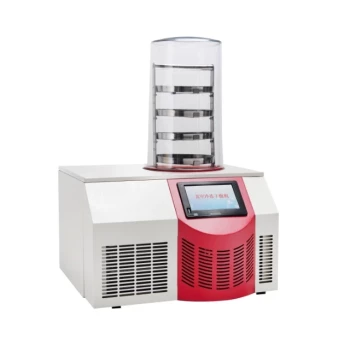
The primary advantage is the preservation of structural integrity through low-temperature solvent removal. By significantly lowering the ambient pressure, a vacuum drying oven reduces the boiling points of residual water and ethanol. This allows SiO2@AuAg/PDA powders to dry rapidly at mild temperatures (such as 45 °C), preventing the thermal degradation that typically occurs in standard atmospheric drying.
Core Takeaway Vacuum drying decouples evaporation from high heat, allowing you to remove solvents without subjecting sensitive nanostructures to thermal stress. For SiO2@AuAg/PDA, this is critical to prevent the aging of the polydopamine layer and the aggregation of metal nanoclusters, ensuring the final powder retains its intended biological and catalytic performance.
The Mechanics of Material Preservation
Lowering the Thermal Threshold
The fundamental benefit of this process is the depression of boiling points. Under standard atmospheric pressure, removing water and ethanol requires temperatures that can damage organic coatings. By creating a vacuum, these solvents evaporate efficiently at much cooler temperatures, such as 45 °C.
Protecting the Organic Layer
The polydopamine (PDA) shell is an organic component sensitive to environmental conditions. High temperatures can accelerate the "aging" of the PDA layer, potentially altering its chemical structure. Vacuum drying mitigates this risk, ensuring the PDA coating remains chemically stable and functional.
Preventing Metal Aggregation
Heat is a primary driver of sintering and aggregation in metal nanoparticles. If exposed to high drying temperatures, the Gold-Silver (AuAg) nanoclusters on the surface may migrate and clump together. The low-temperature environment of the vacuum oven maintains the dispersion of these nanoclusters, which is vital for their performance.
Impact on Functional Performance
Preserving Photothermal Capabilities
The structural arrangement of the AuAg nanoclusters and the PDA layer directly dictates the material's ability to convert light into heat. By preventing aggregation and organic degradation, vacuum drying ensures the photothermal performance of the nanospheres remains optimal.
Maintaining Catalytic and Biological Activity
The surface area and chemical state of the nanospheres are crucial for their interaction with biological systems and chemical reactions. Vacuum drying protects the active sites on the material's surface. This preservation ensures high catalytic activity and maintains the biological compatibility required for downstream applications.
Understanding the Trade-offs
Risk of Solvent "Bumping"
While vacuum drying is efficient, applying a deep vacuum too suddenly can cause solvents to boil violently (bumping). This rapid expansion can physically disrupt the powder morphology or splatter the sample. Pressure must be reduced gradually to ensure controlled evaporation.
Equipment Complexity and Maintenance
Compared to simple convection ovens, vacuum drying systems require more maintenance. Users must regularly check vacuum seals and pump oil to prevent back-streaming, which could contaminate the sensitive SiO2@AuAg/PDA surface with hydrocarbons.
Making the Right Choice for Your Goal
To maximize the quality of your SiO2@AuAg/PDA powders, align your drying parameters with your specific performance metrics:
- If your primary focus is biological application: Prioritize keeping the temperature at or below 45 °C to prevent any denaturation or aging of the PDA layer.
- If your primary focus is catalytic efficiency: focus on achieving a steady, deep vacuum to fully remove solvents without causing the AuAg clusters to aggregate, maximizing surface area.
By controlling pressure to lower thermal stress, you ensure that the delicate architecture of your nanospheres survives the synthesis process intact.
Summary Table:
| Feature | Advantage for SiO2@AuAg/PDA | Resulting Benefit |
|---|---|---|
| Low-Temp Boiling | Removes water/ethanol at ~45 °C | Prevents thermal degradation of organic layers |
| Low Pressure | Rapid solvent evaporation | Maintains structural integrity & morphology |
| Thermal Stability | Protects Polydopamine (PDA) shell | Ensures chemical stability & functional performance |
| Cluster Preservation | Prevents AuAg nanocluster sintering | Maintains optimal catalytic & photothermal activity |
Elevate Your Nanomaterial Synthesis with KINTEK Precision
Don't let high temperatures compromise your sensitive SiO2@AuAg/PDA research. KINTEK specializes in advanced laboratory solutions designed for precision and durability. Our high-performance vacuum ovens provide the stable, low-temperature environment essential for protecting delicate nanostructures from thermal stress and aggregation.
From high-temperature furnaces and vacuum systems to specialized high-pressure reactors and PTFE consumables, KINTEK offers a comprehensive portfolio to support every stage of your material development. Ensure the highest catalytic and biological activity for your powders with equipment trusted by leading research labs.
Ready to optimize your drying process? Contact our technical experts today to find the perfect equipment for your specific laboratory needs.
References
- Dazheng Ci, Qunling Fang. SiO<sub>2</sub>@AuAg/PDA hybrid nanospheres with photo-thermally enhanced synergistic antibacterial and catalytic activity. DOI: 10.1039/d3ra07607e
This article is also based on technical information from Kintek Solution Knowledge Base .
Related Products
- 56L Vertical Laboratory Vacuum Drying Oven
- 23L Laboratory Vacuum Drying Oven
- Laboratory Scientific Electric Heating Blast Drying Oven
- Benchtop Laboratory Vacuum Freeze Dryer
- Dental Porcelain Zirconia Sintering Ceramic Vacuum Press Furnace
People Also Ask
- Why is a laboratory vacuum drying oven recommended for rice straw residues? Protect Your Biomass Integrity
- What role does a laboratory vacuum drying oven play in the preparation of modified multi-walled carbon nanotubes?
- What is the importance of using a laboratory vacuum drying oven? Preserving Slow-Release Microcapsule Integrity
- Why is a Laboratory Vacuum Drying Oven recommended for PBAT microspheres? Protect Sensitive Polymer Integrity
- What role does a laboratory vacuum drying oven play in processing nanoparticle powder samples? Protect Sample Integrity