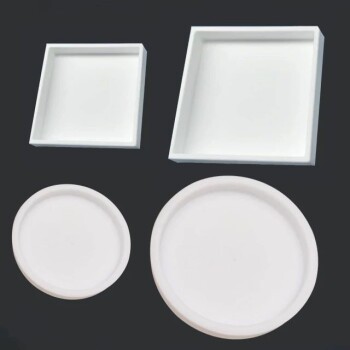
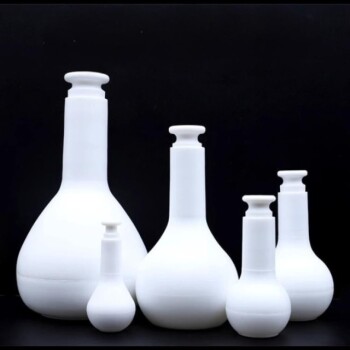
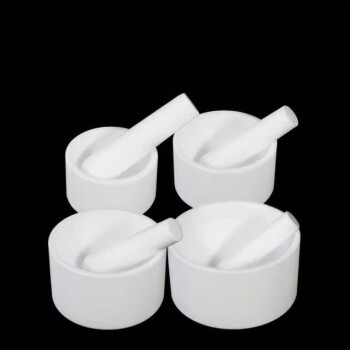
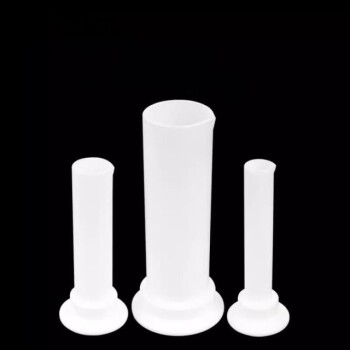
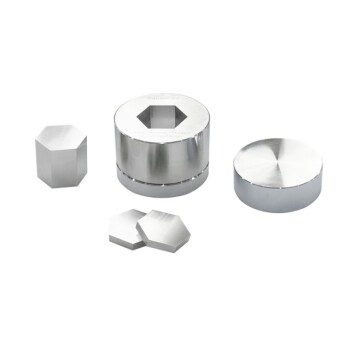
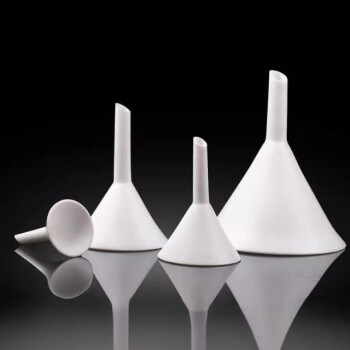
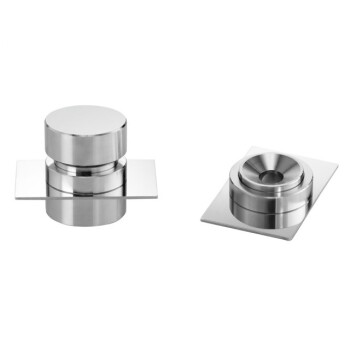
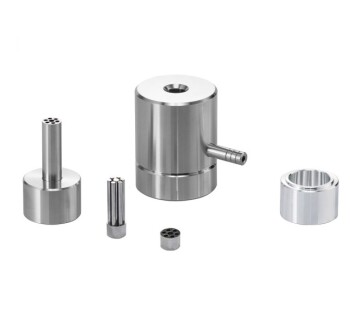
The primary advantage of using PTFE (polytetrafluoroethylene) molds lies in their ability to facilitate damage-free demolding through exceptionally low surface energy and chemical inertness. When preparing poly(ether-urethane) solid-state electrolyte membranes via solution casting, these molds prevent the polymer from bonding to the substrate, ensuring the final film can be peeled off intact with a smooth, uniform surface.
Core Takeaway PTFE molds are essential for fabricating high-quality electrolyte membranes because their non-stick properties enable the production of ultra-thin, self-supporting films without defects. By preventing adhesion during solvent evaporation, they guarantee the physical integrity and surface uniformity necessary for optimal battery performance.
The Critical Role of Surface Properties
Facilitating Non-Destructive Demolding
The defining characteristic of PTFE is its extremely low surface energy. In the context of solution casting, this property acts as a passive release agent.
When the poly(ether-urethane) solution is poured and the solvent evaporates, the polymer solidifies but does not adhere to the mold surface. This allows researchers to peel off ultra-thin membranes completely without tearing or mechanical damage, which is often a point of failure with other mold materials.
Ensuring Surface Smoothness
The physical quality of the mold directly dictates the topography of the electrolyte membrane. Because the polymer does not stick to the PTFE, the membrane replicates the mold's finish precisely.
This results in a smooth, defect-free surface on the electrolyte. A smooth interface is critical for reducing contact resistance when the membrane is eventually integrated into a solid-state battery stack.
Chemical Stability and Uniformity
Preventing Chemical Contamination
Poly(ether-urethane) preparation involves chemical solvents that must evaporate over time. PTFE is renowned for its excellent chemical inertness.
It acts as a neutral carrier, meaning it will not react with the polymer slurry or the solvents during the casting or curing process. This ensures the chemical purity of the final solid-state electrolyte is maintained.
Promoting Thickness Uniformity
Achieving a consistent thickness across the entire membrane is vital for reliable battery performance. The non-stick nature of PTFE aids in the uniform spreading of the slurry before it sets.
Because the solution does not "drag" or cling unevenly to the mold surface, it cures into a flat layer. This uniformity ensures consistent lithium-ion transport paths and prevents localized hot spots in the final device.
Understanding the Trade-offs
Durability and Surface Maintenance
While PTFE offers superior release properties, it is a relatively soft polymer compared to metal molds (like stainless steel).
Scratches on the mold transfer to the membrane. Because the membrane replicates the mold surface so perfectly, any physical damage to the PTFE mold—such as scratches from cleaning or handling—will create defects on the electrolyte surface. Molds must be handled with care to maintain the smoothness required for high-performance electrolytes.
Dimensional Stability Under Heat
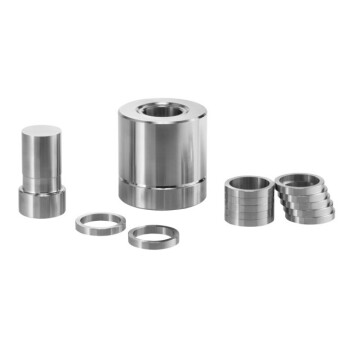
PTFE has a higher coefficient of thermal expansion than metals. If the fabrication process involves high-temperature curing or hot pressing, strictly controlled limiting molds or spacers are often required alongside the PTFE to maintain precise thickness control and prevent deformation.
Making the Right Choice for Your Goal
When designing your fabrication process for solid-state electrolytes, consider your specific priorities:
- If your primary focus is fabrication yield: PTFE is the superior choice because its low surface energy minimizes the risk of tearing delicate films during the peeling process.
- If your primary focus is electrochemical performance: The smoothness provided by PTFE molds ensures optimal interfacial contact, which is essential for uniform current distribution and accurate ionic conductivity measurements.
By leveraging the inert and non-stick properties of PTFE, you ensure the production of robust, high-integrity membranes ready for rigorous testing.
Summary Table:
| Feature | Advantage of PTFE Molds | Impact on Electrolyte |
|---|---|---|
| Surface Energy | Extremely low (Non-stick) | Damage-free peeling and high fabrication yield |
| Chemical Inertness | High resistance to solvents | Maintains chemical purity and integrity |
| Surface Finish | Replicates smooth mold topography | Reduces contact resistance in battery stacks |
| Thickness Control | Facilitates uniform slurry spreading | Ensures consistent lithium-ion transport paths |
Elevate Your Battery Research with KINTEK Precision
Maximize your fabrication success and ensure the electrochemical performance of your solid-state electrolytes. KINTEK specializes in high-quality laboratory consumables, including precision-engineered PTFE products designed to meet the rigorous demands of material science.
Beyond specialized molds, our comprehensive portfolio supports every stage of your workflow with:
- High-Temperature Furnaces & Reactors for advanced material synthesis.
- Hydraulic Presses & Milling Systems for precise pellet and slurry preparation.
- Battery Research Tools tailored for next-generation energy storage development.
Don't let subpar molds compromise your research data. Contact KINTEK today to source the reliable equipment and consumables your laboratory needs to lead in battery innovation!
Related Products
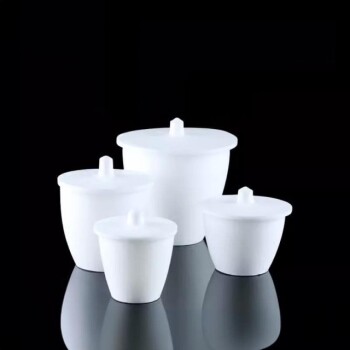
- Custom Machined and Molded PTFE Teflon Parts Manufacturer with PTFE Crucible and Lid
- Custom PTFE Teflon Parts Manufacturer for Hydrothermal Synthesis Reactor Polytetrafluoroethylene Carbon Paper and Carbon Cloth Nano-growth
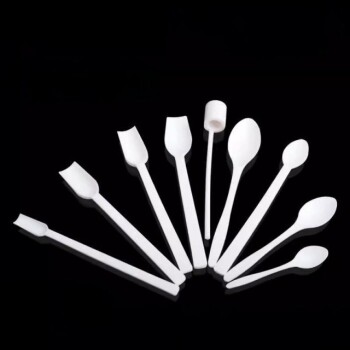
- Custom PTFE Teflon Parts Manufacturer for Sampling Solution Sample and Dry Powder Spoons
- Custom PTFE Teflon Parts Manufacturer for Non-Standard Insulator Customization
- Custom PTFE Teflon Parts Manufacturer for PTFE Mesh F4 Sieve
People Also Ask
- Why is a PTFE crucible preferred for plasma etching? Ensure Chemical Integrity and Targeted Action
- What essential consumables are required for laboratory processes? Expert Guide to PTFE, Ceramics, and Crucibles
- Why are PTFE molds used for dental resin specimens? Ensure Pure Samples and Accurate Testing
- What are the advantages of using PTFE molds for preparing PUA hybrid films? Ensure High Purity and Easy Demolding
- What advantages do PTFE molds offer for composite polymer electrolyte casting? Ensure Defect-Free Membrane Fabrication