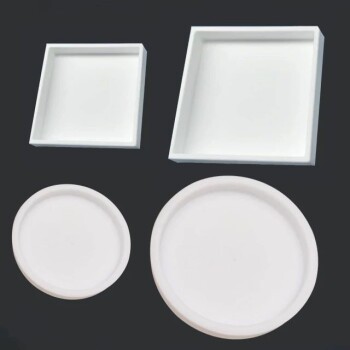
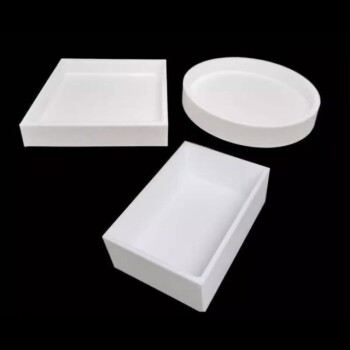
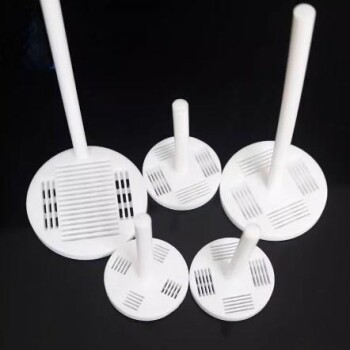
The primary benefit of using a Polytetrafluoroethylene (PTFE) plate as a casting substrate is its unique combination of chemical inertness and extremely low surface energy. These properties create a non-stick interface that is critical for the solution casting of composite electrolytes, such as PEO-LLZTO or PVDF-LATP systems. This ensures the resulting membrane can be removed without damage, structural distortion, or contamination.
Core Takeaway PTFE substrates solve the most critical challenge in membrane fabrication: adhesion during the drying phase. By preventing the electrolyte from sticking to the mold, PTFE allows for the production of intact, self-supporting films with uniform thickness and smooth surfaces.
The Mechanics of Successful Casting
To understand why PTFE is the superior choice for this application, one must look at how the material interacts with polymer slurries during the casting process.
Superior Chemical Inertness
Composite electrolytes often contain reactive salts, solvents, and ceramic fillers.
PTFE is highly resistant to chemical attack. It does not react with the solvents or active components within the polymer electrolyte solution. This ensures the purity of the membrane is maintained throughout the curing process.
Promoting Uniform Spreading
Achieving a consistent film thickness is difficult if the solution behaves unpredictably in the mold.
Despite its non-stick nature, a PTFE mold facilitates the uniform spreading of mixed slurries (such as PVDF and LATP). This results in a flat, even layer before the solvent begins to evaporate.
Ensuring Membrane Integrity During Demolding
The most significant risk in membrane fabrication occurs after the solvent evaporates. This is where PTFE distinguishes itself from other substrates like glass or metal.
Frictionless Peeling
Once the solvent evaporates, the solid-state electrolyte membrane becomes fragile and ultra-thin.
The low surface energy of PTFE prevents the polymer from forming a strong bond with the substrate. This allows researchers to peel the film off easily and completely.
Preventing Structural Damage
Adhesion to the substrate causes tension, which leads to tearing, stretching, or micro-cracking during removal.
By eliminating this adhesion, PTFE prevents adhesion-induced tearing. This is essential for creating self-supporting membranes that maintain their mechanical strength and dimensional stability.
Achieving Defect-Free Surfaces
Any irregularity on the casting surface can transfer to the electrolyte.
The smooth release provided by PTFE ensures the final composite membrane is free of surface defects. This smoothness is vital for ensuring good contact between the electrolyte and the battery electrodes later in the assembly process.
Understanding the Trade-offs
While PTFE is excellent for creating free-standing films, it is important to understand its specific application context to avoid process errors.
Suitability for Free-Standing Films Only
PTFE is designed to reject adhesion.
If your goal is to cast an electrolyte directly onto an electrode or current collector for permanent bonding, a PTFE substrate is the wrong tool. It is specifically engineered for processes where the film must be separated from the mold.
Surface Softness
Compared to glass or steel, PTFE is a relatively soft material.
Care must be taken when cleaning or handling the plates. Scratches or gouges on the PTFE surface will replicate onto every membrane cast thereafter, compromising the uniformity you are trying to achieve.
Making the Right Choice for Your Goal
Selecting the right substrate depends heavily on the specific requirements of your electrolyte fabrication process.
- If your primary focus is Membrane Integrity: Use PTFE to ensure ultra-thin films can be peeled off without tearing or stretching.
- If your primary focus is Surface Homogeneity: Rely on PTFE’s low surface energy to prevent meniscus formation and edge defects during the drying phase.
Using a PTFE plate transforms the casting process from a delicate manual challenge into a reliable, repeatable method for producing high-quality composite electrolytes.
Summary Table:
| Feature | Benefit for Membrane Casting |
|---|---|
| Low Surface Energy | Enables effortless peeling and prevents membrane tearing or stretching. |
| Chemical Inertness | Prevents contamination and reactions with reactive salts or solvents. |
| Surface Smoothness | Produces defect-free, uniform membranes for better electrode contact. |
| High Thermal Stability | Resists deformation during the solvent evaporation and curing phase. |
| Non-Stick Interface | Ideal for creating self-supporting, thin-film composite electrolytes. |
Elevate Your Material Research with KINTEK
Precision in membrane fabrication starts with the right substrate. KINTEK specializes in providing high-quality PTFE products and ceramics specifically designed for the demanding needs of battery research and material science. Whether you are developing next-generation PEO-LLZTO or PVDF-LATP systems, our laboratory solutions—including high-temperature furnaces, hydraulic pellet presses, and advanced electrolytic cells—ensure your research is supported by the best equipment in the industry.
Ready to achieve superior film integrity and repeatable results?
Contact KINTEK Today for Expert Consultation
Related Products
- Custom PTFE Teflon Parts Manufacturer for Hydrothermal Synthesis Reactor Polytetrafluoroethylene Carbon Paper and Carbon Cloth Nano-growth
- Custom PTFE Wafer Holders for Lab and Semiconductor Processing
- Custom PTFE Teflon Parts Manufacturer for Gaskets and More
- Custom Machined and Molded PTFE Teflon Parts Manufacturer with PTFE Crucible and Lid
- Custom PTFE Teflon Parts Manufacturer Grinding Bowl
People Also Ask
- What is the function of a PTFE reactor in MXene etching? Ensure Safe, High-Purity MAX Phase Conversion
- Why is a PTFE reactor required for titanium-based nano-ceramic coating solutions? Ensure Chemical Inertness & Purity
- Why must a Polytetrafluoroethylene (PTFE) reactor be used for Ti3C2TX MXene etching? Ensure Safety and Purity
- Why are PTFE reactors preferred for silver phosphate glass testing? Ensure Purity and Kinetic Accuracy
- What are the advantages of using polytetrafluoroethylene (PTFE) liners in hydrothermal synthesis reactors? High Purity