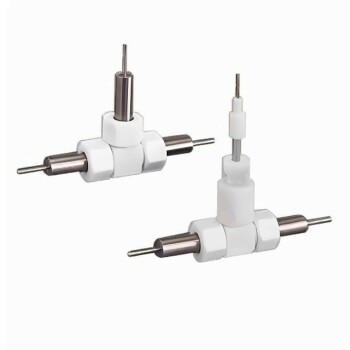
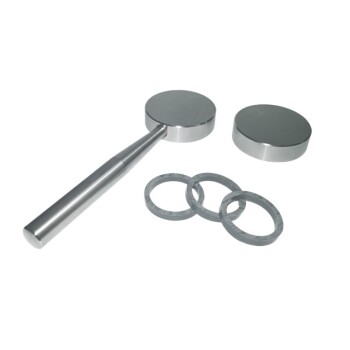
Specialized zinc-air battery test molds serve as the critical interface between theoretical material science and practical application. These devices precisely secure the porous air cathode, separator, and zinc anode to replicate actual operating conditions. Their primary function is to enable real-time monitoring of voltage gaps over extended charge-discharge cycles, providing definitive data on a catalyst's performance and durability.
The true value of these molds lies in their ability to simulate failure modes. They are indispensable for evaluating how a catalyst withstands corrosion and mechanical stress under the harsh, dynamic conditions of long-term battery cycling.
Bridging the Gap Between Material and System
Precise Component Assembly
To evaluate a catalyst effectively, you must control the physical environment. Specialized molds are designed to securely hold the porous air cathode, separator, and zinc anode in a fixed configuration.
Simulating Real-World Geometry
Unlike open beakers, these molds mimic the specific geometry and pressure of a functioning battery. This ensures that the data collected reflects how the catalyst will behave in a commercial device.
Capturing Critical Performance Metrics
Real-Time Voltage Gap Monitoring
The most vital metric in bifunctional catalyst evaluation is the voltage gap—the difference between charging and discharging voltage. Test molds allow researchers to monitor changes in this gap in real-time.
Long-Term Cycling Analysis
Stability cannot be determined in a few hours. These devices facilitate testing over thousands of hours of charge-discharge cycling. This extended duration is the only way to catch slow-developing degradation issues.
Evaluating Catalyst Durability
Assessing Corrosion Resistance
Zinc-air batteries typically utilize strong alkaline electrolytes. The test mold creates a contained environment to rigorously test whether the catalyst can resist corrosion during prolonged exposure to these harsh chemicals.
Testing Structural Integrity
Bifunctional catalysts face unique stress. They must frequently switch between Oxygen Evolution (charging) and Oxygen Reduction (discharging) processes.
Withstanding Dynamic Stress
This switching process can physically degrade materials. The mold evaluates whether the catalyst maintains its structural integrity under this repetitive chemical and electrical stress.
Understanding the Trade-offs
Assembly Complexity
Using specialized molds adds variables to your experiment. Improper assembly, such as poor contact between the cathode and the current collector, can introduce artificial resistance that masks the catalyst's true performance.
Isolation of Variables
While molds simulate a full system, this can sometimes make it difficult to isolate the root cause of failure. It may be unclear if a voltage drop is due to the catalyst degrading or the zinc anode passivating.
Making the Right Choice for Your Evaluation
Different stages of research require different tools. Here is how to apply this to your project:
- If your primary focus is initial screening: Use standard electrochemical cells to quickly identify catalytic activity without the complexity of full-cell assembly.
- If your primary focus is commercial viability: You must use specialized test molds to validate durability and corrosion resistance over thousands of cycles.
Ultimately, the test mold is the gatekeeper that determines if a promising lab catalyst can survive the reality of energy storage.
Summary Table:
| Core Function | Description | Key Performance Metric |
|---|---|---|
| Component Assembly | Secures air cathode, separator, and zinc anode | Physical stability & geometry |
| Real-Time Monitoring | Tracks voltage gaps during charge/discharge | Energy efficiency & round-trip loss |
| Durability Testing | Simulates long-term corrosive alkaline environments | Catalyst lifespan & corrosion resistance |
| Stress Simulation | Evaluates structural integrity during OER/ORR switching | Mechanical & chemical stability |
Maximize Your Catalyst Research with KINTEK Precision
Bridge the gap between theoretical material science and commercial viability. KINTEK specializes in providing high-performance laboratory equipment, including specialized electrolytic cells, electrodes, and comprehensive battery research tools designed to withstand harsh alkaline environments. Whether you need precise hydraulic presses for electrode preparation or advanced testing molds for zinc-air battery evaluation, our solutions ensure your data is accurate and reproducible.
Ready to upgrade your laboratory’s evaluation capabilities? Contact us today to explore our full range of battery research consumables and high-temperature furnaces!
References
- Evgeny V. Rebrov, Pengzhao Gao. Molecular Catalysts for OER/ORR in Zn–Air Batteries. DOI: 10.3390/catal13091289
This article is also based on technical information from Kintek Solution Knowledge Base .
Related Products
- High Purity Zinc Foil for Battery Lab Applications
- Button Battery Disassembly and Sealing Mold for Lab Use
- Button Battery Tablet Press Sealing Mold for Lab Use
- Battery Lab Equipment 304 Stainless Steel Strip Foil 20um Thick for Battery Test
- Li-Air Battery Case for Battery Lab Applications
People Also Ask
- What are the functions of high-purity zinc foil and specialized separators in ZAB assembly? Enhance Battery Life & Power
- Why is high-purity copper foil preferred for silicon-based anodes? Boost Efficiency and Loading Density
- What is the function of a High-purity Platinum Foil Electrode? Master TiO2 Nanotube Anodic Oxidation
- In which fields is nickel foam widely used? A Key Material for Advanced Engineering
- What procedures should be followed after using nickel or copper foam? A Guide to Reliable Reuse and Performance