At its core, the disadvantages of a three-plate mold all stem from its increased mechanical complexity compared to a simpler two-plate design. The primary drawbacks are significantly higher manufacturing costs, longer production lead times, and increased operational demands. These factors arise from the additional components and more intricate actions required for the mold to function.
A three-plate mold introduces higher upfront costs and complexity in exchange for greater design freedom in part gating and the significant long-term benefit of automatic runner separation. The key is understanding if that trade-off is justified for your specific application.
Why a Three-Plate Mold is More Complex
To understand the disadvantages, you must first understand the fundamental structural difference. Unlike a two-plate mold that separates at a single parting line, a three-plate mold is designed to open in two stages.
The Additional "Runner" Plate
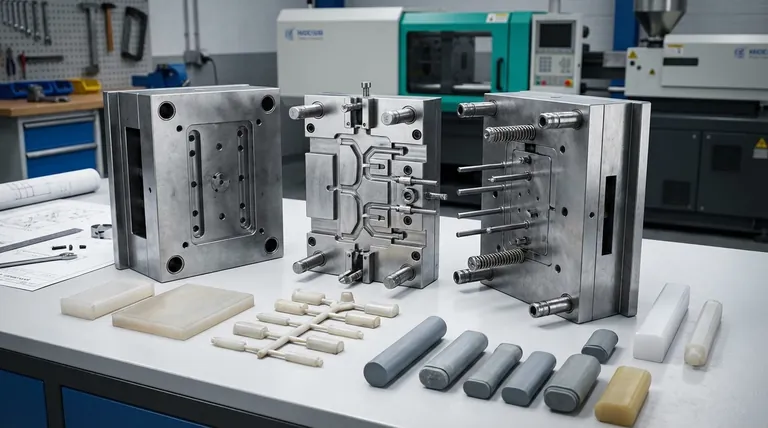
A three-plate mold consists of a stationary side, a moving side, and a middle "runner stripper" plate. This third plate's sole purpose is to house and then separate the runner system from the molded parts. This extra, precision-machined plate is the primary source of the added cost and weight.
Intricate Mechanical Action
The mold requires a more complex sequence to operate. Puller bolts first create a gap to break the pin-point gates, and then a separate action fully opens the parting line to eject the part. This multi-stage movement requires more components, precise timing, and a longer press stroke.
Increased Mold Height and Weight
The addition of the runner plate and its associated mechanisms directly increases the overall height and weight of the mold. This not only adds to the raw material and machining cost but may also necessitate a larger, more robust injection molding press to handle the tool.
The Disadvantages in Detail
The inherent complexity of the three-plate design translates directly into several tangible disadvantages during manufacturing and operation.
Higher Manufacturing and Machining Costs
This is the most significant drawback. The cost is higher not just because of more steel, but because of the additional precision machining required for the runner plate, the complex runner channels, and the mechanisms (like puller bolts and latches) that control the two-stage opening.
Longer Lead Times
More complexity means more design time, more machining time, and more time for assembly and testing. Each additional component and mechanism adds hours to the mold-building process, extending the lead time before production can begin.
Increased Cycle Time
While not always the case, a three-plate mold can have a longer cycle time. The press must open further to accommodate the two separate parting lines, which adds a few moments to every cycle. Over a run of millions of parts, this can impact overall output.
Higher Maintenance Demands
More moving parts mean more points of potential wear and failure. The mechanisms that control the runner plate require regular inspection and maintenance to ensure the mold continues to function reliably. A stuck runner can halt production entirely.
Understanding the Trade-offs: Why Choose One?
Given these clear disadvantages, the decision to use a three-plate mold is always a calculated trade-off. Engineers accept these drawbacks to gain specific, crucial advantages.
The Benefit of Flexible Gating
The primary advantage is the ability to use pin-point gates and place them almost anywhere on the part surface, including the center. This is impossible with a standard two-plate mold and is critical for achieving balanced filling in complex parts and for aesthetic reasons, as the gate mark is very small.
The Advantage of Automatic Degating
This is the key operational benefit. The two-stage opening action of the mold automatically shears the runner system away from the parts. This automatic degating eliminates the need for a secondary operation (manual or robotic) to separate parts from the runner, saving significant labor costs in high-volume production.
Making the Right Choice for Your Project
The choice between a two-plate and a three-plate mold depends entirely on the priorities of your project.
- If your primary focus is minimizing upfront cost and complexity: A two-plate mold is the superior choice, especially for parts where an edge gate is acceptable or for lower-volume production runs.
- If your primary focus is part quality and aesthetics: A three-plate mold is often necessary to achieve the desired cosmetic finish or balanced flow by placing small gates in optimal, non-visible locations.
- If your primary focus is high-volume, automated production: The long-term labor savings from a three-plate mold's automatic degating can easily justify its higher initial investment.
Understanding these competing factors empowers you to select the mold architecture that truly aligns with your project's specific financial and technical goals.
Summary Table:
| Disadvantage | Key Impact |
|---|---|
| Higher Manufacturing Cost | More steel, complex machining, and additional components. |
| Longer Lead Time | Increased design, machining, and assembly time. |
| Increased Cycle Time | Longer press stroke for two-stage opening. |
| Higher Maintenance | More moving parts increase potential for wear and failure. |
Struggling to choose the right mold design for your project?
At KINTEK, we specialize in providing the lab equipment and consumables you need to make informed decisions. Our experts understand the trade-offs between two-plate and three-plate molds and can help you select the right solution to balance cost, quality, and production efficiency.
Let KINTEK support your laboratory's injection molding projects. Contact our team today for a consultation tailored to your specific needs!
Visual Guide

Related Products
- Special Heat Press Mold for Lab Use
- Double Plate Heating Press Mold for Lab
- Ring Press Mold for Lab Applications
- XRF Boric Acid Lab Powder Pellet Pressing Mold for Laboratory Use
- XRF & KBR steel ring lab Powder Pellet Pressing Mold for FTIR
People Also Ask
- What is the primary function of mold pressing for LAGP powders? Achieve High-Performance Solid Electrolytes
- What is the process of hot press molding? A Guide to High-Density Material Manufacturing
- How to use a press mold? Master the Art of Creating Consistent Ceramic Forms
- Why is hot press molding preferred over traditional solution casting? Expert Comparison for Polymer Electrolytes
- What is a press mold used for? Achieve Repeatable Precision and Efficiency