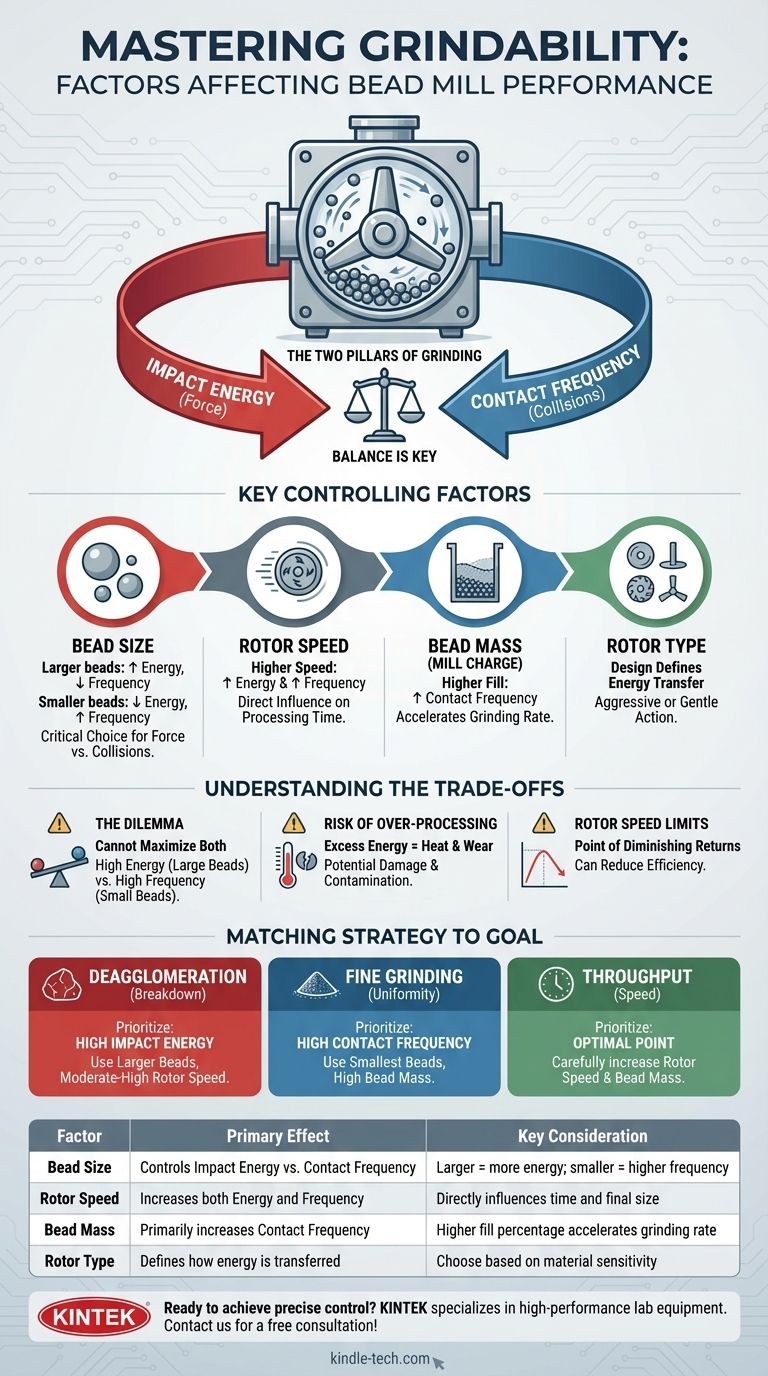
In a bead mill, grindability is primarily controlled by four interconnected factors: the size of the grinding beads, the speed of the rotor, the type of rotor used, and the total mass of the beads charged into the mill. These variables collectively determine the energy and frequency of the grinding events, which directly dictate the final particle size and the overall speed of the process.
The core principle of grindability is a balance between two competing forces: impact energy (the force of each individual collision) and contact frequency (the total number of collisions). Mastering your grinding process requires you to manipulate the key factors to achieve the right balance for your specific material and target outcome.
The Two Pillars of Grinding: Energy and Frequency
To effectively control a grinding process, you must understand how you are applying force to your material. This is achieved through two distinct but related mechanisms.
Impact Energy: The Force of Each Collision
Impact energy is the amount of kinetic force transferred during a single collision between a grinding bead and a material particle.
High impact energy is essential for fracturing larger, harder particles or breaking up tough agglomerates.
Contact Frequency: The Number of Collisions
Contact frequency refers to the total number of grinding events (collisions) that occur within the mill over a period of time.
High contact frequency is critical for efficiently reducing particles to a very fine, uniform size and for increasing the overall processing rate.
Key Factors Controlling Grindability
Each parameter of your bead mill setup is a lever you can pull to adjust the balance between impact energy and contact frequency.
Bead Size
The size of your grinding media is one of the most critical choices.
Larger beads carry more momentum and therefore create higher impact energy. However, fewer large beads can fit into the mill chamber, resulting in a lower contact frequency.
Conversely, smaller beads deliver much lower impact energy but allow for a vastly higher number of beads in the mill, dramatically increasing contact frequency.
Rotor Speed
Rotor speed (often measured as agitator tip speed) is a primary control for adding energy to the system.
Increasing rotor speed increases both the impact energy of each collision and the overall contact frequency. It is the most direct way to influence processing time.
Bead Mass (Mill Charge)
This refers to the total mass of beads loaded into the mill, often expressed as a percentage of the chamber volume (e.g., 80% fill).
A higher bead mass means more beads are in the chamber. This significantly increases contact frequency, which accelerates the grinding process.
Rotor Type
The physical design of the rotor (e.g., discs, pins, or paddles) fundamentally changes how energy is transferred to the bead slurry.
Some rotor designs are more aggressive, creating zones of very high energy for intense grinding. Others are designed for more gentle, uniform circulation, which can be better for sensitive materials.
Understanding the Trade-offs
Optimizing grindability is not about maximizing every variable. It's about making deliberate choices and understanding the consequences.
The Energy vs. Frequency Dilemma
You cannot simultaneously maximize impact energy and contact frequency.
High-energy setups (large beads) are inefficient for fine grinding because the number of contact points is too low. High-frequency setups (small beads) may lack the force needed to break down the initial feed material.
The Risk of Over-Processing
Simply running the mill at maximum speed for a long time can be counterproductive.
Excessive energy input can generate heat, potentially damaging the product. It also accelerates the wear of your beads and mill components, which can introduce contamination.
Rotor Speed Isn't a Silver Bullet
While increasing rotor speed is effective, there is a point of diminishing returns.
Beyond an optimal speed, the additional energy input can cause the bead mass to "pack" against the mill wall or introduce process instability, reducing grinding efficiency rather than increasing it.
Matching Your Strategy to Your Goal
Your ideal setup depends entirely on your objective. Use these principles to guide your decisions.
- If your primary focus is breaking down large, hard particles (Deagglomeration): Prioritize high impact energy by using larger grinding beads and a moderate-to-high rotor speed.
- If your primary focus is achieving a very fine, uniform particle size (Fine Grinding): Prioritize high contact frequency by using the smallest beads capable of the task and a high bead mass.
- If your primary focus is maximizing processing speed (Throughput): Carefully increase rotor speed and bead mass to find the optimal point that accelerates the process without generating excessive heat or wear.
By understanding these fundamental factors, you gain precise control over your grinding process and its final outcome.
Summary Table:
| Factor | Primary Effect on Grinding | Key Consideration |
|---|---|---|
| Bead Size | Controls Impact Energy vs. Contact Frequency | Larger beads = more energy; smaller beads = higher frequency |
| Rotor Speed | Increases both Energy and Frequency | Directly influences processing time and final particle size |
| Bead Mass (Mill Charge) | Primarily increases Contact Frequency | Higher fill percentage accelerates the grinding rate |
| Rotor Type | Defines how energy is transferred | Choose based on material sensitivity and required grinding intensity |
Ready to achieve precise control over your particle size and grinding efficiency?
KINTEK specializes in high-performance lab equipment and consumables, including bead mills and grinding media. Our experts can help you select the ideal setup—balancing bead size, rotor speed, and other critical factors—to perfectly match your material and target outcome.
Contact us today to discuss your specific application and discover how our solutions can enhance your lab's productivity and results.
Visual Guide
Related Products
- Laboratory High Throughput Tissue Grinding Mill Grinder
- Laboratory Hybrid Tissue Grinding Mill
- Vibrating Disc Mill Small Laboratory Grinding Machine
- Laboratory Micro Tissue Grinding Mill Grinder
- Laboratory Ball Mill Jar Mill with Metal Alloy Grinding Jar and Balls
People Also Ask
- What is the purpose of using a laboratory grinder with specific mesh sieves for oat straw? Optimize Pellet Quality
- What are the components of a grinding mill? Understand the Core Systems for Efficient Comminution
- What is the role of laboratory-grade grinders and sieves in sample prep? Ensure High-Precision Corrosion Analysis
- What is a grinder used in labs? Essential for Homogeneous Sample Preparation & Analysis
- Which mill is used for grinding? Match the Mill to Your Material for Optimal Results