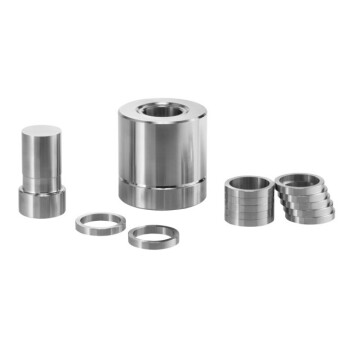
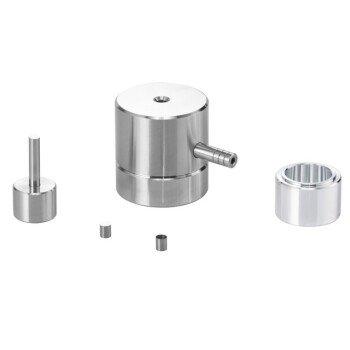
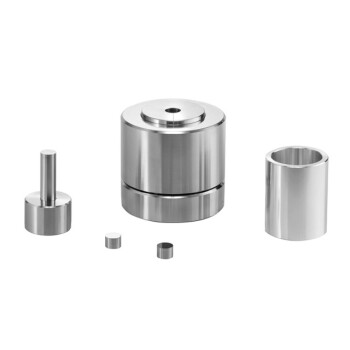
Graphite molds function as the primary structural vessel and the active pressure transmission medium during the vacuum hot-press sintering of diamond/copper composites. They are responsible for confining the powder mixture to define its geometry, transferring immense hydraulic pressure to densify the material, and mediating heat flow, all while resisting extreme thermal conditions.
Core Insight: The utility of a graphite mold lies in its ability to simultaneously act as a high-strength mechanical piston and a chemically inert container. It must transfer massive physical force to densify the composite without physically bonding to the copper matrix or deforming under the high heat required for sintering.
Structural Containment and Geometry
During the sintering process, the most immediate function of the graphite mold is to define the physical shape of the final composite.
Defining the Component Shape
The mold acts as a precise container for the loose diamond and copper composite powder. It holds the mixture in place, ensuring the final sintered part meets specific dimensional requirements.
Maintaining Integrity at High Temperatures
The mold must retain its shape and strength while subjected to temperatures up to 900°C (and potentially higher). Unlike many metals that soften at these temperatures, high-strength graphite maintains its structural rigidity, ensuring the composite does not warp during the heating phase.
Pressure Transmission and Densification
Beyond simple containment, the mold is an active component in the mechanical densification of the material.
Transmitting Hydraulic Force
The mold assembly serves as the medium that transfers pressure from the external hydraulic system directly to the powder. It must withstand and transmit significant pressures, often reaching 80 MPa (with some applications requiring up to 100 MPa), to force particle contact.
Facilitating Particle Diffusion
By effectively transmitting this uniaxial pressure, the mold forces the copper and diamond particles together. This mechanical compression expels trapped gases and is critical for achieving high material density and a strong metallurgical bond.
Thermal Regulation
Graphite is selected not just for its strength, but for its thermal properties which are vital for the sintering kinetics.
Uniform Heat Distribution
Graphite possesses high thermal conductivity. This allows the mold to transfer heat from the furnace elements to the composite sample rapidly and uniformly.
Promoting Homogeneous Sintering
Uniform heat transfer prevents "hot spots" or uneven melting of the copper matrix. This consistency is essential for the even diffusion of the matrix metal, ensuring the final composite has uniform physical properties throughout its volume.
Chemical Compatibility and Surface Quality
The interaction between the mold wall and the composite material dictates the quality of the final surface finish.
Preventing Matrix Adhesion
Graphite is chemically inert regarding copper in reducing atmospheres. This prevents the copper matrix from bonding or sticking to the mold walls, which is a common issue with other mold materials.
Ensuring Smooth Demolding
Because the mold does not adhere to the copper, the finished composite sample can be removed easily after cooling. This ensures a high-quality surface finish and reduces the need for extensive post-process machining.
Understanding the Trade-offs
While graphite is the standard for this process, it introduces specific operational constraints that must be managed.
Oxidation Risks
Graphite oxidizes and degrades rapidly in the presence of oxygen at high temperatures. Therefore, the use of a graphite mold strictly requires a vacuum or inert gas atmosphere to preserve the mold's integrity and prevents it from burning away.
Mechanical Brittleness
Although graphite has excellent compressive strength at high temperatures, it is brittle compared to steel. Misalignment of the hydraulic ram or uneven loading can cause the mold to fracture catastrophically rather than deform plastically.
Making the Right Choice for Your Project
The selection of the specific graphite grade for your mold depends on your priority metrics.
- If your primary focus is Maximum Density: Prioritize high-strength graphite grades capable of withstanding pressures exceeding 80 MPa to ensure maximum compaction without mold failure.
- If your primary focus is Dimensional Precision: Prioritize isostatic graphite with fine grain structure to ensure uniform thermal expansion and minimal reaction with the copper matrix.
Success in vacuum hot-pressing relies on viewing the graphite mold not just as a container, but as a critical, active tool that mediates pressure, temperature, and surface chemistry simultaneously.
Summary Table:
| Function | Role in Sintering Process | Impact on Final Composite |
|---|---|---|
| Structural Containment | Defines geometry and retains shape at 900°C+ | Ensures dimensional precision and prevents warping |
| Pressure Transmission | Transmits hydraulic force up to 80-100 MPa | Achieves high density and strong metallurgical bonding |
| Thermal Regulation | Provides uniform heat distribution via high conductivity | Prevents hot spots for homogeneous material properties |
| Chemical Inertness | Prevents bonding between copper matrix and mold walls | Ensures easy demolding and superior surface finish |
| Atmosphere Support | Operates within vacuum/inert environments | Prevents oxidation and maintains material purity |
Maximize Your Material Performance with KINTEK Precision Solutions
Achieving the perfect diamond/copper composite requires more than just high temperatures—it demands the right tools. KINTEK specializes in advanced laboratory equipment, including high-performance vacuum hot-presses, crushing and milling systems, and premium graphite consumables.
Our high-strength isostatic graphite molds and precision hydraulic presses are engineered to withstand extreme pressures and thermal conditions, ensuring your research yields maximum density and dimensional accuracy. Whether you are developing next-generation thermal management materials or advanced cutting tools, KINTEK provides the comprehensive range of high-temperature furnaces, isostatic presses, and ceramic/graphite crucibles you need to succeed.
Ready to elevate your lab's sintering capabilities? Contact our technical experts today to find the ideal solution for your specific material challenges!
Related Products
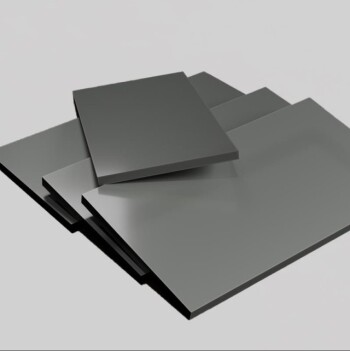
- Carbon Graphite Plate Manufactured by Isostatic Pressing Method
- High Purity Pure Graphite Crucible for Evaporation
- High Purity Pure Graphite Crucible for Electron Beam Evaporation
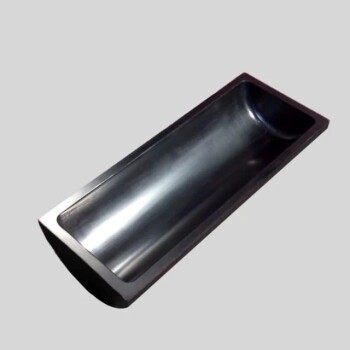
- Carbon Graphite Boat -Laboratory Tube Furnace with Cover
- Vertical High Temperature Graphite Vacuum Graphitization Furnace
People Also Ask
- What is the process of isostatic graphite manufacturing? Achieve Unmatched Material Uniformity and Performance
- What is isostatic graphite? The Ultimate Material for High-Tech and High-Temperature Applications
- What is the density of isostatic graphite? Unlock Superior Performance for Demanding Applications
- How big is the isostatic pressing market? A Deep Dive into the $1.2B+ Advanced Manufacturing Enabler
- Why Use an Isostatic or High-Precision Hydraulic Press for Li/LLZO/Li Batteries? Master Solid-State Interfaces