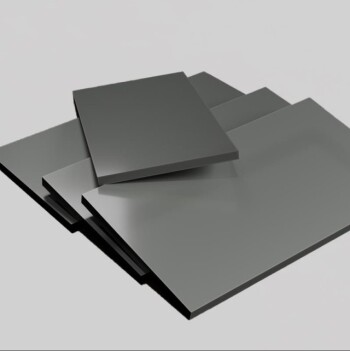
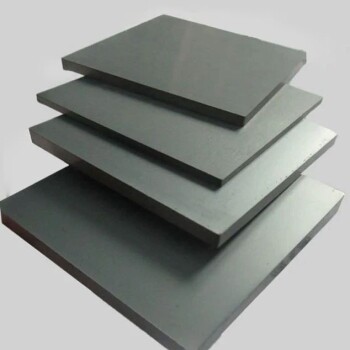
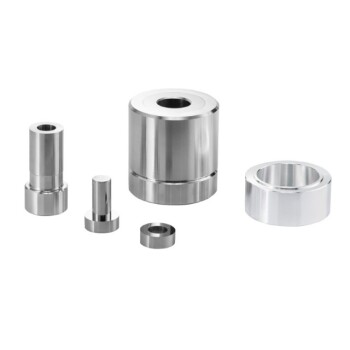
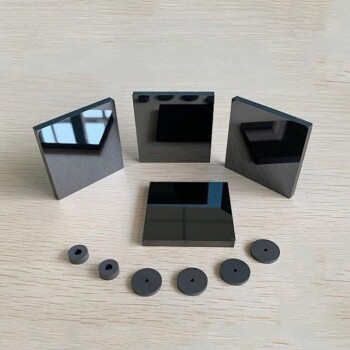
High-purity graphite molds act as the active structural and thermal interface in the manufacturing of Silicon Carbide (SiC) ceramics. In both hot pressing and Spark Plasma Sintering (SPS), these molds perform three simultaneous critical functions: they define the component's geometry, serve as the primary heating element or conductor, and transmit the massive mechanical pressure required to turn powder into a dense solid.
Core Takeaway The graphite mold is not merely a passive container; it is an active component of the sintering machine. Its ability to simultaneously conduct electricity for heating and withstand tons of pressure determines the density, homogeneity, and geometric accuracy of the final Silicon Carbide product.
The Role of Geometric Definition
Precise Containment
The most immediate function of the graphite mold is to serve as the shaping container. It confines the loose Silicon Carbide powder, defining the final dimensions and surface profile of the sintered component.
Dimensional Stability at High Heat
Graphite is unique because it maintains its structural integrity at the extreme temperatures required to sinter Silicon Carbide. Unlike metals that soften, graphite retains the rigidity necessary to hold tight geometric tolerances during the heating cycle.
The Thermal Engine: Generating and Transferring Heat
Resistive Heating in SPS
In Spark Plasma Sintering (SPS), the mold plays an active electrical role. It functions as a resistive heating element, conducting the pulsed electrical current passed through the system.
Efficient Energy Conversion
Because high-purity graphite is electrically conductive, it converts this current directly into thermal energy. This allows for rapid heating rates, transferring heat immediately to the SiC powder within.
Induction Receptors in Hot Pressing
In vacuum hot pressing, the mold often acts as an induction receptor. It absorbs electromagnetic energy from induction coils and converts it into heat, which is then transferred via thermal conduction to the ceramic powder.
Mechanical Integrity and Densification
Withstanding High Pressure
Densifying Silicon Carbide requires immense force. The mold must possess high mechanical strength to withstand external pressures (often tens of MegaPascals) without fracturing or deforming.
Uniform Pressure Transmission
The mold serves as the medium that transfers the force from the press rams to the powder. This transmission must be uniform to ensure the "plastic flow" and diffusion of particles, which are the physical mechanisms that eliminate porosity and create a dense ceramic.
Ensuring Geometric Accuracy
If the mold deforms under pressure, the final part will be distorted. The rigidity of the graphite ensures that the force is applied directly to densifying the powder, rather than warping the container.
Understanding the Trade-offs
Chemical Reactivity and Barriers
While graphite is excellent for heat and pressure, it can chemically react with certain materials at high temperatures. In SiC processing, it is often necessary to apply a barrier coating, such as Boron Nitride (BN), to the inner walls to prevent the ceramic from sticking to or reacting with the mold.
Oxidation Vulnerability
Graphite oxidizes and degrades rapidly in the presence of air at high temperatures. Therefore, these molds are most effective—and have a much longer service life—when used in vacuum or inert gas environments to prevent material loss.
Making the Right Choice for Your Goal
If your primary focus is Maximum Density: Ensure the mold grade chosen has the highest possible compressive strength to transmit maximum pressure without deformation.
If your primary focus is Process Speed (SPS): Prioritize graphite with consistent electrical resistivity to ensure uniform heating and prevent hot spots during rapid temperature ramp-ups.
If your primary focus is Component Purity: Utilize high-purity graphite combined with a reliable release agent (like Boron Nitride) to prevent carbon contamination on the SiC surface.
Success in sintering Silicon Carbide relies on viewing the graphite mold not as consumable tooling, but as a critical process variable.
Summary Table:
| Function Category | Role in Sintering Process | Impact on Final SiC Product |
|---|---|---|
| Geometric Definition | Confines powder and maintains rigidity at extreme heat | Ensures dimensional accuracy and surface integrity |
| Thermal Engine | Conducts current (SPS) or induction heat (Hot Press) | Enables rapid heating and uniform thermal distribution |
| Mechanical Integrity | Transmits MegaPascal-level pressure to the powder | Eliminates porosity to achieve maximum material density |
| Chemical Barrier | Prevents sticking (often via BN coating) | Protects component purity and eases demolding |
Elevate Your Advanced Ceramic Manufacturing with KINTEK
Precision in Silicon Carbide sintering begins with high-performance tooling. KINTEK specializes in providing the laboratory equipment and high-purity consumables essential for successful material research and production.
Whether you are utilizing SPS, vacuum hot pressing, or CVD systems, our high-purity graphite molds and crucibles are engineered to withstand extreme pressures and temperatures while ensuring uniform heat distribution. Beyond molds, our portfolio includes high-temperature furnaces, crushing and milling systems, and hydraulic presses to support your entire workflow.
Ready to optimize your densification process? Contact KINTEK today to discuss how our specialized lab solutions and consumables can enhance your research efficiency and component quality.
References
- Hidehiko Tanaka. Silicon carbide powder and sintered materials. DOI: 10.2109/jcersj2.119.218
This article is also based on technical information from Kintek Solution Knowledge Base .
Related Products
- Special Shape Press Mold for Lab
- Carbide Lab Press Mold for Laboratory Applications
- High Purity Pure Graphite Crucible for Evaporation
- High Purity Pure Graphite Crucible for Electron Beam Evaporation
- Anti-Cracking Press Mold for Lab Use
People Also Ask
- How to use a press mold? Master the Art of Creating Consistent Ceramic Forms
- What is the press mould method? A Guide to Consistent, Detailed Ceramic Forms
- Why are pressure molds with non-conductive resin inner walls required for battery testing? Ensure Data Accuracy
- What is the purpose of specialized pressure devices in sulfide solid-state batteries? Ensure Chemo-Mechanical Stability
- What is the function of press molds during the preparation of SiCf/Ti-43Al-9V composites? Achieve Structural Precision