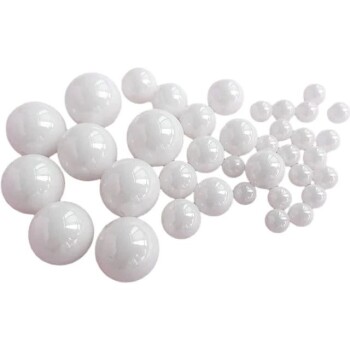
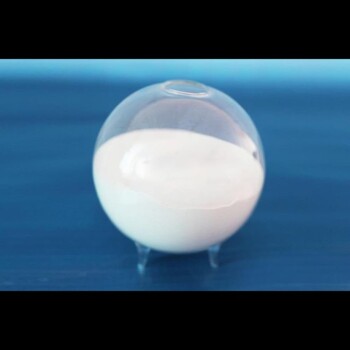
High-purity quartz balls and quartz sand serve as essential inert consumables that stabilize the physical and thermal environment within a micro-reactor. They act as a mechanical support layer to fix the catalyst in place, a preheating zone to bring reactants to the target temperature, and a fluid distributor to ensure uniform flow across the entire catalyst cross-section.
Core Takeaway: Reactor loading is about more than just the catalyst; it is about creating a controlled environment. Quartz consumables transform a simple tube into a precision instrument by locking the bed in place, normalizing flow dynamics, and ensuring thermal equilibrium before the reaction occurs.
The Architecture of a Loaded Reactor
To understand the function of these materials, it is helpful to visualize how they are arranged within the reactor tube.
The Standard Loading Hierarchy
According to standard loading procedures, high-purity quartz balls are typically placed at the bottom of the reactor.
The Upper Layer
Conversely, quartz sand is placed on top of the catalyst bed. This specific stratification ensures the catalyst is sandwiched between stable, inert media.
Three Critical Functions
The presence of these quartz materials addresses three specific engineering challenges inherent in micro-reactor testing.
1. Mechanical Support and Fixation
The primary role of the quartz balls at the bottom is to act as a robust support layer.
They physically hold the catalyst bed in position, preventing it from migrating downstream due to gravity or gas flow. This fixation is vital for maintaining a consistent bed length throughout the duration of the experiment.
2. Thermal Preheating
Reactants entering a micro-reactor are often cooler than the reaction zone.
The quartz layer acts as a preheating section. As reactants flow through this heated inert zone, they reach the target temperature before they ever touch the active catalyst, ensuring the reaction data reflects the intended temperature rather than a thermal gradient.
3. Fluid Distribution
In an empty tube, fluids tend to flow faster in the center, leading to uneven contact time.
The quartz sand and balls function as fluid distributors. They force the reactant stream to navigate a tortuous path, spreading the flow uniformly across the entire catalyst cross-section to maximize efficiency and reproducibility.
Critical Considerations for Reactor Loading
While these materials are consumables, their quality and application directly impact data integrity.
The Necessity of Inertness
The reference specifically highlights high-purity quartz.
If the quartz contains impurities, it may cease to be inert, potentially catalyzing side reactions or contaminating the main catalyst. Always ensure the grade of quartz used is chemically compatible with your specific reactants.
Uniformity is Key
The goal of using these materials is to eliminate variables.
If the quartz layers are packed unevenly, they can fail as distributors. This leads to "channeling," where reactants bypass parts of the catalyst bed, resulting in inaccurate conversion data.
Ensuring Experimental Success
To maximize the reliability of your catalyst testing, apply these principles to your loading strategy:
- If your primary focus is Thermal Stability: Ensure your preheating zone (quartz layer) is long enough to fully equilibrate the reactant temperature before it hits the bed.
- If your primary focus is Flow Mechanics: Pay close attention to the packing of the top layer (sand) to guarantee the fluid permeates the cross-section evenly.
By treating your inert loading materials with the same care as your catalyst, you ensure that your data reflects true chemical performance rather than experimental artifacts.
Summary Table:
| Component | Placement | Primary Functions |
|---|---|---|
| Quartz Balls | Bottom of Reactor | Mechanical support, catalyst fixation, downstream prevention |
| Quartz Sand | Top of Catalyst | Fluid distribution, preheating zone, elimination of channeling |
| Combined System | Entire Bed | Thermal equilibrium, inert environment, flow normalization |
Elevate Your Catalyst Research with KINTEK Precision
Don't let impurities or poor flow dynamics compromise your experimental data. KINTEK specializes in high-performance laboratory equipment and consumables designed for the most demanding research environments.
Our high-purity quartz consumables, including balls and sand, ensure the chemical inertness and thermal stability required for accurate catalyst testing. Beyond consumables, we provide a comprehensive range of solutions for your lab:
- Thermal Processing: Muffle, tube, vacuum, and CVD/PECVD furnaces.
- Material Preparation: Crushing and milling systems, hydraulic presses (pellet, hot, isostatic), and sieving equipment.
- Reactor Systems: High-temperature high-pressure reactors, autoclaves, and electrolytic cells.
- Sample Handling: PTFE products, technical ceramics, and precision crucibles.
Whether you are scaling up battery research or optimizing a micro-reactor, KINTEK delivers the quality and expertise your project deserves. Contact us today to optimize your lab setup!
References
- Jianhua Li, Xiaojun Bao. Carboxylic acids to butyl esters over dealuminated–realuminated beta zeolites for removing organic acids from bio-oils. DOI: 10.1039/c7ra05298g
This article is also based on technical information from Kintek Solution Knowledge Base .
Related Products
- High Purity Pure Graphite Crucible for Evaporation
- Precision Machined Zirconia Ceramic Ball for Engineering Advanced Fine Ceramics
- High Purity Alumina Granulated Powder for Engineering Advanced Fine Ceramics
- High Temperature Resistant Optical Quartz Glass Sheet
- Optical Window Glass Substrate Wafer Quartz Plate JGS1 JGS2 JGS3
People Also Ask
- Why are high-purity graphite crucibles preferred for sulfide solid electrolytes? Achieve Superior Material Purity
- Why is a high-purity graphite crucible required for Chromel-TaC composites? Ensure Peak Purity at 1400°C
- What role do high-purity graphite crucibles play in molten salt corrosion research? Ensure Reactor-Grade Precision
- Why are high-purity graphite crucibles used for magnesium distillation? Ensure 3N8 Purity & Thermal Stability
- Why is a high-purity graphite crucible ideal for nitrogen-doped graphene at 1500 °C? Maximize Purity and Stability